TOKYO, JAPAN / MANILA, PHILIPPINES — November 11, 2026 | WWC ONE MEDIA | Global Entertainment, Business, Technology and Anime Industry
Japanese technology and entertainment giant Sony Group Corporation is making one of the boldest strategic bets in its nearly 80-year history, positioning anime at the center of its transformation into a global intellectual property powerhouse.
The company behind PlayStation, Spider-Man and Crunchyroll wants to build anime franchises capable of generating revenue for decades through streaming, movies, video games, music, merchandise and potentially even theme parks.
And the financial stakes are enormous.
The global anime industry is worth approximately US$28 billion, according to Bloomberg’s November 10, 2026 investigation, with international audiences driving increasing demand for Japanese storytelling.
Sony is seeking to turn that opportunity into a long-term business advantage by expanding its ownership, production and distribution of popular entertainment franchises.
Its strategy has already produced a spectacular example.
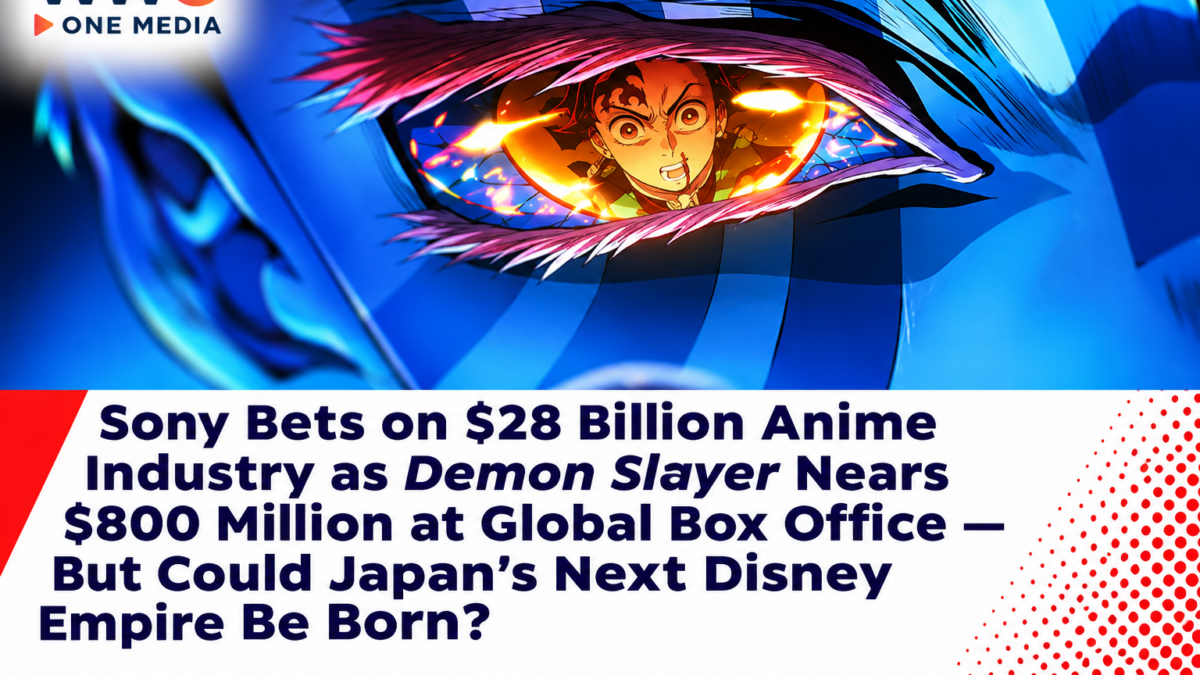
Demon Slayer: Kimetsu no Yaiba — Infinity Castle has generated approximately US$800 million at the worldwide box office, according to Bloomberg, demonstrating how a Japanese manga adaptation can become a major international theatrical event.
Meanwhile, Sony’s anime streaming platform Crunchyroll surpassed 21 million paying subscribers as of March 2026.
But the Japanese conglomerate wants much more than another blockbuster film or successful streaming service.
It wants to help create the next generation of entertainment properties that could remain commercially relevant for 50 or even 100 years.
Could anime become Sony’s most valuable long-term growth engine—and eventually allow the Japanese company to challenge Disney’s dominance in global entertainment franchises?
Sony’s $28 Billion Anime Opportunity Could Reshape the Entertainment Industry
For generations, Sony built its international reputation around consumer electronics.
Its products included iconic devices such as the Walkman, television systems, cameras and PlayStation gaming consoles.
But the company has increasingly emphasized entertainment content, intellectual property and recurring digital services.
Anime has become an important part of that evolution.
According to Bloomberg, Sony is investing in its anime production and distribution operations while searching for stories capable of becoming enduring global franchises.
Atsuhiro Iwakami, president of Sony Music Entertainment Japan and chairman of Aniplex, is among the key executives driving the initiative.
In Bloomberg’s interview, Iwakami explained that Sony’s ambitions extend far beyond the normal commercial life of a successful television series.
The company wants franchises that audiences will continue following across generations.
That could mean stories remaining relevant through sequels, streaming adaptations, console games, concerts, merchandise and other consumer experiences.
The underlying strategy is straightforward.
A successful character or fictional universe can generate income through multiple products over many years.
Unlike a physical device that eventually becomes outdated, a compelling story can be adapted, reintroduced and rediscovered by new audiences.
The Walt Disney Company has demonstrated the potential of this model with franchises such as Mickey Mouse, Marvel, Star Wars and its animated properties.
Sony wants to strengthen its ability to create and develop similarly durable entertainment assets.
However, the US$28 billion estimate represents the broader anime industry’s value, not Sony’s annual anime revenue or profits.
Sony has not announced that it controls the entire market.
Its ability to capture future growth will depend on investment decisions, competition, licensing arrangements and the commercial success of new content.
Demon Slayer’s $800 Million Success Proves Anime Can Compete With Hollywood
Perhaps the clearest evidence supporting Sony’s strategy is the extraordinary international success of Demon Slayer.
The franchise began as a Japanese manga created by Koyoharu Gotouge and published by Shueisha.
Its anime adaptation, produced by animation studio ufotable and backed by partners including Sony’s Aniplex, expanded its audience internationally.
In 2020, Demon Slayer: Mugen Train became Japan’s highest-grossing film, surpassing the previous record held by Studio Ghibli’s Spirited Away.
The success established the franchise as a major theatrical property.
Five years later, the first installment of the Infinity Castle film trilogy demonstrated that the audience had not disappeared.
Bloomberg reported that the movie had generated approximately US$800 million worldwide.
For Sony, the achievement illustrates how Japanese storytelling can compete internationally with established Hollywood franchises.
Anime’s distinctive animation techniques, character development and storytelling traditions have increasingly attracted viewers outside Japan.
The success has also created opportunities in music, merchandise, games and consumer licensing.
However, there is a critical ownership distinction.
Sony does not own the underlying Demon Slayer manga intellectual property.
Those rights remain with publisher Shueisha.
Sony participates through Aniplex and other businesses involved in producing, distributing and commercializing the adaptations under relevant agreements.
That difference helps explain why Sony’s next strategic priority is gaining greater control over intellectual property itself.
Why Sony Wants to Own the Next Demon Slayer Instead of Simply Distributing It
Sony already has significant expertise in producing and marketing Japanese anime.
But the company recognizes that distributing a hit franchise is not necessarily the same as owning the underlying characters and stories.
The Japanese anime industry traditionally relies on production committees.
These arrangements often involve publishers, animation studios, broadcasters, distributors and other investors sharing production costs and commercial rights.
The model can reduce financial risk for individual participants.
However, it can also divide ownership and revenue among multiple companies.
A business that only controls distribution rights may not benefit equally from future merchandise, games or theme park attractions.
Sony wants to strengthen its position across more stages of the creative and commercial process.
That could involve developing original stories, collaborating more closely with manga publishers, investing in intellectual property companies and acquiring strategic ownership stakes.
Iwakami told Bloomberg that Sony would consider potential investments or acquisitions when suitable opportunities become available.
The executive did not announce an agreement to purchase Shueisha.
Nor has Sony disclosed a completed transaction granting it ownership of the Demon Slayer manga.
The distinction is significant because Japan’s major publishers control valuable libraries of globally recognized characters.
Securing greater access to those libraries could become an important source of competitive advantage.
But acquiring rights can be expensive, legally complicated and dependent on the willingness of publishers and creators to negotiate.
Crunchyroll’s 21 Million Subscribers Give Sony a Powerful Global Distribution Network
Sony’s biggest advantage may be its ability to distribute Japanese anime directly to fans across international markets.
Crunchyroll has developed into the world’s leading streaming platform dedicated primarily to anime.
According to Sony’s May 2026 corporate strategy announcement, the service had surpassed 21 million paid subscribers worldwide by the end of March 2026.
That audience gives Sony an established distribution channel for new anime productions.
Rather than depending entirely on unrelated streaming platforms, Sony can support releases through a service closely connected to its wider entertainment operations.
Crunchyroll also participates in merchandise, gaming, theatrical distribution and live events.
The strategy allows Sony to connect audiences with entertainment properties through several commercial channels.
A fan might discover a television series through Crunchyroll, purchase merchandise, attend an event or play a related game.
Each activity creates another potential source of revenue.
That does not mean every franchise will succeed across every category.
Consumer preferences differ, and the costs of producing merchandise, games and events can be substantial.
Nevertheless, Crunchyroll’s existing subscriber base gives Sony access to a large international audience that smaller production companies may struggle to reach independently.
The company is also exploring ways to integrate anime more closely with the PlayStation ecosystem.
During its November 5 earnings presentation, Sony said it planned to introduce a dedicated Crunchyroll hub on the PlayStation 5 home screen in spring 2027.
The feature is intended to help gamers discover anime and strengthen the relationship between Sony’s gaming and streaming operations.
Sony Launches Crunchyroll Storyworks to Create the Next Global Anime Hit
Sony is not relying exclusively on existing franchises.
On October 7, 2026, Crunchyroll officially announced a new division called Crunchyroll Storyworks.
The initiative brings together expertise from Crunchyroll, Aniplex, Sony Pictures Entertainment and Japanese creative partners.
Its objective is to develop new anime projects and expand international storytelling opportunities.
The division is led by Sony veteran Tohru Iokibe.
According to Sony Pictures Entertainment, Storyworks plans to work with Japanese creators to adapt stories from around the world into anime.
It will also explore live-action adaptations of Japanese anime properties.
The new division is intended to strengthen the content pipeline for HAYATE, an anime production venture established by Crunchyroll and Aniplex.
HAYATE focuses on developing and producing anime projects for international audiences.
This combination is important because it gives Sony opportunities to participate earlier in the creation of potential franchises.
Instead of waiting for a manga or television series to become popular, Sony can help develop projects from their earliest stages.
That could improve its ability to secure commercial rights and coordinate marketing campaigns.
It could also provide creators with additional resources for developing ambitious projects.
However, creating original intellectual property is inherently uncertain.
Even major entertainment companies cannot reliably predict which characters or stories will resonate with global audiences.
Sony’s challenge will be combining corporate scale with the creative experimentation that makes successful anime distinctive.
Kadokawa Investment Gives Sony Access to a Valuable Manga and Gaming Ecosystem
Another important component of Sony’s strategy involves Kadokawa Corporation.
Kadokawa controls a substantial portfolio of Japanese publishing, anime, film and gaming assets.
Its operations include manga, novels, animation-related businesses and the influential game developer FromSoftware.
Sony increased its ownership position in Kadokawa and became its largest shareholder through a strategic capital and business alliance.
The investment strengthens relationships between Sony and a company with an extensive collection of stories and entertainment properties.
This provides potential opportunities for cooperation involving anime adaptations, games and international distribution.
However, becoming the largest shareholder does not automatically mean Sony owns every Kadokawa property or can independently control all licensing decisions.
Ownership rights remain governed by Kadokawa’s corporate structure and the relevant commercial agreements.
The partnership is nevertheless consistent with Sony’s wider ambition.
By strengthening ties with companies that originate popular stories, Sony can seek opportunities earlier in the intellectual property development cycle.
The strategy resembles the broader entertainment industry’s increasing emphasis on recognizable characters and franchises.
Sony’s PlayStation, Music and Movie Businesses Could Create a Powerful Anime Ecosystem
Few entertainment companies possess the same combination of businesses as Sony.
Its corporate portfolio includes music labels, movie studios, gaming platforms, animation production and global streaming services.
That combination could become particularly valuable as anime develops into a mainstream international entertainment category.
Sony can potentially support an intellectual property franchise through several different businesses:
Anime production: Aniplex and associated studios can participate in developing animated productions.
Streaming: Crunchyroll can distribute anime to international subscribers.
Movies: Sony Pictures can support theatrical releases and other screen adaptations.
Gaming: PlayStation and Sony’s game-related businesses can participate in suitable adaptations and promotional partnerships.
Music: Sony Music can support theme songs, soundtracks, artist collaborations and live performances.
Merchandise and experiences: Licensing partners can develop products, exhibitions and events tied to popular characters.
These capabilities could allow Sony to generate revenue from a franchise long after its initial release.
But ownership and licensing arrangements still determine how the financial returns are divided.
Sony cannot automatically use every anime character or story across its businesses without the necessary rights.
In a related report, WWC ONE MEDIA examined Sony’s broader profit ambitions, including how PlayStation and Spider-Man could support growth while rising hardware costs challenge the company.
The anime initiative represents another part of Sony’s attempt to reduce its dependence on individual hardware launches and expand long-term entertainment revenue.
Sony’s Financial Results Show Why Entertainment Is Becoming More Important
Sony’s latest financial performance provides additional context for its anime expansion.
On November 5, the company raised its operating profit forecast for the financial year ending March 2027 to approximately ¥1.87 trillion, an increase of about 15% from its previous outlook.
Operating profit for the July–September quarter reached approximately ¥622.3 billion.
Quarterly revenue totaled about ¥3.43 trillion.
According to Bloomberg, the stronger outlook followed better-than-expected financial results supported by entertainment-related businesses.
These figures cover Sony’s wider corporate operations, not anime alone.
They should not be interpreted as evidence that Crunchyroll or Aniplex independently generated ¥1.87 trillion in operating profit.
Nevertheless, the company’s direction is clear.
Sony increasingly wants entertainment intellectual property to become a durable source of value alongside its technology businesses.
The strategy could help diversify earnings across movies, gaming, music, streaming and other products.
However, content investment also exposes the company to unpredictable audience demand, production expenses and competition for valuable intellectual property.
Netflix and Disney Are Competing for the Same Anime Audience
Sony’s ambitious expansion is taking place during a major shift in international entertainment.
Anime is no longer confined to a relatively narrow community of dedicated fans.
Streaming services have made Japanese animation accessible to viewers across North America, Europe, Latin America and Southeast Asia.
Netflix has expanded its anime catalog and invested in partnerships involving Japanese creative studios.
Disney has also pursued anime distribution through its streaming businesses.
These competitors possess extensive international reach and significant financial resources.
For Sony, Crunchyroll’s specialized anime focus offers an advantage, but it does not eliminate competition.
Media Partners Asia reported in September 2026 that anime was reaching a larger share of streaming users than any other genre across the Asian markets examined.
Its research also found that anime viewing hours on Netflix increased 39% over three years, compared with approximately 4.5% growth in Netflix’s overall viewing hours.
The figures demonstrate the strength of demand for anime within mainstream streaming.
But they also show why major international platforms are competing aggressively for the same content.
The stakes are not limited to attracting subscribers.
Streaming companies also want access to valuable franchises that can support merchandise, licensing and other business opportunities.
Sony must therefore compete both for viewers and for the rights to compelling stories.
Could Sony Become Japan’s Answer to Disney?
The comparison with Disney is increasingly relevant because Sony is exploring opportunities beyond traditional film and television distribution.
Bloomberg reported that Iwakami is open to considering the possibility of Sony eventually developing theme park experiences.
He emphasized that control over intellectual property would be important for such a project.
Disney has built an extensive entertainment model around theme parks, films, television, merchandise and character licensing.
Sony already operates across several comparable categories.
However, Sony has not announced a confirmed anime theme park project, construction budget, location or opening date in the reporting reviewed.
The idea remains a potential future business opportunity rather than an approved development.
Nevertheless, Sony has already expanded its exposure to family-oriented entertainment properties.
The company increased its ownership of Peanuts Holdings to 80%, giving it a stronger position in the business associated with Snoopy and other Peanuts characters.
That investment complements Sony’s interest in creating franchises capable of remaining popular across generations.
The company is also experimenting with new entertainment formats.
The investment illustrates a broader interest in expanding the ways audiences experience entertainment properties.
Sony’s eventual ambitions could extend into attractions, exhibitions and location-based entertainment.
But whether such ventures can generate profitable long-term returns remains uncertain.
Japan’s Anime Industry Faces a Serious Production Bottleneck
Despite strong international demand, Japan’s animation industry faces a major challenge.
Producing high-quality anime takes considerable time, specialized expertise and significant financial resources.
Bloomberg reported that animation production schedules have expanded substantially over the past two decades.
Iwakami recalled that television anime projects could previously move from planning to broadcast in approximately one year.
Today, comparable development and production processes can take three to four years.
The industry also faces shortages of skilled animators and rising production costs.
These constraints could limit how quickly Sony and its competitors can create new content.
A larger streaming audience does not automatically result in more finished anime.
Studios must recruit and train artists, organize complex production schedules and maintain the quality that viewers expect.
Sony is investing in training young animators and working with local governments on initiatives intended to improve the industry’s creative infrastructure.
The effort reflects an important concern.
If anime demand expands faster than Japan’s ability to produce content, companies could experience delays and rising expenses.
That could reduce profitability even when international audiences remain enthusiastic.
For Sony, solving production constraints may be just as important as acquiring new stories.
Artificial Intelligence Could Help Anime Studios—but Sony Rejects Replacing Artists
Generative artificial intelligence is creating new opportunities and controversies across the animation industry.
AI tools may help with certain repetitive production tasks, technical processes and administrative workflows.
But their use raises concerns involving artistic quality, copyright, employment and the preservation of distinctive creative styles.
Sony has emphasized that its approach is intended to support human creators.
During its May 2026 corporate strategy presentation, CEO Hiroki Totoki described artificial intelligence as a tool for expanding creative capabilities rather than replacing artists.
Bloomberg’s November interview similarly highlighted Iwakami’s preference for tools that assist animators while preserving human craftsmanship.
The issue is especially important for Japanese anime because its international appeal depends partly on distinctive visual techniques and storytelling traditions.
A system that produces content more cheaply but weakens those qualities could undermine the very appeal companies are trying to monetize.
Sony therefore faces the challenge of introducing new production technology without damaging relationships with creators or reducing artistic standards.
Sony Wants Anime That Appeals to Children, Families and Future Generations
Much of anime’s recent international growth has been driven by action-oriented franchises.
Titles such as Demon Slayer, One Piece and Naruto have attracted substantial audiences through stories involving adventure, combat and elaborate fictional worlds.
But Sony is considering opportunities beyond those categories.
Bloomberg reported that Iwakami is interested in animation aimed at younger children and family audiences.
He cited examples including Bluey and Japan’s Chiikawa as illustrations of characters and stories with wider demographic appeal.
Such properties can remain commercially relevant as audiences grow older and introduce characters to younger generations.
Family-oriented entertainment also creates opportunities in toys, books, consumer products, events and other experiences.
Sony’s increased stake in Peanuts Holdings fits into this broader strategy.
However, expanding into family animation would require a different approach from developing established action-focused anime.
The company would need to create stories that appeal to children while remaining attractive to parents and other audiences.
Success is far from guaranteed.
But the potential commercial lifespan of a widely recognized family character could be considerably longer than that of a single hit television series.
What Sony’s Anime Expansion Means for Filipino Fans
The Philippines is an important part of Southeast Asia’s anime fan community.
Japanese animation has influenced Filipino television audiences for decades, with anime remaining popular across broadcast television, streaming services, gaming communities and fan events.
Sony’s expanding production and distribution capabilities could potentially make more anime titles accessible to Filipino viewers.
Crunchyroll already distributes content in the Philippines, although availability depends on individual licensing agreements and release schedules.
The expanding availability of anime through legitimate streaming platforms could create additional opportunities for local fan communities.
The potential extends beyond subscriptions.
Anime-related films, music events, exhibitions and licensed merchandise can also attract Filipino consumers.
The country’s enthusiasm for Japanese storytelling is visible through cultural events.
The festival includes animated films alongside live-action productions and Japanese cinema classics.
While such festivals are separate from Sony’s corporate strategy, they demonstrate the continuing interest in Japanese entertainment within the Philippine market.
For local businesses, anime’s growing international reach may support opportunities involving licensed products, cinema distribution, events and digital entertainment.
However, such opportunities depend on proper licensing agreements and cannot be treated as automatic financial benefits from Sony’s expansion.
Could Anime Challenge the Global Gaming Industry?
Sony’s strategy also raises questions about the increasingly close relationship between anime and video games.
Many anime franchises are adapted into interactive entertainment.
Conversely, popular games can inspire television series, films and other media.
Sony’s ownership of PlayStation provides a possible connection between these categories.
However, it also faces significant competition.
Chinese developers have become increasingly successful in the international mobile gaming market.
In another report, WWC ONE MEDIA examined China’s $25.5 billion mobile gaming market and how Chinese publishers are challenging companies in the United States and Japan.
The development illustrates how entertainment companies increasingly compete for the same consumer attention across multiple platforms.
A successful anime franchise may support games, merchandise and streaming subscriptions.
But companies must still deliver compelling experiences in each category.
An anime hit does not guarantee a successful video game adaptation.
Likewise, popularity on PlayStation does not automatically translate into television ratings or merchandise sales.
Sony’s advantage lies in having established businesses across several segments, allowing it to explore combinations that smaller companies may find difficult to replicate.
Five Major Risks Could Determine Whether Sony’s Anime Gamble Succeeds
Despite the scale of the opportunity, Sony faces significant challenges.
1. Competition for intellectual property
Major publishers and rights holders control some of Japan’s most commercially valuable characters and stories. Sony cannot assume that acquisition or licensing rights will always be available.
2. Rising production costs
Anime development requires skilled artists, sophisticated production systems and increasingly long schedules. Higher costs could reduce profitability.
3. Competition from Netflix, Disney and other platforms
International streaming companies are investing in Japanese entertainment, potentially increasing the price of licensing agreements and production partnerships.
4. Unpredictable audience demand
Even highly experienced producers cannot guarantee the creation of another Demon Slayer. Original franchises may fail to attract a sufficiently large international audience.
5. The challenge of integrating businesses
Sony’s entertainment divisions have different management structures, commercial responsibilities and contractual obligations. Delivering cross-company benefits may be more complicated than simply bringing existing businesses under one corporate strategy.
These challenges mean Sony’s broader transformation will require careful investment, creative development and cooperation with partners.
Sony’s Next Big Test: Can Anime Become a 100-Year Business?
Sony has already demonstrated its ability to turn Japanese animation into major international entertainment.
Demon Slayer’s box-office performance illustrates the commercial potential of successful anime adaptations.
Crunchyroll’s more than 21 million paid subscribers provide an established global distribution platform.
And Sony’s investments in Kadokawa, HAYATE, Crunchyroll Storyworks and other intellectual property businesses demonstrate that management is committing resources to long-term expansion.
But becoming a global intellectual property powerhouse will require more than successful distribution.
Sony must develop or secure rights to stories that remain valuable across generations.
It must attract creators, navigate Japan’s complex publishing industry and compete with powerful international entertainment companies.
It must also manage production costs while maintaining the artistic traditions that make anime distinctive.
The company is no longer simply trying to manufacture another successful entertainment product.
It wants to build a system capable of generating new franchises and extending their commercial lives for decades.
For shareholders, that could eventually create more recurring income and reduce dependence on the timing of individual hardware launches.
For fans, it could mean more anime productions, international releases, games and entertainment experiences.
But for Japan’s creative industry, the transformation also raises questions about ownership, artistic independence and who ultimately benefits when a locally developed story becomes a global commercial phenomenon.
The Bottom Line: Sony Wants the Next Disney-Sized Entertainment Empire
Sony’s anime expansion represents a major strategic shift for one of Japan’s best-known corporations.
Instead of depending primarily on consumer electronics, Sony is strengthening its position in intellectual property, storytelling and entertainment distribution.
The global anime industry is worth approximately US$28 billion, Crunchyroll has surpassed 21 million paying subscribers, and Demon Slayer’s latest theatrical success has demonstrated the potential of Japanese animation to compete internationally.
Sony now wants to turn those advantages into a repeatable business model.
Its ambition includes developing original anime, securing greater intellectual property rights and connecting successful franchises across streaming, music, gaming, film and physical experiences.
The strategy could help reshape Sony’s future and expand the international influence of Japanese entertainment.
Yet success depends on the company’s ability to discover the next generation of stories, not merely benefit from titles that are already popular.
Sony helped define the global electronics industry with the Walkman and PlayStation. Now it wants anime to become the foundation of a new entertainment empire. But as Netflix, Disney and other media giants compete for Japan’s most valuable stories, can Sony create the next 100-year franchise—or will the battle for anime’s future become more expensive than even the world’s biggest entertainment companies expect?