
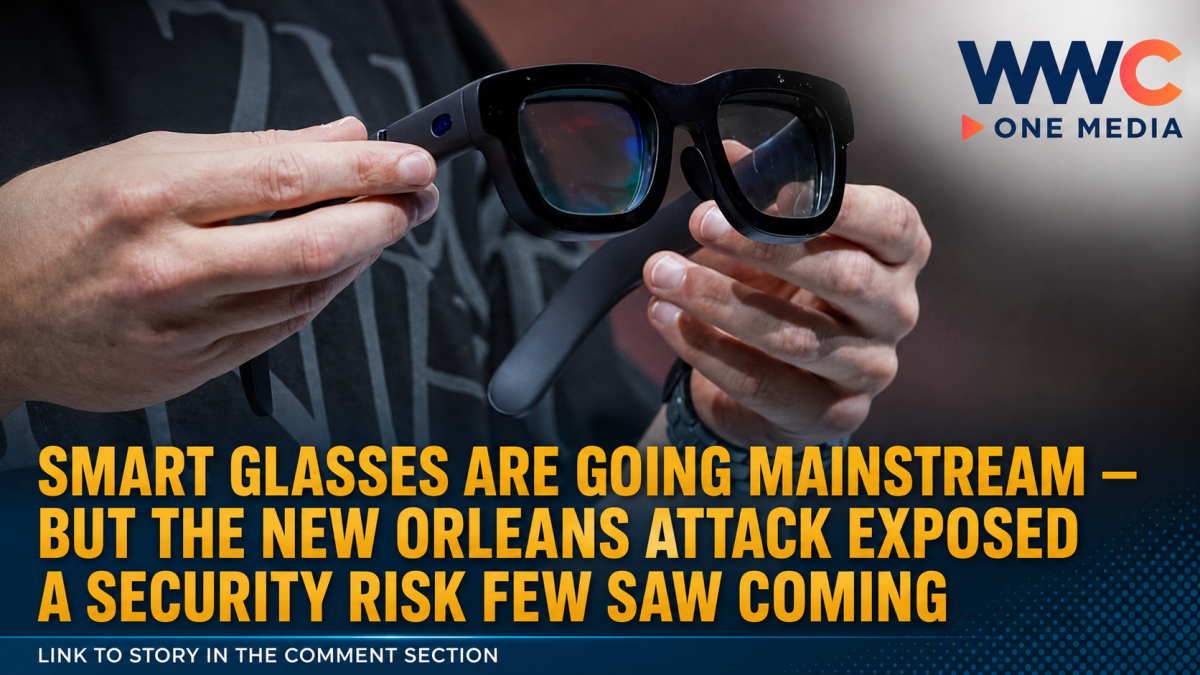
Smart glasses are being marketed as the next step beyond smartphones: cameras that can see what users see, microphones that can hear their surroundings and increasingly powerful artificial intelligence available without ever reaching into a pocket.
But as the technology races toward the mainstream, security researchers are asking a darker question:
What happens when the same hands-free technology designed to make everyday life easier is adopted by violent extremists?
That concern moved beyond theory after investigators revealed that the man responsible for the deadly January 1, 2025 attack on Bourbon Street in New Orleans had previously used Meta smart glasses while surveying the French Quarter.
Shamsud-Din Jabbar rode through the area wearing Ray-Ban Meta glasses and recorded video during an earlier reconnaissance visit, according to reporting by The Associated Press citing the FBI investigation. Jabbar later drove a pickup truck into crowds celebrating New Year’s Day, killing 14 people and physically injuring at least 57 others.
There is an important distinction: investigators did not say the smart glasses were necessary to carry out the attack, and AP reported that although Jabbar was wearing them during the assault, he did not activate their livestreaming capability.
That distinction matters.
The emerging security concern is not that smart glasses suddenly give extremists powers they never possessed. Smartphones already allow people to record locations, communicate, navigate and distribute material online.
The difference is that wearable technology can make some of those activities hands-free, less conspicuous and increasingly connected to artificial intelligence.
A WARNING FROM THE NEW ORLEANS ATTACK
Writing in a commentary published by Channel NewsAsia on September 3, Lowy Institute researcher James Paterson argues that smart glasses could become another example of commercially developed technology being repurposed by extremists.
The pattern has happened before.
Commercial drones were built for photography, recreation and industry before extremist organisations adapted readily available models for surveillance, propaganda and battlefield operations. Artificial intelligence, cryptocurrencies, encrypted communications and even 3D printing have similarly attracted attention from governments because technologies developed for legitimate civilian uses can also become useful to malicious actors.
Smart glasses could follow the same path.
Their cameras allow users to record exactly what they are looking at without visibly holding a phone in front of them. Voice controls can make recording and communication even less cumbersome. Newer generations increasingly connect those cameras with AI systems capable of interpreting the user’s surroundings.
For an ordinary consumer, that can mean identifying objects, receiving navigation help, taking photographs or asking an AI assistant questions about what is nearby.
For someone carrying out surveillance for malicious purposes, security researchers fear the very same convenience could lower existing barriers.
THE TECHNOLOGY IS GETTING CHEAPER — FAST
That concern is becoming more significant because smart glasses are no longer an experimental product available only to technology enthusiasts.
Meta and eyewear giant EssilorLuxottica have rapidly expanded their wearable lineup, and in June 2026 Meta announced a new collection of AI-powered glasses starting at US$299.
Reuters reported that Meta held roughly 76.1 per cent of global smart-glasses sales in the previous year, underscoring how quickly the market has developed.
Competition is accelerating.
Google announced in May that its first Gemini-powered Android XR audio glasses, developed with partners including Samsung, Gentle Monster and Warby Parker, are expected to arrive in fall 2026. The devices are designed to let wearers take photographs, send messages, receive directions and interact with Gemini while remaining hands-free.
Apple is also widely reported to be developing its own smart glasses, although the company has not publicly announced a finished consumer product and reported launch timelines remain subject to change.
The result is a technology category moving toward lower prices, greater availability and far more sophisticated AI.
And that combination—cheap, capable and easy to obtain—is precisely what counter-terrorism researchers watch closely when assessing whether a civilian technology might be repurposed.
FROM RECONNAISSANCE TO PROPAGANDA
Another concern involves the way extremist violence is documented and distributed.
Attacker-generated footage is valuable to extremist networks because first-person images can be repackaged as propaganda long after an attack has ended.
The 2019 Christchurch mosque attacks demonstrated the destructive reach of attacker-generated first-person video and prompted governments and technology platforms to strengthen efforts against the rapid spread of terrorist content.
Smart glasses potentially remove another practical barrier between an attacker and that type of footage because recording can occur from the wearer’s perspective without holding a camera.
That does not mean widespread terrorist use of smart glasses is already occurring.
Publicly documented evidence remains limited, and the New Orleans case should not be interpreted as proof that smart glasses have become a standard extremist tool.
Instead, it provides something security authorities rarely receive with an emerging technology: an early real-world warning of possible misuse before the technology reaches full mass adoption.
AI COULD CHANGE THE EQUATION AGAIN
The bigger issue may eventually be artificial intelligence.
Today’s wearable cameras can already capture what a user sees. Connecting those cameras to increasingly powerful multimodal AI systems means future devices may also be able to analyse surroundings, recognise objects, translate information or provide contextual assistance in real time.
Google, for example, describes Android XR glasses as devices capable of using Gemini to provide information about the wearer’s environment while remaining hands-free.
Those capabilities have enormous legitimate potential, including accessibility, navigation and assistance for people with impaired vision.
But like almost every dual-use technology, the benefits come with risks.
The United Nations has repeatedly warned that terrorist organisations adapt emerging technologies for propaganda, recruitment, planning, financing and operations. UN counter-terrorism guidance specifically identifies artificial intelligence, unmanned aircraft, virtual assets and other emerging technologies as areas requiring greater international attention.
That does not amount to a UN warning specifically against smart glasses.
Rather, smart glasses potentially fit a broader pattern policymakers are already trying to understand: consumer technologies becoming powerful enough to perform functions that previously required specialised equipment or expertise.
PRIVACY FEARS ARE ALREADY FORCING CHANGES
Security concerns are emerging alongside a much more immediate controversy: privacy.
Smart glasses can resemble ordinary eyewear even when equipped with cameras, raising concerns about people being recorded without meaningful consent.
In August, German digital-rights organisation HateAid filed a criminal complaint concerning Meta’s AI glasses and alleged that their design could enable covert recording. German prosecutors confirmed receipt of the complaint, according to Reuters; the filing itself is an allegation and does not establish that Meta violated German law.
Meta says its glasses include a visible capture LED designed to alert people when photographs or videos are being taken. The company has also strengthened safeguards so attempts to block or physically tamper with that indicator can disable camera functionality.
Those protections highlight the balancing act facing manufacturers.
Making wearable cameras useful requires them to operate naturally and conveniently.
Making them trustworthy requires people nearby to know when those cameras are operating.
And making them resistant to malicious use may prove considerably harder.
THE REAL RISK ISN’T THE GLASSES — IT’S HOW ORDINARY THEY COULD BECOME
Governments cannot realistically treat every new consumer gadget as a counter-terrorism threat.
Nor should smart glasses be portrayed as inherently dangerous simply because one attacker used them.
Millions of people may use wearable AI for entirely legitimate purposes, and the same technologies could provide substantial benefits in accessibility, communication, productivity and navigation.
The security lesson from New Orleans is narrower—but potentially more important.
Extremists frequently do not need to invent revolutionary technology.
They simply wait until somebody else makes useful technology cheap enough, powerful enough and ordinary enough to exploit.
That was the transformation seen with commercial drones.
AI has created another version of it.
And if smart glasses eventually become as commonplace as wireless earbuds or smartphones, security agencies may have to confront a world in which a camera, microphone and AI assistant can disappear almost completely into an everyday pair of frames.
The New Orleans attack did not prove that smart glasses will become the next major terrorism tool.
It showed something more uncomfortable:
the experimentation may already have begun.
WWC ONE MEDIA MJE




Leave a Reply