
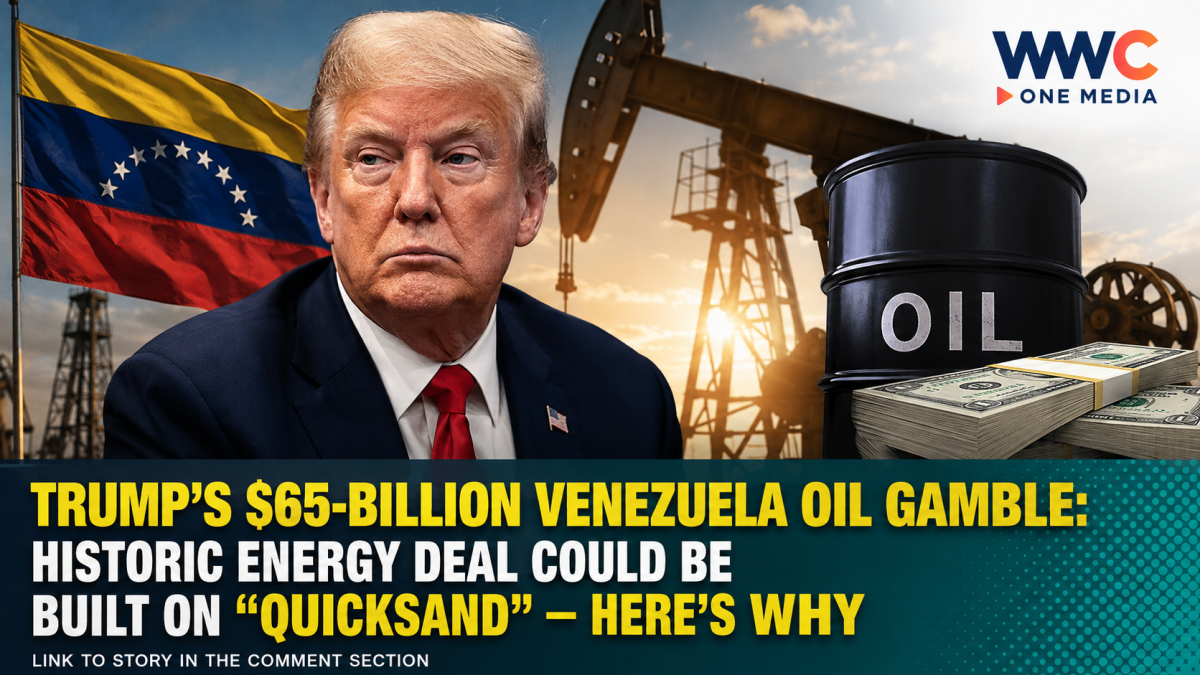
WASHINGTON/CARACAS — President Donald Trump’s sweeping oil agreement with Venezuela is being promoted by his administration as a historic step toward American energy dominance and Venezuela’s economic recovery.
But beneath the promise of billions of dollars in investment and a potential revival of one of the world’s largest oil industries lies a major question: Can a deal built around political power and an unelected Venezuelan government survive the political and legal changes that could come next?
That uncertainty is at the center of growing criticism of Trump’s Venezuela strategy.
The White House says the agreement gives North American Blue Energy Partners (NABEP) 100-year concessions covering 17 Venezuelan oil fields with approximately 65 billion barrels of proven reserves. The U.S. government is set to receive a 35% equity stake in NABEP’s corporate parent, while Washington will have the right to purchase 20% of the company’s production at production cost and a right of first refusal on much of the remaining output.
Trump has described the arrangement as the “biggest oil deal in world history.” His administration argues that it can help rebuild Venezuela’s devastated petroleum industry, strengthen U.S. energy security and reduce reliance on foreign energy suppliers.
Yet critics say the unprecedented structure could create precisely the kind of uncertainty that large oil companies usually try to avoid.
THE BIGGEST QUESTION: WHO REALLY CONTROLS THE DEAL?
The agreement was negotiated with Venezuela’s interim government under Acting President Delcy Rodríguez, following the U.S. removal of former President Nicolás Maduro in January.
That political foundation is one of the deal’s biggest vulnerabilities.
CNA commentary argues that an oil agreement of this magnitude could ultimately become unstable if Venezuela returns to an elected government that decides the terms were negotiated without sufficient democratic legitimacy.
Reuters has similarly highlighted questions over the agreement’s legality, transparency and long-term durability, noting that the full contents of the government-to-government arrangement have not been publicly disclosed and that experts have raised concerns about institutional approval and the way the private partner was selected.
Venezuela’s National Assembly, which is dominated by the ruling party, nevertheless backed the agreement on Sept. 1.
That vote may strengthen the agreement politically in the short term—but it does not eliminate questions about what happens if a future elected government takes a different position.
A 100-YEAR OIL BET
The scale of the arrangement is extraordinary.
NABEP is being granted long-term rights covering 17 oil fields containing roughly 65 billion barrels of proven reserves. The White House says the company could invest as much as $100 billion to rebuild Venezuela’s oil infrastructure and expand production.
Venezuela has enormous underground resources, but turning those reserves into commercially viable production is a completely different challenge.
Years of underinvestment, mismanagement, sanctions and deteriorating infrastructure have left the country’s petroleum industry far below its historical production levels.
Reuters estimates that Venezuela currently produces roughly 1 million to 1.25 million barrels of crude per day, compared with around 3.5 million barrels per day during the 1990s.
The country’s crude is also particularly challenging to develop because much of its reserves consist of extra-heavy oil.
That means Venezuela needs more than access to reserves. It needs capital, drilling equipment, electricity, pipelines, storage, refining capacity, export infrastructure and technical expertise.
And rebuilding those systems could take years.
COULD TRUMP’S DEAL ACTUALLY SCARE INVESTORS AWAY?
This is where the agreement becomes particularly controversial.
Reuters analysts warn that giving NABEP preferential commercial treatment could create a two-tiered Venezuelan oil market.
Under the proposed arrangement, NABEP would have privileged access to U.S. government support and guaranteed purchasing arrangements, while other international producers would operate under different commercial conditions.
That could become a problem for companies deciding whether to commit billions of dollars to Venezuela.
Investors typically want to know that the rules governing their projects will remain stable for decades.
If companies begin to believe that political connections—not economics—determine who receives the best terms, investment could become more difficult and expensive.
In other words, a deal intended to unlock Venezuela’s oil wealth could potentially discourage some of the additional investors Venezuela needs.
CHEVRON IS MOVING—BUT THE ROAD AHEAD IS LONG
Despite the criticism, major energy companies are not abandoning Venezuela.
Chevron has announced plans to invest more than $7 billion in the Orinoco Belt and aims to double its Venezuelan production to around 600,000 barrels per day. Eni has also announced a $1.5 billion investment in the Junín 5 heavy-oil area, while GE Vernova is involved in efforts connected to Venezuela’s severely weakened electricity infrastructure.
Those developments show that international energy companies see significant potential in Venezuela.
But they also demonstrate how difficult the recovery will be.
The country’s oil industry cannot simply turn on the taps and immediately return to its former production levels.
THE POLITICAL RISK MAY BE BIGGER THAN THE OIL RISK
Trump’s administration says the Venezuela strategy is part of a broader plan involving stabilization, reconstruction and democratic transition.
The White House says oil investment will generate revenue for Venezuela while helping rebuild the country’s economy and institutions.
But critics fear the sequence could work in reverse.
If control over Venezuela’s oil becomes closely tied to the current interim government and Washington, future political negotiations could become more complicated.
The central concern is simple:
What happens if a future Venezuelan government rejects the agreement?
Oil companies could find themselves caught between contracts signed under one political order and a new administration claiming that those agreements lack legitimacy.
That possibility is particularly significant given Venezuela’s history of nationalization, contract changes and disputes with foreign energy companies.
WASHINGTON ALSO HAS ITS OWN POLITICAL CLOCK
Trump’s strategy is unfolding against another deadline: the U.S. midterm elections in November.
His administration is under pressure over energy prices, while Trump has repeatedly promoted increased Venezuelan oil production as a way to strengthen supply and potentially reduce costs.
The White House insists the arrangement will strengthen U.S. energy security and provide access to lower-cost Venezuelan crude.
But analysts caution that Venezuelan production cannot be rebuilt overnight.
Even if billions of dollars begin flowing into the country’s oil sector, major infrastructure projects can take years before they produce substantial additional barrels.
That creates a potential mismatch between political expectations today and industrial realities tomorrow.
THE REAL TEST IS WHETHER THE DEAL SURVIVES THE POLITICS
The Venezuela agreement could ultimately succeed if it attracts enough investment to restore production, creates reliable revenue for Venezuela and survives future political transitions.
But that is a very large “if.”
The Trump administration is betting that U.S. involvement can provide the confidence necessary to bring massive amounts of private capital back into Venezuela.
Critics counter that Washington’s unusually direct role could have the opposite effect by making the investment environment more politically dependent.
That leaves Venezuela facing a difficult balancing act.
The country desperately needs foreign capital and expertise to rebuild its oil industry. At the same time, the legitimacy of the political framework governing those investments could determine whether the projects survive for decades.
And that is why the biggest risk to Trump’s historic oil gamble may not be how much oil Venezuela has underground.
It may be whether the political ground beneath the deal remains solid enough to keep those barrels flowing.
For now, Washington is betting that American power, capital and political influence can transform Venezuela into a major energy supplier again.
The unanswered question is whether that strategy will create a durable oil revival—or a massive investment whose future changes with the next government in Caracas.
WWC ONE MEDIA MJE



Leave a Reply