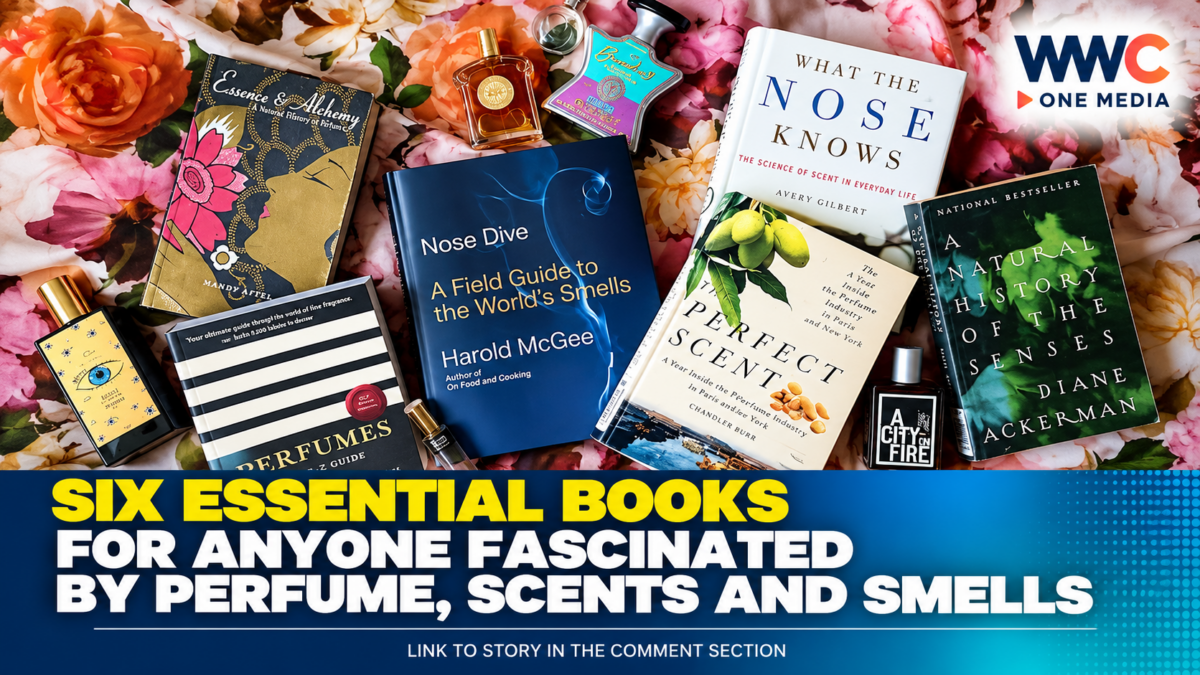
Perfume is more than a beautiful fragrance in a bottle. Behind every scent is a world of botanical ingredients, chemistry, history, craftsmanship and human memory. For readers fascinated by how smells are created and why certain aromas affect us so strongly, a number of books offer fascinating ways to explore the invisible world of fragrance.
From the origins of natural perfume ingredients to the science of smell and the fragrance traditions of royal courts, these books approach scent from very different perspectives. Together, they reveal how deeply fragrance is connected to nature, culture, science and everyday life.
In Search of Perfumes: A Lifetime Journey to the Sources of Nature’s Scents by Dominique Roques takes readers behind the scenes of the natural fragrance industry. Drawing on three decades of experience buying natural extracts, Roques explores where important perfume ingredients come from and how they are cultivated, harvested and transformed into materials used by fragrance houses.
The book travels across the world through ingredients including Indian jasmine, Venezuelan tonka bean, Laotian benzoin and French lavender. It also examines the environmental, economic and social challenges surrounding the production of natural aromatic materials, offering a closer look at the people and landscapes behind familiar perfume notes.
Scent: A Natural History of Fragrance by Elise Vernon Pearlstine approaches fragrance through botany and natural history. As an ethnobotanist and wildlife biologist, Pearlstine explores why plants produce aromatic compounds and how those scents function in the natural world.
The book looks at flowers, spices, woods and resins while connecting plant biology with the long history of humans collecting, trading and using aromatic materials. It provides a scientific foundation for understanding many of the natural ingredients that form the basis of perfumery.
For those more interested in the everyday experience of smell, The Smell of Fresh Rain: The Unexpected Pleasures of Our Most Elusive Sense by Barney Shaw examines the aromas people encounter around them every day. Damp earth, old books and wet asphalt become subjects for exploring how the human sense of smell works.
The book also considers one of the difficulties of discussing fragrance: unlike colour, there is no universally simple vocabulary for describing smells. Shaw examines how people identify and interpret aromas and encourages readers to become more attentive to the scents surrounding them.
Harold McGee’s Nose Dive: A Field Guide to the World’s Smells takes a more scientific route. Best known for his work on food science, McGee explores the chemistry behind smells across both the natural and manufactured worlds.
The book examines volatile compounds and explains how molecules such as terpenes, esters and amines can produce dramatically different aromas depending on where they occur. Its wide-ranging approach makes it particularly useful for readers who want to understand the chemistry underlying the smells of everything from flowers and food to industrial materials.
Essence and Alchemy: A Natural History of Perfume by Mandy Aftel explores perfume as both a craft and an art. Aftel traces fragrance-making from ancient rituals and alchemical traditions to modern natural perfumery, while explaining how individual ingredients can be combined to create a balanced composition.
The book also introduces readers to the traditional structure of perfume, including top, middle and base notes, while exploring natural materials such as frankincense, ambergris and rose. The revised 2022 edition offers an updated entry point into Aftel’s approach to botanical fragrance creation.
For a journey into the history of fragrance and royalty, A Scented Palace: The Secret History of Marie Antoinette’s Perfumer by Elisabeth de Feydeau focuses on Jean-Louis Fargeon, the official perfumer to Marie Antoinette.
Drawing on historical archives and Fargeon’s papers, the book explores 18th-century French perfumery, including the production of scented waters, powders and pomades. It also shows how fragrance was connected to hygiene, fashion, court etiquette and the changing social and political environment surrounding Versailles and the French Revolution.
Taken together, these six books show that perfume is far more complex than a collection of pleasant notes. It is shaped by botanical science, molecular chemistry, agriculture, trade, history, craftsmanship and personal memory.
For anyone who wants to look beyond the perfume bottle and understand the stories, science and traditions behind the scents we encounter, these books offer a deeper way to experience the world of fragrance.