
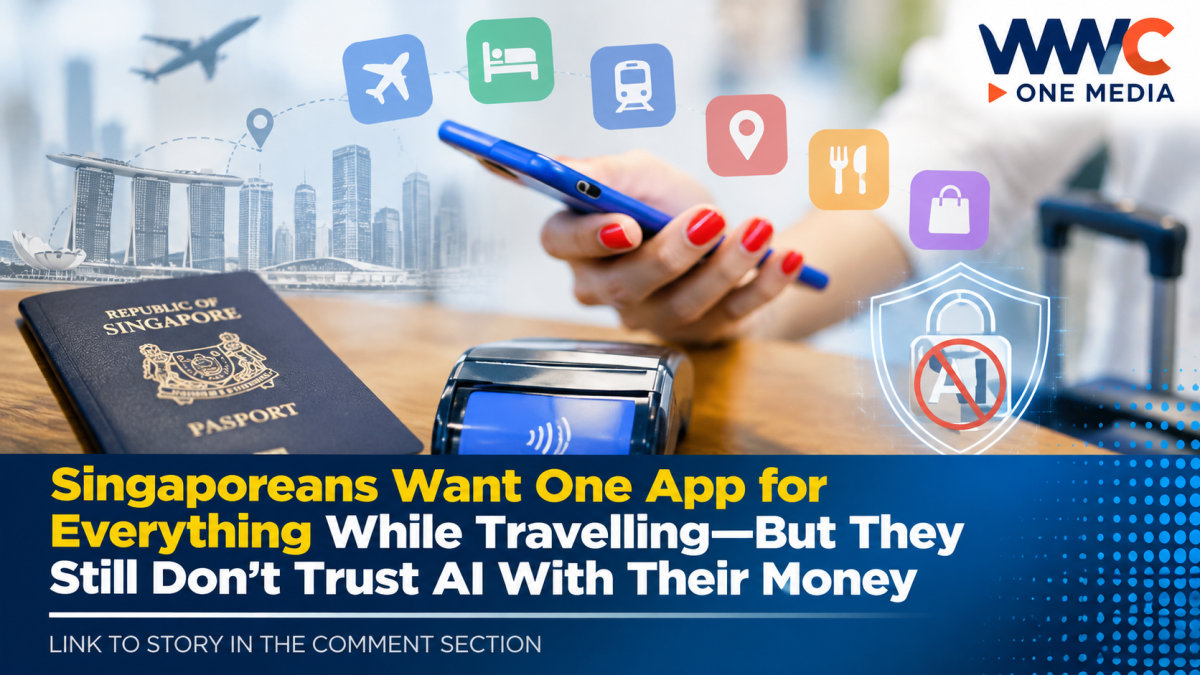
SINGAPORE — Singaporeans want travel to become simpler.
One app.
One place to plan.
One place to book.
One place to pay.
But when artificial intelligence moves from offering travel suggestions to actually spending their money, many consumers draw the line.
A new global study has found that consumers in Singapore are among those showing particularly strong demand for integrated digital experiences that bring travel bookings, transport, attractions, restaurants and payments together in a single app.
At the same time, the findings reveal a growing trust gap around AI.
Consumers are increasingly willing to use AI to discover destinations and plan trips.
But enthusiasm drops sharply when AI is asked to make purchases or handle payments without direct human control.
Singaporeans Are Leading the Push for All-in-One Travel Apps
The latest research by Alipay+ and S&P Global found that demand for integrated travel services is accelerating.
Consumers expressed interest in using a single digital platform for multiple travel activities, including:
- Restaurant reservations and payments
- All-in-one travel bookings
- Attraction tickets and passes
- Local transportation bookings
The report found particularly strong demand for integrated experiences among consumers in markets including Singapore, China, Thailand and Malaysia.
For digitally connected travellers, the appeal is obvious.
Instead of switching between separate apps for flights, hotels, transport, attractions and payments, consumers increasingly want a smoother experience where everything works together.
The Travel App of the Future Could Do Almost Everything
Imagine arriving in another country and opening just one app.
It helps you:
Find a hotel.
Book a restaurant.
Buy attraction tickets.
Reserve local transport.
Pay for purchases.
Track rewards and promotions.
And potentially use AI to recommend what to do next.
That is increasingly the type of digital experience consumers expect.
According to the Alipay+ and S&P Global research, 61% of consumers expressed interest in restaurant reservations and payments through integrated services.
Another 58% showed interest in all-in-one travel booking.
Meanwhile, 57% were interested in attraction tickets and passes, while 54% wanted local transportation booking integrated into their digital experience.
For Singaporeans, who are already among the world’s most digitally connected consumers, the demand for convenience is becoming increasingly clear.
Less app-switching.
Less friction.
More control from one place.
AI Is Becoming Part of Travel Planning
AI is already changing how people plan trips.
Consumers are using AI-powered tools to search for destinations, compare travel options and discover experiences.
The Alipay+ and S&P Global research found that more than 81% of consumers surveyed had already used AI-powered tools to explore destinations and experiences.
And many consumers are open to using AI for more travel-related tasks in the future.
Around 73% said they would be open to using AI for hotel or flight bookings over the next 12 months.
That suggests AI has already crossed an important line in travel.
It is no longer just an experimental technology.
It is becoming part of the planning process.
But Then Comes the Big Question: Would You Let AI Pay?
This is where enthusiasm begins to fade.
Consumers may be comfortable asking AI:
Where should I go?
Which hotel is cheaper?
What attractions should I visit?
But when the question changes to:
Should AI complete the payment for you?
The answer becomes far more cautious.
The Alipay+ and S&P Global research found that only 26% of consumers expressed interest in allowing AI to move closer to autonomous action and transactions.
The findings point to a major divide between using AI as an adviser and allowing AI to become an independent actor with access to money.
Singapore Consumers Want AI Help—But Also Want Control
The trust issue is not unique to travel.
Recent Singapore research has shown that consumers are increasingly open to AI handling certain tasks but remain concerned about fraud, unauthorised purchases and loss of control.
A separate survey reported by Singapore Business Review found that 44% of Singapore consumers were open to allowing an AI agent to browse and buy on their behalf either immediately or within the next year.
But the same study found major concerns beneath that growing interest.
About 63% worried about unauthorised purchases.
Another 61% were concerned about fraud.
The message is clear.
Singaporeans may want convenience.
But they do not necessarily want to surrender control.
Privacy Is Another Major Barrier
Money is not the only concern.
Data matters too.
The Alipay+ and S&P Global report found that 43% of consumers expressed privacy concerns around AI-powered commerce.
Some consumers also said they preferred to plan travel themselves or rely on human advice rather than allowing an AI assistant to take control.
This creates a difficult challenge for travel companies and payment providers.
Consumers want:
Personalisation.
Convenience.
Faster bookings.
Integrated payments.
But they also want:
Privacy.
Transparency.
Security.
Control.
The companies that succeed may be those capable of delivering both.
The Global Travel Industry Has the Same AI Trust Problem
Singapore is not alone.
Research from other travel and technology companies shows that consumers worldwide are becoming more comfortable using AI for planning but remain cautious about letting it complete transactions.
A 2026 Expedia Group study found that two-thirds of travellers said they would not trust an AI assistant to buy or book something on their behalf.
Only a small share said they were comfortable booking through an AI platform.
Among the biggest concerns were:
- Loss of control
- Privacy of payment and personal details
- Misuse of personal data
- What happens when something goes wrong
The issue is not necessarily whether travellers believe AI can find information.
The bigger question is whether they trust it with the consequences of making the final purchase.
Only 17% Would Trust an AI Travel Bot With Payments Without Human Oversight
Another recent travel survey highlighted just how cautious consumers remain when sensitive information is involved.
Riskified reported that only 17% of consumers would trust an AI travel bot to handle payment or passport details without human oversight.
Payment security was also identified as one of the top concerns when consumers purchased tickets online.
The findings show a major difference between AI-powered travel discovery and AI-powered transactions.
Travellers may enjoy asking AI for advice.
But letting an AI system access money or sensitive documents is another matter entirely.
Travel Payments Are Still Full of Friction
Even without AI, travellers continue to face payment problems abroad.
The Alipay+ and S&P Global research found that consumers often struggle with issues including:
- Uncertainty over whether payments will be accepted
- Lack of access to preferred payment methods
- Security concerns
- Foreign exchange rates and fees
- Unfamiliar payment processes
More than half of respondents said they had experienced problems related to payment acceptance or access to their preferred payment method.
Security was also a major concern.
As a result, some travellers continue to carry cash as a backup even as mobile payments become increasingly common.
The Real Opportunity Is Integration
The research suggests that consumers do not necessarily want more travel apps.
They want fewer.
But better connected.
The future could involve digital wallets evolving beyond simple payment tools.
Instead of merely paying for purchases, a wallet or super app could become a travel companion that helps consumers discover, plan, book and pay.
For Singaporeans, that kind of integrated experience could be particularly attractive.
The country already has high digital adoption.
Consumers are familiar with mobile payments.
And cross-border travel remains an important part of life for many Singapore residents.
The challenge is making the experience seamless without sacrificing security.
AI May Need to Earn Trust Before It Earns Access to Your Wallet
The biggest takeaway from the research is simple.
Consumers appear increasingly comfortable with AI as an assistant.
They are less comfortable with AI as an independent decision-maker.
There is a major difference between asking:
“Which flight should I book?”
And saying:
“Book the flight and charge my card.”
That second step requires a far higher level of trust.
Consumers want to know:
Who is responsible if something goes wrong?
Can the AI make an unauthorised purchase?
Where does their payment information go?
Can they stop the transaction?
Can they get their money back?
Until those questions are answered clearly, AI-powered payments may face a much slower path to mainstream adoption.
Singapore’s Digital Future May Depend on Trust, Not Just Technology
Singaporeans appear ready for a more integrated travel experience.
They want digital services that reduce friction.
They want travel bookings and payments to work together.
And they are increasingly familiar with AI-powered planning.
But convenience has a limit.
When AI starts moving from recommendation to action, trust becomes the deciding factor.
The technology may already be capable of doing more.
The question is whether consumers are ready to let it.
For now, the answer appears to be:
Use AI to help me plan.
Use AI to help me compare.
Use AI to help me save money.
But before it spends my money—ask me first.
And that may be the biggest challenge facing the next generation of travel apps.
Singaporeans want everything in one place.
They want it faster.
They want it smarter.
But above all, they still want to stay in control.
WWC ONE MEDIA J.M.D




Leave a Reply