
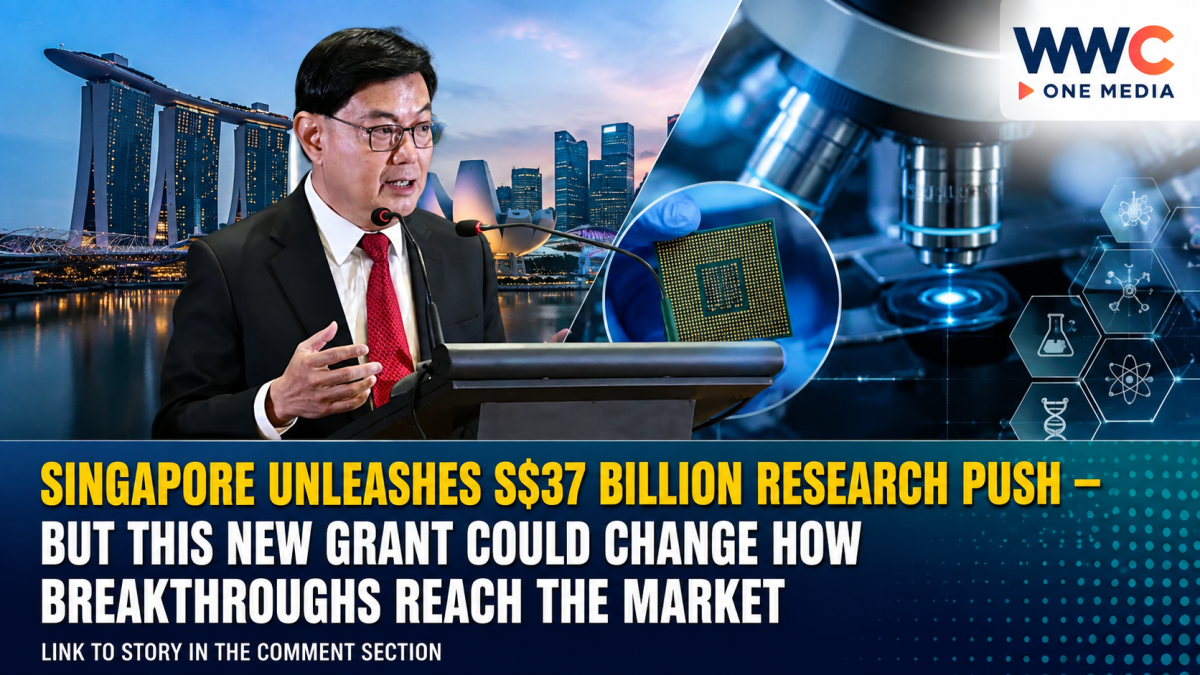
SINGAPORE — Singapore is making a major push to turn scientific discoveries into commercially viable technologies, unveiling the full details of its record S$37 billion Research, Innovation and Enterprise 2030 (RIE2030) plan and introducing a new grant designed to move promising research closer to the marketplace.
The five-year investment, which runs from April 2026 through 2030, represents Singapore’s largest RIE funding commitment to date and is equivalent to roughly 1 per cent of the country’s GDP.
But beyond the headline figure, officials are putting a sharper emphasis on a long-standing challenge: how to turn research breakthroughs into technologies that companies can actually invest in, develop and scale.
At the centre of that effort is the new Research Translation Grant, which will support the development of early-stage technologies emerging from Singapore’s public research institutions.
The National Research Foundation said the grant is intended to create a more direct pathway for universities and the Agency for Science, Technology and Research (A*STAR) to develop commercially promising research.
Projects can receive up to S$2 million, while those that secure early involvement from investors can qualify for up to S$3 million.
The objective is not simply to produce more research.
It is to make promising discoveries easier for investors and companies to take from the laboratory to the market.
The bigger bet: Singapore wants its research ecosystem to produce not only scientific breakthroughs, but globally investible businesses.
From laboratory breakthroughs to commercial opportunities
The new approach comes after Singapore’s review of its previous five-year research programme identified room for improvement in commercialising research.
Under RIE2025, Singapore invested S$28 billion in research, innovation and enterprise. The latest review found that business expenditure on research and development increased substantially, while the number of industry R&D jobs also expanded.
Business R&D spending rose from S$5.5 billion in 2018 to S$9 billion in 2023, an increase of about 64 per cent.
Industry R&D employment also grew by about 33 per cent, from more than 24,000 jobs in 2018 to over 32,000 in 2023, with more than 70 per cent of those positions held by Singapore residents.
Singapore’s deep-tech sector has also continued attracting capital, with deep-tech startups receiving at least S$1 billion in venture funding annually over the past four years.
However, the number of deals has declined since 2023 amid higher borrowing costs, tighter financial conditions and broader global economic uncertainty.
RIE2030 therefore aims to strengthen public-private funding partnerships, particularly to help deep-tech companies move beyond the early stages of development.
Where the S$37 billion will go
The RIE2030 plan covers four major domains:
- Human Health and Potential
- Manufacturing, Trade and Connectivity
- Urban Solutions and Sustainability
- Smart Nation and Digital Economy
The plan also introduces two new mechanisms — RIE Flagships and RIE Grand Challenges — designed to coordinate research across institutions and focus resources on major national and economic priorities.
A total of S$3 billion has been allocated to these large-scale initiatives.
Semiconductors and healthy longevity were identified as the initial priorities, while transport and connectivity and decarbonisation have subsequently been added.
The major allocations include:
S$800 million for semiconductor research
Singapore is using the funding to deepen its position in the global semiconductor ecosystem, including research into advanced packaging, heterogeneous integration and advanced photonics.
Singapore is already a significant semiconductor manufacturing and equipment hub, making the sector a strategic priority under RIE2030.
S$800 million for transport and connectivity
The transport programme aims to strengthen Singapore’s position as a global connectivity hub, with research spanning aviation, maritime and land transport.
About two-thirds of the funding is focused on autonomy and digital twins for connectivity.
S$800 million for decarbonisation
The programme will focus on developing and accelerating low-carbon technologies for Singapore’s industrial and power sectors, including support for technology pilots.
S$350 million for healthy longevity
Singapore is placing ageing and longevity at the centre of its research agenda as it prepares for the challenges of an ageing population. The programme combines healthcare, technology and social research to help people live healthier and more independent lives.
The remaining S$250 million of the S$3 billion allocation is being kept as a buffer for future, unexpected research priorities.
AI gets another major boost
Artificial intelligence is another major component of Singapore’s research strategy.
Separately, the Government announced more than S$1 billion over five years for the National AI Research and Development Plan, running from 2025 to 2030. The programme is intended to strengthen Singapore’s public AI research capabilities and support its ambition to remain a global AI research hub.
RIE2030 also places greater emphasis on AI, data and advanced computing capabilities across the wider research ecosystem.
The strategy reflects a broader shift: AI is no longer being treated simply as an individual technology sector but as an enabling capability that can transform research across healthcare, manufacturing, sustainability and other fields.
Water, healthcare and infrastructure are already seeing the money
The RIE2030 strategy is already translating into sector-specific programmes.
Singapore’s national water agency PUB, for example, has received almost S$100 million in initial RIE2030 funding for municipal and industrial water technologies.
Of that amount, S$85 million is allocated to municipal water solutions, while another S$12 million will support industrial water solutions aimed particularly at water-intensive sectors such as semiconductor manufacturing and data centres.
Healthcare is another major beneficiary.
The Ministry of Health has committed S$2.5 billion over five years under RIE2030 to strengthen translational and clinical research, including precision medicine and the use of AI in healthcare.
The talent race is just as important
Singapore’s strategy is not only about funding laboratories and technology.
The country is also investing heavily in researchers, scientists, entrepreneurs and deep-tech founders.
The NRF’s new Postdoctoral Award, for example, provides promising researchers with a S$250,000 research grant and up to four years of salary support, giving young scientists greater opportunity to pursue independent research.
RIE2030 also includes initiatives aimed at strengthening the pipeline of deep-tech entrepreneurs and giving researchers more opportunities to work internationally and move their discoveries toward commercial applications.
Meanwhile, an additional S$1 billion has been allocated to the Startup SG Equity scheme, strengthening government support for early-stage startups.
A bigger question for Singapore
The scale of RIE2030 is significant, but the ultimate test will not simply be how much money is spent.
It will be whether the investment produces new companies, technologies, jobs, intellectual property and solutions to national problems.
Singapore’s own data shows why the Government is pushing harder on this front.
Over the past decade, public research institutions have filed around 8,000 patents under the RIE plans. About 20 per cent have been commercialised through licensing or assignment, with first commercialisation typically taking between two and four years.
That means the new Research Translation Grant could become one of the more important pieces of RIE2030 — not because it is the largest pool of money, but because it targets the difficult gap between having a promising invention and having a technology that investors and companies are willing to back.
And that may ultimately determine whether Singapore’s S$37 billion research gamble becomes another chapter in its scientific development — or a springboard for its next generation of globally competitive companies.
For Singapore, the race is no longer simply to discover what comes next. It is to make sure those discoveries do not remain inside the laboratory.

Leave a Reply