
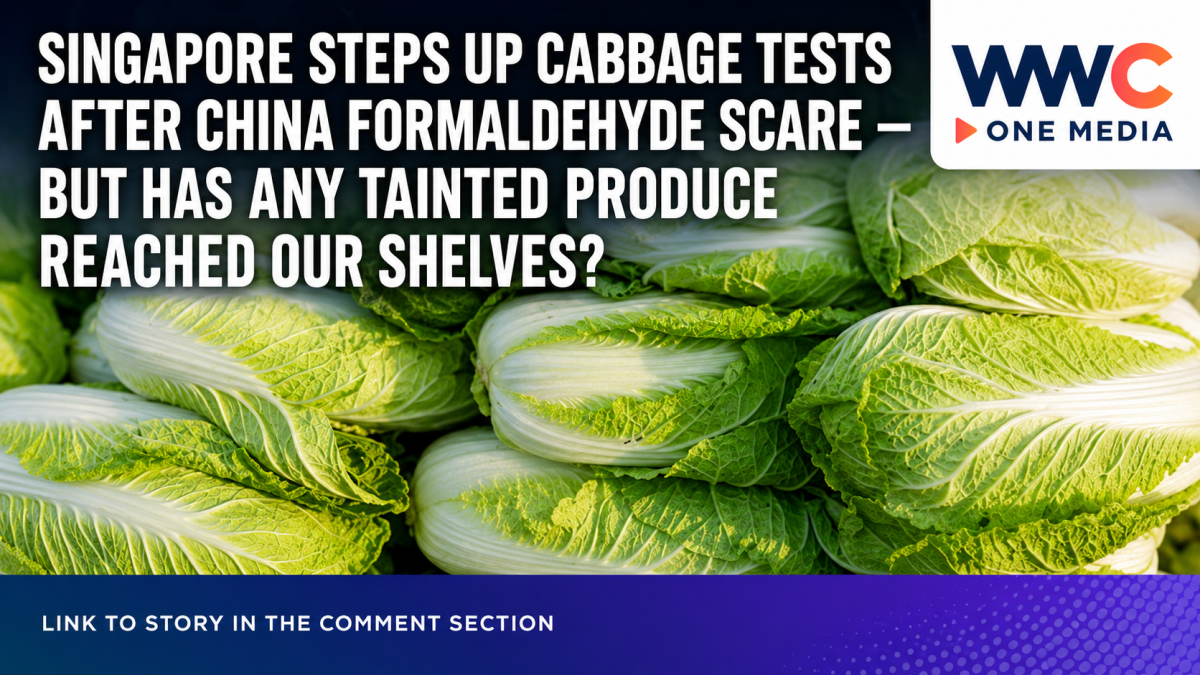
SINGAPORE — A food-safety controversy that began with a viral video in northern China has now put cabbage imports under closer scrutiny in Singapore, after authorities confirmed that formaldehyde had been illegally used on some vegetables during transportation.
The Singapore Food Agency (SFA) said on September 1 that it had stepped up surveillance and testing of cabbages as part of its food-safety monitoring programme following reports about the practice in China.
But there is an important distinction for consumers: Singapore authorities have not announced that formaldehyde-contaminated cabbage has been discovered for sale here.
The increased testing is therefore a precautionary response while authorities monitor an investigation that has already triggered checks across several parts of Asia.
How a Viral Video Triggered a National Food-Safety Investigation
The controversy erupted on August 22 after a Chinese environmental content creator posted footage on Douyin that appeared to show workers in Kangbao County, Hebei province, dipping cabbages into a liquid before loading them onto trucks.
Containers labelled as formaldehyde solution could be seen near the vegetables, according to reports.
Workers recorded in the video reportedly said the treatment could keep the cabbage fresh for another two or three days during transportation. Some of the produce was reportedly headed towards cities in eastern China.
What initially looked like an alarming social-media allegation quickly became an official investigation.
Authorities in Kangbao County subsequently confirmed that the practices shown in the footage had taken place and said using formaldehyde to preserve cabbage during transportation was illegal. Police took measures against the people and vehicles involved, while officials began tracing where the affected vegetables had been sent.
China’s State Council Food Safety Office, Ministry of Agriculture and Rural Affairs and State Administration for Market Regulation then directed authorities nationwide to inspect perishable vegetables and investigate similar practices.
Why Formaldehyde Is Raising Alarm
Formaldehyde is a colourless chemical used extensively in industrial applications and as a preservative. The International Agency for Research on Cancer classifies formaldehyde as carcinogenic to humans.
That classification does not mean every exposure automatically causes cancer — health risks depend on factors including concentration, route and duration of exposure — but intentionally using formaldehyde to preserve food raises an obvious food-safety concern.
China prohibits formaldehyde from being used as a food-processing aid, and adding it to food is illegal under the country’s food-safety rules.
Singapore similarly requires food sold here to comply with regulatory limits governing additives and contaminants, while imported fresh fruits and vegetables must meet SFA requirements concerning prohibited substances and chemical residues.
Singapore Is Testing — But There Is No Confirmed Local Contamination Yet
SFA’s response is significant because Singapore depends heavily on overseas food.
More than 90 per cent of Singapore’s food is imported, although the country now sources food from more than 180 countries and regions as part of its strategy to reduce dependence on individual suppliers.
That makes rapid surveillance particularly important whenever a food-safety problem develops overseas.
SFA already operates market-monitoring programmes that collect and test food samples from retailers, with higher-risk products receiving more targeted scrutiny. The agency said cabbage testing has now been stepped up as developments in China are monitored.
However, as of September 1, SFA’s public statement did not say contaminated cabbage had been detected in Singapore, nor did it announce a recall linked to the Hebei incident.
That distinction matters.
An investigation overseas and additional testing in Singapore should not automatically be interpreted as evidence that dangerous cabbage has entered the local food supply.
South Korea’s Results Offer an Important Reality Check
South Korea moved even earlier, tightening inspections of Chinese napa cabbage imports from August 24.
Initial tests on eight imported consignments found no formaldehyde, according to South Korea’s Ministry of Food and Drug Safety.
Authorities then expanded the investigation to products already being sold.
In a major follow-up, South Korea said it tested 82 samples of Chinese cabbage, salted cabbage and cabbage kimchi circulating domestically — and formaldehyde was not detected in any of them.
Officials also investigated the sourcing of cabbage used by all 55 HACCP-certified Chinese manufacturers authorised to export cabbage kimchi to South Korea.
According to the ministry, none of those manufacturers was found to be sourcing cabbage from Kangbao County, the area at the centre of the controversy. South Korea later said the cabbage involved in China’s formaldehyde incident had not been exported there.
Those findings do not settle what happened to every affected cabbage inside China, but they provide important context: a confirmed illegal practice in one supply chain does not mean all Chinese cabbage is contaminated.
China Is Still Tracing Where the Affected Cabbage Went
That remains the biggest unanswered question.
Chinese authorities have been tracing the distribution of the cabbage involved in the Kangbao case while conducting broader inspections of vegetable purchasing, transportation and sales.
Beijing’s Fengtai district said the implicated batches had not entered the major Xinfadi wholesale market as of the initial investigation, while the market increased testing for illegal additives following the controversy.
The incident has nevertheless revived uncomfortable memories.
Reports of traders using formaldehyde to prolong cabbage freshness also surfaced in China in 2012, when Chinese media investigated similar practices in Shandong province.
That history helps explain why a relatively localised incident has generated such intense regional attention.
What Singapore Consumers Should Watch Next
For Singapore, the next major development will be the results of SFA’s stepped-up testing.
If testing identifies a food-safety problem, Singapore has systems allowing regulators to investigate suppliers and order affected food removed from sale. But until such findings are announced, claims that Singapore supermarkets are selling “formaldehyde cabbage” would go beyond the available evidence.
For now, the verified picture is narrower but still serious:
Chinese authorities have confirmed illegal formaldehyde use during cabbage transportation in Kangbao County. China has launched wider inspections. Singapore has intensified cabbage surveillance. South Korea has also conducted extensive testing — with its reported samples so far coming back negative.
The scandal has therefore reached Singapore’s food-safety radar.
Whether it ever reached Singapore’s dinner tables is a different question — and one authorities are now testing to answer.
WWC ONE MEDIA MJE



Leave a Reply