
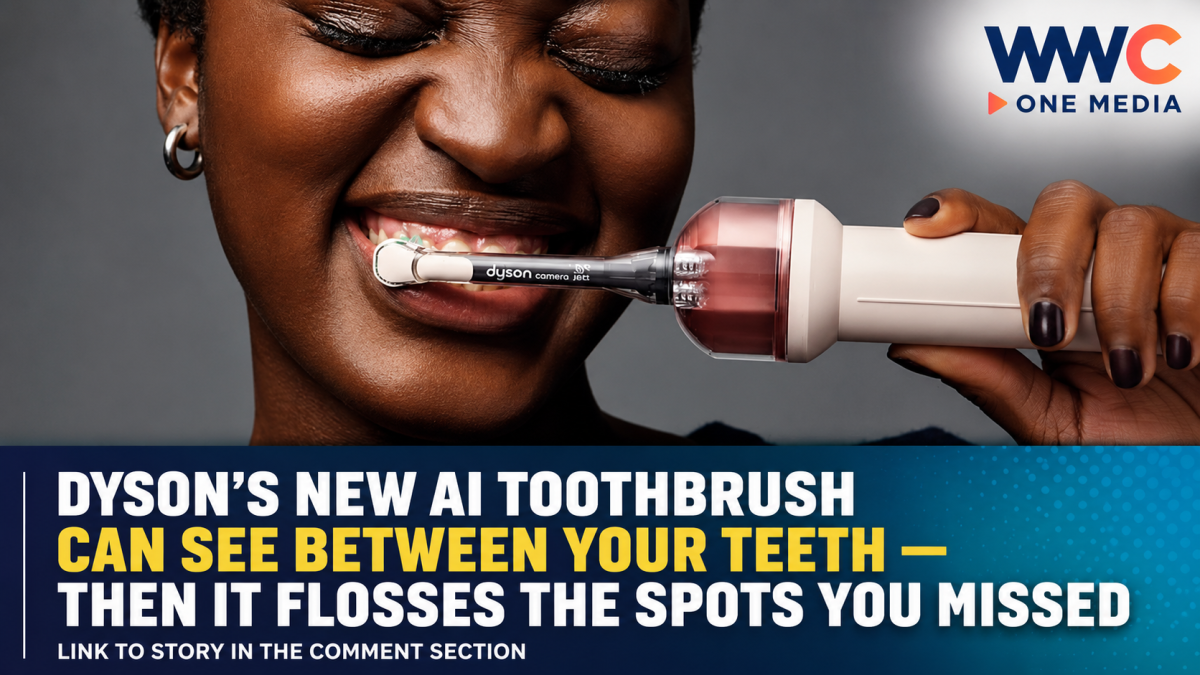
Dyson has entered the smart oral-care market with the CameraJet, a high-tech electric toothbrush that uses a tiny camera, machine learning and a precision mouth-rinse jet to identify gaps between teeth and clean them while you brush.
The days of simply brushing and hoping you didn’t miss a spot may be getting a futuristic upgrade.
Dyson has launched the CameraJet, an electric toothbrush designed to combine brushing and precision flossing in a single routine. The device was unveiled in Paris on Sept. 1 and is now available in Singapore for S$699, with Ceramic Ultra Blue and Ceramic Pink versions offered through Dyson’s official website. In the US, Dyson lists the CameraJet at US$499.99.
But the feature attracting the most attention isn’t the toothbrush’s motor.
It’s the camera.
A toothbrush that can actually see the gaps
Built into the CameraJet is a 100,000-pixel macro camera designed to look between the teeth as users brush.
Dyson says the camera captures up to 28 images per second, with its machine-learning system — called Gap Optical Targeting — designed to identify, track and predict interdental gaps in real time. When the system detects a gap, a precision jet positioned beneath the brush head releases a burst of mouth rinse into the area.
The jet is designed differently from the narrow, needle-like streams commonly associated with water flossers. Dyson says its broader, conical spray is intended to cover the gap while using lower pressure.
According to Dyson, the jet can react within about 100 milliseconds after detecting a gap.
That means the user doesn’t necessarily have to stop brushing, locate each gap manually and operate a separate flosser. The CameraJet is designed to do the targeting automatically while brushing continues.
You can also watch inside your own mouth
The camera isn’t used only for automated flossing.
Because the CameraJet connects to the MyDyson app through Wi-Fi and Bluetooth, users can access a live view of the camera while brushing. The app also provides brushing and flossing insights, coverage mapping, guided cleaning and personalised feedback.
Dyson says camera images are not stored on the toothbrush or in the cloud, with the camera activated for live viewing or when the automatic jetting function is operating. That privacy claim comes from Dyson and has not been independently audited by the technology publications covering the launch.
Dyson spent years developing it
The CameraJet is not a quick experiment.
Dyson says the product involved six years of development, with reporting from The Guardian and other outlets putting the engineering effort at 661 Dyson engineers. The company says the system involves around 16 million lines of code and was trained using more than 470,000 dental images.
One particularly unusual part of the development process involved creating a synthetic material designed to mimic dental plaque.
Dyson worked with the National University of Singapore’s Faculty of Dentistry to develop what it calls “proxy plaque.” The material allowed engineers to repeatedly test prototypes and plaque-removal performance without conducting a human clinical trial for every iteration.
It is more than a camera and water jet
The CameraJet also incorporates a redesigned brush head with different bristle types.
Softer outer bristles are intended to clean around the gumline, while firmer inner bristles are designed to help remove surface stains. Dyson also uses what it calls variable sonic oscillation, which changes the movement of the bristles to help keep them moving when they encounter resistance from the teeth.
The toothbrush has a 12.5ml mouth-rinse reservoir built into the device.
Its so-called “anti-gravity” system is designed to maintain fluid delivery even when the toothbrush is tilted or held horizontally — something Dyson says is particularly useful when reaching difficult areas such as the back teeth.
After use, the docking station can recharge the toothbrush and refill the reservoir. Dyson says the refill process takes approximately three seconds.
The brush heads also contain RFID technology that allows the device to monitor usage and alert users when replacement is due.
Dyson is also selling its own toothpaste and mouth rinse
There is another unusual twist.
Dyson has developed its own non-foaming toothpaste and low-foaming mouth rinse for the CameraJet.
The reason is practical: excessive foam could interfere with the camera’s ability to see between the teeth. The products are therefore designed to work with the CameraJet’s optical system.
In Singapore, the toothpaste comes in three variants and the mouth rinse in two flavours, with prices starting at S$15.
But does the $699 toothbrush actually clean better?
This is where the headline-making technology needs some context.
Dyson has made substantial plaque-removal claims based on its testing, including comparisons with premium electric toothbrushes. However, independent reporting suggests consumers should be cautious about treating those claims as proof that the CameraJet will produce dramatically better long-term dental outcomes.
Allure reported that Dyson provided clinical data from a four-week study involving 60 participants comparing the CameraJet with a manual toothbrush. The CameraJet performed better across the measures reported, although the difference in plaque reduction was considerably smaller than some of the gum-health differences.
The Guardian also quoted British Dental Association chair Eddie Crouch warning that expensive technology should not be viewed as a substitute for a consistent oral-care routine.
That distinction matters.
A camera-equipped toothbrush may make brushing and interdental cleaning more convenient, but it doesn’t automatically replace professional dental care or guarantee better oral health.
The bigger question: is this the future of brushing?
At S$699 in Singapore and US$499.99 in the US, the CameraJet sits firmly in the premium end of the electric-toothbrush market.
Its appeal is less about simply making a toothbrush move faster and more about automating something many people struggle to do consistently: cleaning between their teeth.
Dyson is effectively combining an electric toothbrush, camera, machine-learning system, precision flosser and connected app into one device.
That makes the CameraJet one of the most unusual oral-care products to reach the market.
Whether consumers will consider that worth hundreds of dollars remains the bigger question.
For now, Dyson has managed to turn one of the most ordinary objects in the bathroom into something considerably more futuristic — a toothbrush that looks for the gaps you miss and tries to clean them for you.
And the strangest part may be that you can actually watch it happen on your phone.
WWC ONE MEDIA MJE




Leave a Reply