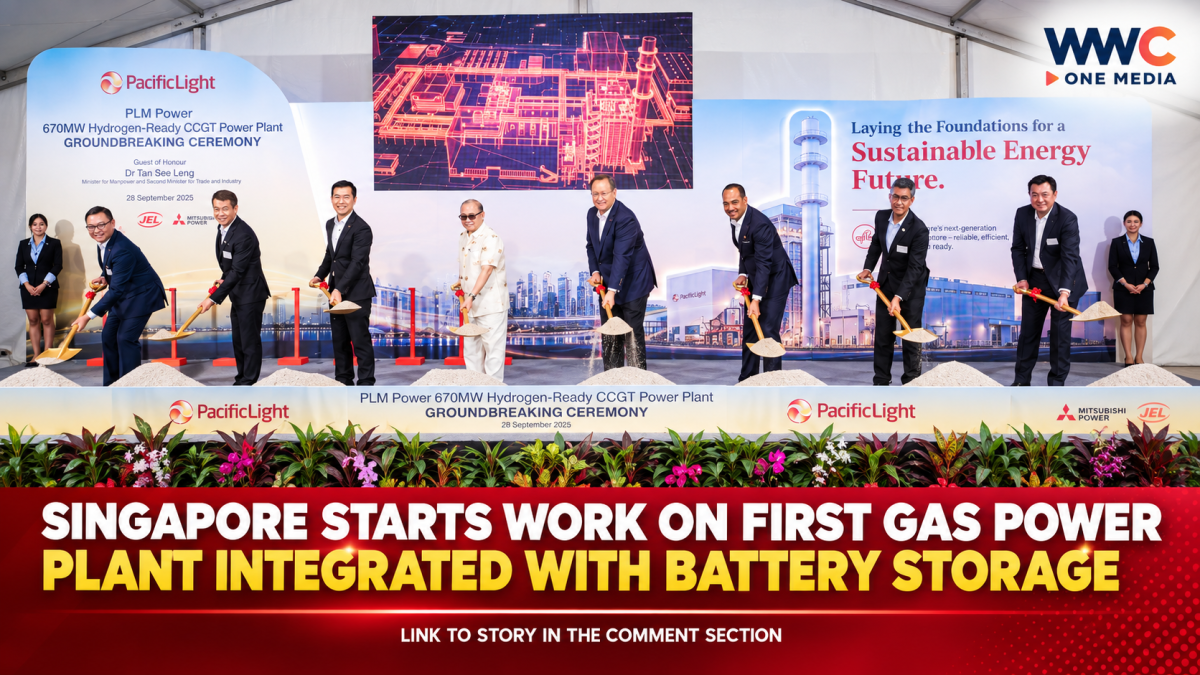
SINGAPORE — Singapore has begun construction of a new 670-megawatt gas-fired power plant on Jurong Island, marking a major step in the country’s effort to strengthen electricity supply while preparing its power system for more renewable energy.
PacificLight Power started work on the facility on Sept. 28. The project, which is expected to cost about S$1 billion, will be Singapore’s first gas-fired power plant integrated with a large-scale battery energy storage system (BESS).
The plant is scheduled to begin operations in 2029 and will be hydrogen-ready, adding another layer to Singapore’s strategy for balancing energy security with longer-term decarbonisation goals.
Why the battery matters
The combination of a gas turbine and battery storage is one of the project’s defining features.
PacificLight says the battery will allow the plant to install a larger gas turbine while helping maintain grid stability. The storage system can also provide rapid support when electricity demand or supply changes, an increasingly important function as Singapore expands solar power.
The facility’s battery is designed to provide 70MW of instantaneous power, according to Singapore International Energy Week. The project also includes a 100MW fast-start capability that can reach full load in about 18 minutes.
That combination is intended to give Singapore’s electricity system more flexibility when intermittent renewable sources, particularly solar, are supplying the grid.
A bigger plant built for Singapore’s rising power needs
Singapore already relies heavily on natural gas for electricity generation, with more than 20 gas-fired power plants currently operating.
PacificLight’s new facility is designed to add significant generation capacity as electricity demand continues to grow, including demand associated with advanced manufacturing and the digital economy.
The Energy Market Authority previously awarded PacificLight the right to develop the project, requiring a new combined-cycle gas turbine facility with at least 600MW of capacity and a targeted 2029 operating date. PacificLight subsequently proposed the larger 670MW configuration with integrated battery storage.
Hydrogen-ready from the beginning
The project is also being designed with future fuel flexibility in mind.
PacificLight says the plant will be capable of operating with at least 30% hydrogen at the outset, with the potential to eventually operate entirely on hydrogen.
The site has also been designed with room for potential future technologies, including a second combined-cycle gas turbine and possible carbon capture, utilisation and storage infrastructure.
Singapore is simultaneously pursuing other pathways to reduce the carbon intensity of its electricity system, including advanced gas turbines, carbon capture studies and imports of low-carbon electricity from the region. The Energy Market Authority is targeting around 6GW of low-carbon electricity imports by 2035.
A new model for Singapore’s power grid?
PacificLight’s project reflects a broader shift in how Singapore is planning its next generation of electricity infrastructure.
Instead of relying solely on conventional generation, the new facility combines gas generation, battery storage and hydrogen-ready technology in a single project.
The approach is designed to provide reliable electricity today while giving the facility options as cleaner technologies develop.
Construction has now begun on Jurong Island, with commercial operations targeted for 2029.
And as Singapore’s electricity demand continues to rise, the bigger question is becoming increasingly important: Can a gas plant equipped with batteries and hydrogen technology become the bridge between today’s power system and the country’s lower-carbon energy future?
WWC ONE MEDIA G,A