
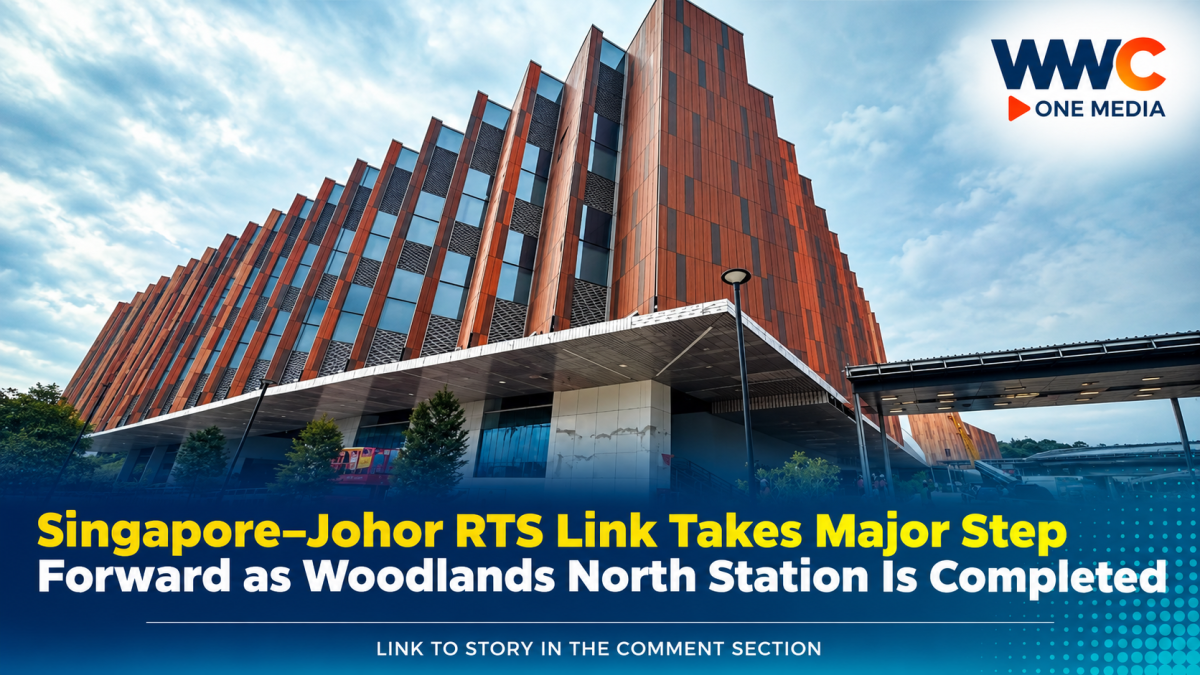
SINGAPORE — The long-awaited Johor Bahru–Singapore Rapid Transit System (RTS) Link has moved another step closer to passenger service, with Singapore’s Woodlands North station now officially completed.
The milestone, announced by Singapore’s Land Transport Authority (LTA) on September 4, 2026, comes as the cross-border rail project enters its crucial testing and commissioning phase.
The 4km RTS Link will connect Woodlands North in Singapore with Bukit Chagar in Johor Bahru, potentially transforming one of Southeast Asia’s busiest cross-border travel corridors.
Once passenger service begins, the journey between the two stations is expected to take around five minutes, dramatically shortening the time needed to cross the Singapore–Malaysia border by road during busy periods.
Woodlands North station is now complete
The newly completed Woodlands North station is an underground facility directly connected to Singapore’s Thomson-East Coast Line (TEL).
Passengers arriving by MRT will be able to transfer to the RTS Link through the station’s spacious Basement 1 concourse.
The station has two basement levels, reaches a maximum depth of about 28 metres, and includes an underground linkway to the Customs, Immigration and Quarantine facilities.
LTA also revealed several design features intended to give the station a distinctly Singaporean identity.
The pick-up and drop-off area’s colours and design were inspired by trees and the natural character of Woodlands, while artwork inside the ticketing concourse incorporates symbols representing nature, science, friendship and heritage.
Building the station was no easy task
Behind the polished new station was a difficult engineering challenge.
LTA said construction crews encountered a high volume of hard rock while building the station’s foundation.
Because the RTS station sits alongside the existing Thomson-East Coast Line infrastructure, construction teams also had to limit vibrations that could affect MRT passengers.
High-capacity drilling equipment was used, while workers carried out more than 600 controlled rock-blasting operations.
The blasts were conducted in small quantities and timed around train movements to minimise disruption to existing TEL services.
What will happen when passengers arrive?
The RTS Link is designed to make cross-border travel more streamlined, but passengers will still have to clear border controls.
At Woodlands North, security checks will take place at the immigration facilities before passengers proceed to the platforms.
The arrangement is based on co-located border controls, meaning travellers will clear the relevant immigration procedures before boarding rather than facing another immigration clearance immediately after arriving in Johor Bahru.
Malaysia’s Customs, Immigration and Quarantine facilities are integrated into the overall cross-border arrangement.
This is expected to make the experience considerably different from today’s road journey, where travellers can face lengthy queues at the Causeway, particularly during weekends, public holidays and peak commuting periods.
The train crossing will take only minutes
The RTS Link itself stretches approximately 4km between Woodlands North and Bukit Chagar.
The trains are expected to operate at speeds of up to 80km/h, with the journey between the two stations taking roughly five minutes under the planned operating configuration.
The system is designed to handle up to 10,000 passengers per hour in each direction, with anticipated daily ridership of about 40,000 passengers.
That capacity could make the RTS Link a major alternative for commuters who currently depend on buses, cars, taxis and other road transport to cross the border.
Malaysia’s side has also reached a crucial stage
The progress is not limited to Singapore.
In August, Malaysian Transport Minister Anthony Loke said the station and rail infrastructure on the Malaysian side had been completed and that the project had entered its final integration-testing stages involving Singapore and Malaysia.
The Malaysian terminal at Bukit Chagar is also being connected to the wider Johor Bahru transport network.
An overhead pedestrian bridge linking the RTS station with the JB Sentral transport hub and nearby shopping centres has been completed, while Malaysia plans additional improvements to public transport connections.
Malaysia also plans to add 200 buses serving nearby residential areas once the RTS Link begins operations.
A future bridge is planned to improve the connection between the RTS Link and KTM services at JB Sentral, potentially making it easier for passengers to continue their journeys beyond Johor Bahru.
The launch date and fares are still being finalised
Despite the latest construction milestone, commuters cannot start riding the RTS Link just yet.
The project is undergoing testing, commissioning and system integration, including coordination between the two countries’ transport, immigration, customs and security authorities.
Loke said in August that the official operating date and fares would be announced jointly by Malaysia and Singapore after discussions are finalised.
Previous plans have targeted completion by the end of 2026, with passenger operations expected in 2027. Recent reporting continues to place the project on that timetable, but the precise public launch date and fare have not yet been officially announced.
More than just a new train line
The RTS Link is being watched closely because its impact could extend well beyond faster commuting.
For Singapore, the Woodlands area is undergoing broader redevelopment, including plans for a major transport-oriented district around the Woodlands Regional Centre. JTC has highlighted plans for a future transport hub incorporating retail, park and office components.
Across the border, Johor Bahru is also preparing for potentially greater numbers of Singapore visitors, commuters and shoppers.
Property analysts have predicted that improved cross-border connectivity could increase interest in parts of northern Singapore and Johor, while retailers on both sides are preparing for changes in consumer traffic.
For businesses and workers who regularly move between Singapore and Johor, however, the biggest attraction may remain simple:
Less time stuck in traffic.
The RTS Link will not eliminate border procedures, and it will not remove congestion on every road connecting Singapore and Johor Bahru.
But once operational, it could fundamentally change the way tens of thousands of people cross the border every day.
And with Woodlands North station now completed, the long-awaited Singapore–Johor rail connection is entering the final stretch before passengers finally get their turn.
WWC ONE MEDIA J.M.D



Leave a Reply