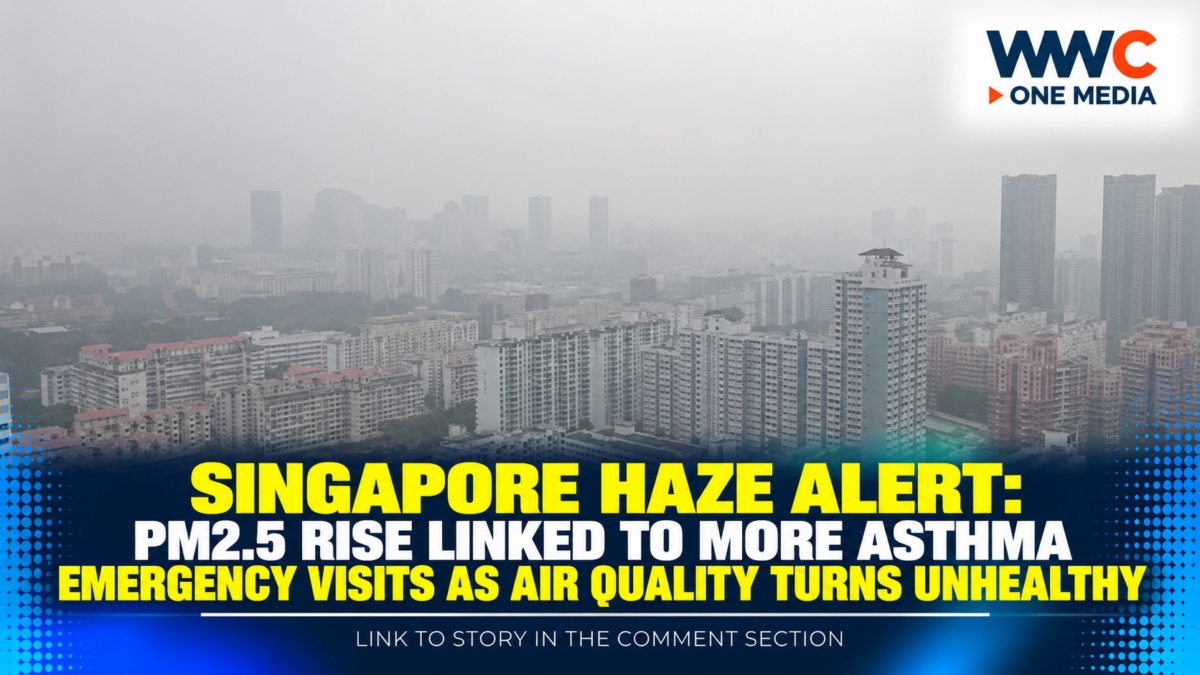
SINGAPORE — A new study is drawing attention to the health effects of fine-particle pollution just as haze pushes air quality across Singapore into the unhealthy range in all five regions.
Research examining respiratory emergency visits in Singapore found that increases in PM2.5 were associated with higher numbers of emergency-department visits for asthma and chronic respiratory disease in the days following increased exposure.
PM2.5 refers to extremely small airborne particles measuring no more than 2.5 microns across. Because of their size, they can penetrate deep into the lungs. The pollutant is also among those measured through Singapore’s Pollutant Standards Index and is a major concern during periods of transboundary haze.
Study Finds Respiratory Risk Can Appear Days Later
The research is particularly notable because the health effects were not necessarily immediate.
The study found an association between increased PM2.5 concentrations and emergency visits for asthma and chronic respiratory conditions, with the impact becoming apparent over the following couple of days.
That delay is important when assessing haze-related health risks. A pollution spike may occur first, while increased demand for emergency respiratory care becomes visible later.
Singapore Air Quality Enters Unhealthy Range
The findings come as Singapore’s haze situation deteriorates.
On Sept. 29, the 24-hour PSI entered the unhealthy range across all five regions. The central region recorded the highest reading, reaching 155 at 7am, while the northern region crossed the unhealthy threshold at 7am with a reading of 101.
The situation subsequently worsened in the central region, where the PSI reached 164 by 10am, marking a new high for the 2026 haze season.
Hourly PM2.5 readings were also elevated across Singapore, with readings ranging from 61 to 112 as of 9am on Tuesday, according to the National Environment Agency’s update reported by CNA.
Smoke Haze Adds to the Concern
Singapore’s latest deterioration has coincided with smoke haze affecting parts of the region.
The National Environment Agency reported hotspots in Sumatra and Kalimantan, with moderate to dense smoke plumes observed in those areas. Smoke haze was also reported across parts of Singapore and neighboring areas.
The agency said dry conditions in parts of the southern ASEAN region were contributing to the conditions, while weather and wind patterns could affect how much haze reaches Singapore.
Why PM2.5 Matters
PM2.5 is small enough to travel deep into the respiratory system, making it an important air-quality indicator during haze episodes.
The new research adds to concerns about short-term exposure by showing that changes in PM2.5 levels can be followed by increased respiratory emergency visits.
The findings do not mean that every asthma or chronic respiratory emergency is caused by haze. Rather, they indicate a population-level association between increased PM2.5 exposure and respiratory emergencies.
The Two-Day Window Could Be Crucial
For health officials, the timing highlighted by the research could be especially important.
Because respiratory effects may become more apparent in the days after a pollution increase, monitoring emergency-department demand alongside real-time air-quality measurements could help provide an earlier picture of potential health impacts.
And with all five Singapore regions now in the unhealthy PSI range, attention is turning not only to today’s haze readings — but to what the latest pollution levels could mean for respiratory emergencies in the days ahead.
The haze may be visible today. The health impact could take longer to appear.
WWC ONE MEDIA G,A