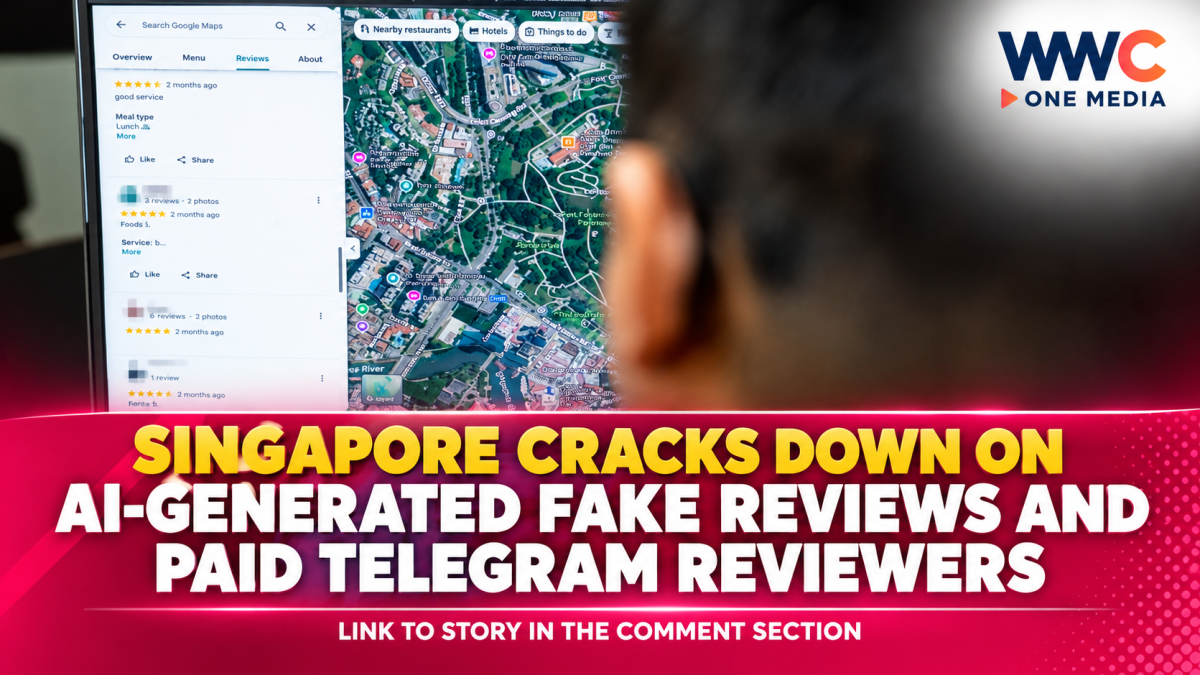
Singapore’s competition watchdog has taken action against a fake-review operation that allegedly used generative artificial intelligence, paid Telegram reviewers and an online dashboard to help businesses manufacture positive online feedback.
The Competition and Consumer Commission of Singapore said the operation, linked to Julian Tung Yan Kai and businesses he operated, provided fake-review services to about 100 businesses. The investigation is being conducted in two phases, with the first involving Tung and 47 businesses.
According to the investigation, businesses could purchase packages of fake reviews for between S$139 and S$219. The reviews were posted across platforms including Google, Facebook, Tripadvisor, Carousell, Yelp and Trustpilot.
Generative AI was reportedly used to make the reviews appear more authentic by varying writing styles, adding Singapore-specific details and introducing imperfections that could make the posts seem like genuine customer experiences. Clients could also edit the AI-generated content before publication.
The operation later introduced an online dashboard that allowed customers to generate, manage and monitor fake reviews. It could use details from existing four- and five-star Google reviews to create additional posts tailored to individual businesses.
Tung also allegedly recruited people through Telegram channels and accounts, offering payment in exchange for posting prepared reviews and ratings. Reviewers were instructed to avoid duplicating content to reduce the chances of detection, while the service also offered replacement reviews when posts were removed by online platforms.
The first phase of the investigation found that 45 businesses admitted purchasing fake reviews. They have committed to stop the practice, remove fake reviews associated with their businesses, report their progress and strengthen their compliance measures.
The businesses must also publish prominent public apologies for six months on their websites, official social media accounts and physical premises or outlets. Tung has likewise committed to stop providing fake-review services and publish an apology on his company’s website for six months. He also agreed to donate proceeds from the fake-review operation to an Institution of a Public Character.
Two of the 47 businesses covered in the first phase declined to provide undertakings on the required terms. The watchdog said investigations into those companies will continue and that stronger enforcement action could follow if supported by the facts.
The case is significant because consumers increasingly rely on online ratings when deciding which businesses and services to trust. The competition watchdog said fabricated reviews can give consumers a misleading impression of a company’s popularity or the quality of its products and services.
The crackdown also highlights how artificial intelligence is making review manipulation more difficult to detect. A separate investigation published recently found that fake-review suppliers were offering payments to individuals to post positive reviews, while experts warned that AI can make fabricated testimonials increasingly polished and convincing.
Under Singapore’s consumer-protection rules, businesses that post or purchase false reviews to deceive or mislead consumers can be treated as engaging in an unfair practice. The latest investigation is now continuing into other businesses that may have obtained fake-review services.