
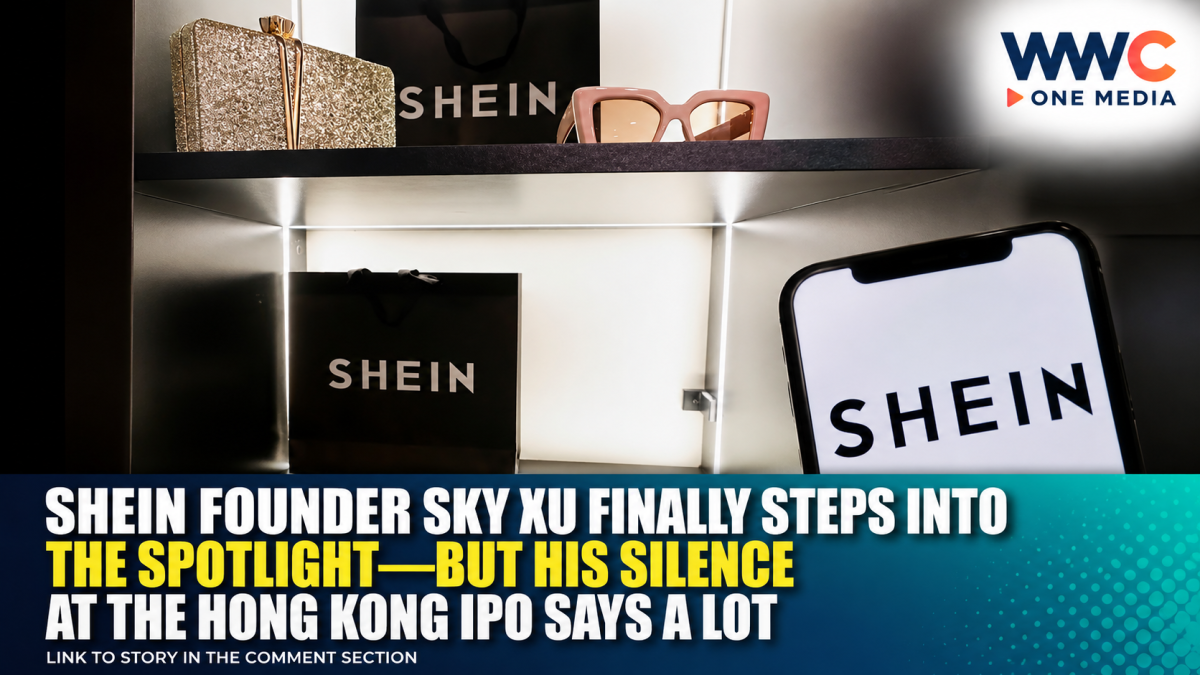
HONG KONG — Shein founder and CEO Xu Yangtian, better known as Sky Xu or Chris Xu, finally appeared at one of the biggest public milestones in his company’s history—but stayed remarkably far from the spotlight.
As Shein began trading on the Hong Kong Stock Exchange on September 1, Xu attended the listing ceremony and later appeared for photographs with employees. But unlike many founders at a major IPO, he did not deliver a speech and did not take part in the traditional gong-striking ceremony that marks the start of trading.
Instead, Shein CFO Leigh Gui represented the company during the ceremony.
The unusually restrained appearance was consistent with Xu’s reputation as one of the world’s most private technology and retail founders. Reuters reported that Xu has long avoided interviews and public appearances, even as Shein grew into a global fast-fashion powerhouse.
A billionaire founder who prefers the shadows
Xu founded Shein in China in 2012 under the name Sheinside, later rebranding the business as Shein in 2015. His background was less traditional fashion executive and more technology entrepreneur, with expertise in software and search-engine optimization helping drive Shein’s data-heavy, supply-chain-focused business model.
That low-profile approach has remained a defining feature of Xu’s public image.
Even during Shein’s long pursuit of a stock-market listing, Reuters described him as an elusive founder who largely stayed away from the public eye. The company had previously explored listings in New York and London before ultimately moving toward Hong Kong.
But the Hong Kong debut represents a major turning point.
Shein’s IPO was far smaller than its $100-billion peak
Shein raised approximately HK$13.6 billion ($1.7 billion) through its Hong Kong IPO by selling 280 million shares at HK$48.56 each.
Yet the company’s market debut underscored how dramatically investor expectations have changed.
Shein was valued at nearly $100 billion in 2022 during its private-market peak. Following its Hong Kong listing, its market value stood at roughly $26 billion—a fraction of that earlier valuation.
The stock also had a rough opening day.
Shares initially fell as much as about 10%, reaching the low-HK$43 range before recovering most of their losses. Shein ultimately closed at HK$48.50, just below its HK$48.56 IPO price.
That muted performance stood in sharp contrast with some of Hong Kong’s recent technology and robotics IPOs, where investor enthusiasm produced much stronger first-day gains.
Why investors are getting more cautious
The weak debut comes as Shein faces a very different business environment from the one that helped propel its valuation toward $100 billion.
The company built its global success around extremely low prices, rapid product launches and a supply chain heavily connected to manufacturers in China. But changes to trade rules, tariffs and low-value import exemptions in major Western markets have increased pressure on its business model.
Shein’s financial performance has also weakened.
Reuters reported that the company generated $41.8 billion in revenue in 2025, up 8%, but net income dropped 39% to about $2.06 billion. In the first quarter of 2026, Shein swung to a $99 million loss, compared with a $395 million profit a year earlier.
The company is also facing continued regulatory scrutiny and criticism surrounding its supply chain, labor practices and environmental impact, while competition from platforms such as Temu continues to pressure the ultra-low-cost online retail market.
From global ambitions back to Hong Kong
Shein’s path to the stock market has been anything but straightforward.
The company originally pursued potential listings in New York and London, but those efforts stalled amid regulatory and political concerns. Hong Kong ultimately became the destination for its long-awaited public debut.
That shift has also coincided with a renewed emphasis on Shein’s Chinese manufacturing roots.
Although Shein moved its headquarters to Singapore, its manufacturing ecosystem remains deeply connected to China. Earlier this year, Xu publicly pledged more than 10 billion yuan ($1.46 billion) over three years to strengthen Shein’s supply chain in Guangdong, highlighting the continuing importance of the region to the company.
The founder’s silence may be the bigger story
For a company whose rise has been built largely behind algorithms, supply chains and an intensely private founder, Xu’s understated Hong Kong appearance was almost perfectly on brand.
He showed up.
He posed with employees.
But he did not make the speech, did not strike the gong and did not turn the IPO into a personal media moment. Reuters reported that he later declined to answer questions from the news agency.
That may have been intentional.
The bigger challenge for Xu now is no longer simply getting Shein onto a stock exchange. It is convincing public-market investors that the company can regain sustainable growth while navigating higher trade costs, tougher regulation and a dramatically lower valuation.
The Hong Kong debut has finally given investors a price for Shein. The question now is whether the market believes that price is a bargain—or a warning.
WWC ONE MEDIA MJE


Leave a Reply