
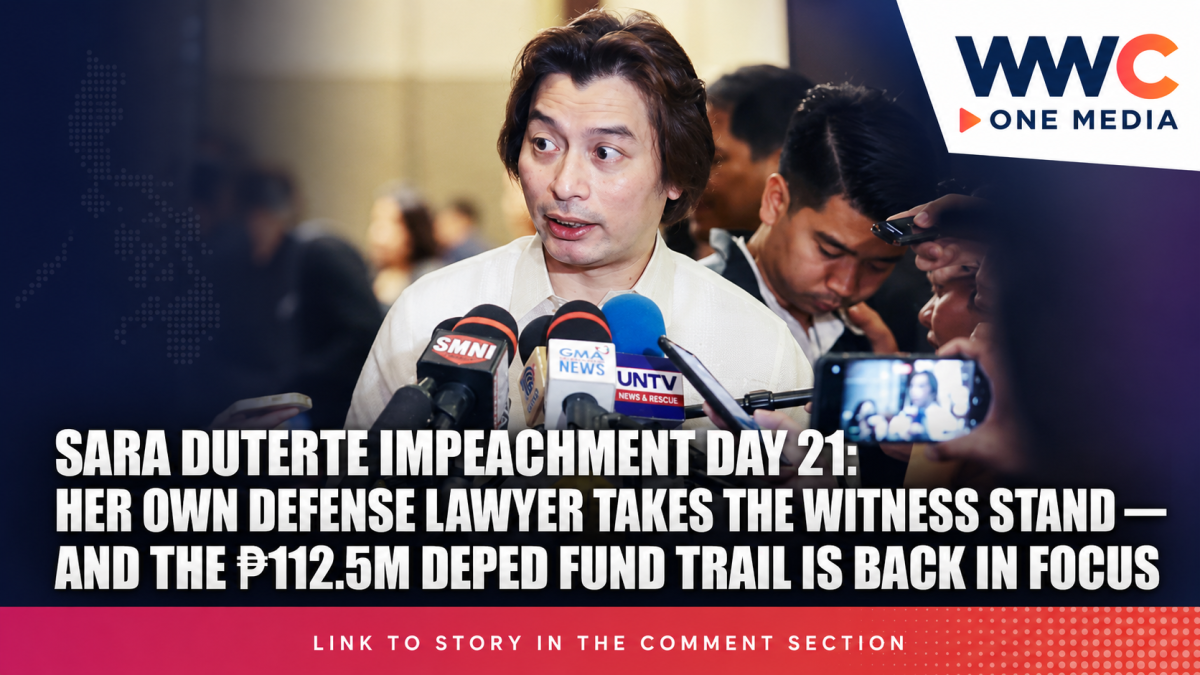
MANILA, Philippines — Day 21 of Vice President Sara Duterte’s impeachment trial is poised to put an unusually significant witness at the center of the Senate courtroom: a lawyer who has been helping defend Duterte but who also worked closely with her when she headed the Department of Education.
Attorney Michael Wesley Poa, a former DepEd official who served as Duterte’s chief of staff and spokesperson, is scheduled to be presented by the House prosecution panel as it continues building its case over the alleged irregular use and liquidation of confidential funds.
Poa has also been serving on Duterte’s impeachment defense team, making his appearance particularly noteworthy. He temporarily stepped away from his spokesperson duties ahead of his expected testimony.
At the time of writing on Wednesday, September 2, Poa and Philippine Statistics Authority official Marizza Grande were still being reported as the prosecution’s next scheduled witnesses.
Why Michael Poa’s testimony matters
The prosecution is expected to question Poa about the ₱112.5 million in confidential funds released to DepEd in 2023, when Duterte was simultaneously serving as Vice President and Education secretary.
That amount forms part of the ₱612.5 million in confidential funds at the heart of Article I of the impeachment case: ₱500 million attributed to the Office of the Vice President and ₱112.5 million to DepEd. The prosecution alleges the money was improperly used or liquidated. Duterte’s defense disputes allegations that the confidential funds were misused.
Poa’s previous position inside DepEd makes his testimony potentially important because senators could question him about what happened when state auditors sought additional documentation supporting some of the department’s confidential expenditures.
One particular issue has already moved to the forefront: ₱15.54 million connected to confidential-fund expenditures and military Youth Leadership Summit activities.
And testimony heard just one day before Poa’s scheduled appearance has made that issue even more closely watched.
Army officers: No DepEd confidential money went to our units
During Day 20 of the trial on September 1, Army officers testified about certifications covering Youth Leadership Summits and related activities conducted in 2023.
Col. Manaros Boransing II told the impeachment court that his Army unit received no money from DepEd, the OVP or the Vice Presidential Security and Protection Group for the activities covered by his certification.
Boransing also said he had not known that his certification would later be used as supporting documentation connected with DepEd’s confidential-fund liquidation.
The Senate impeachment court also heard from Col. Magtanggol Panopio, while the prosecution and defense ultimately agreed on certain facts concerning additional military witnesses, including that confidential funds were not transferred from DepEd to the AFP for the Youth Leadership Summits.
The development does not by itself establish that the ₱15.54 million was illegally spent. That remains part of the dispute the prosecution must prove and the defense is entitled to challenge.
But it creates an obvious question for Day 21:
If the Army certifications established that military activities occurred, what exactly were they intended to prove about DepEd’s confidential-fund expenditures?
That is one reason Poa’s testimony could become one of the more closely scrutinized appearances in the trial.
Then comes the PSA — and the controversial names on the receipts
After Poa, the prosecution is expected to present PSA Assistant National Statistician Marizza Grande.
Her testimony could reopen another explosive portion of the confidential-funds controversy: the identities appearing on acknowledgment receipts submitted in connection with confidential expenditures.
Among the best-known is “Mary Grace Piattos,” a name that became a national talking point during earlier congressional investigations.
The PSA previously reported that it found no birth, marriage or death record for a person under that exact name in its civil registry database.
Grande also testified during an April 2026 House impeachment hearing that searches produced no birth, marriage or death records for names including Mary Grace Piattos, Milky Secuya and Kokoy Villamin. A search for “Irene Tan,” by contrast, produced numerous records because it is a common name.
The prosecution has said it intends to use PSA testimony to support its allegation that some confidential-fund recipients were fictitious.
But there is an important legal and factual distinction.
A negative PSA database search is evidence; it is not automatically a judicial finding that a person is fictitious.
The PSA itself previously noted that further verification could be conducted when additional identifying information — such as parents’ names or the date and place of a vital event — is available.
That distinction could become important when Grande faces questioning from both sides.
More than 1,300 names became part of the impeachment allegation
The scale of the dispute goes well beyond one unusual name.
The Articles of Impeachment allege that 1,322 of 1,992 names of purported OVP confidential-fund recipients submitted for PSA verification did not have corresponding birth records.
The impeachment complaint then alleges that at least ₱254.898 million was recorded as having been disbursed to people whom the complaint characterizes as fictitious.
Those figures are allegations contained in the impeachment case, not findings of guilt by the Senate impeachment court.
That distinction is crucial because the Senate is now hearing the evidence that could either support, weaken or contextualize those allegations.
Defense says absence of proof of identity is not enough
Duterte’s lawyers have consistently contested the prosecution’s broader interpretation of the confidential-fund evidence.
Earlier in the trial, a Commission on Audit witness acknowledged under defense questioning that she could not conclude that a recipient was fictitious merely because a name appeared unusual or humorous.
The defense has also maintained that there was no misuse of the ₱612.5 million in confidential funds and has argued that questions surrounding individual documents must be evaluated within the applicable rules governing confidential expenditures.
Poa himself previously argued during the proceedings that spending ₱125 million within an 11-day period was not, by itself, prohibited under the applicable COA rules — a point a state auditor acknowledged was not specifically barred by the joint circular governing confidential funds.
The prosecution, however, argues that the larger issue is not simply how quickly money was spent but whether expenditures were legitimate, properly documented and connected to authorized confidential activities.
Day 21 could connect two major threads of the case
That is what makes Wednesday’s proceedings more important than an ordinary continuation of witness testimony.
Poa potentially connects the courtroom directly to DepEd’s internal handling of ₱112.5 million in confidential funds.
Grande potentially connects the court to PSA verification of the people whose names appeared on confidential-fund documents.
Together, their testimony could allow prosecutors to connect two questions they have been pursuing throughout Article I:
Where did the money go — and can the documents used to account for it withstand scrutiny?
For Duterte’s defense, the challenge will be to show that the prosecution is drawing conclusions that the underlying documents and witnesses do not actually prove.
And that means Day 21 may ultimately turn less on the strange names that have dominated headlines and more on something far more consequential:
whether prosecutors can establish a credible chain from the release of public money, to its alleged recipients, to the documents used to justify how it was spent.



Leave a Reply