
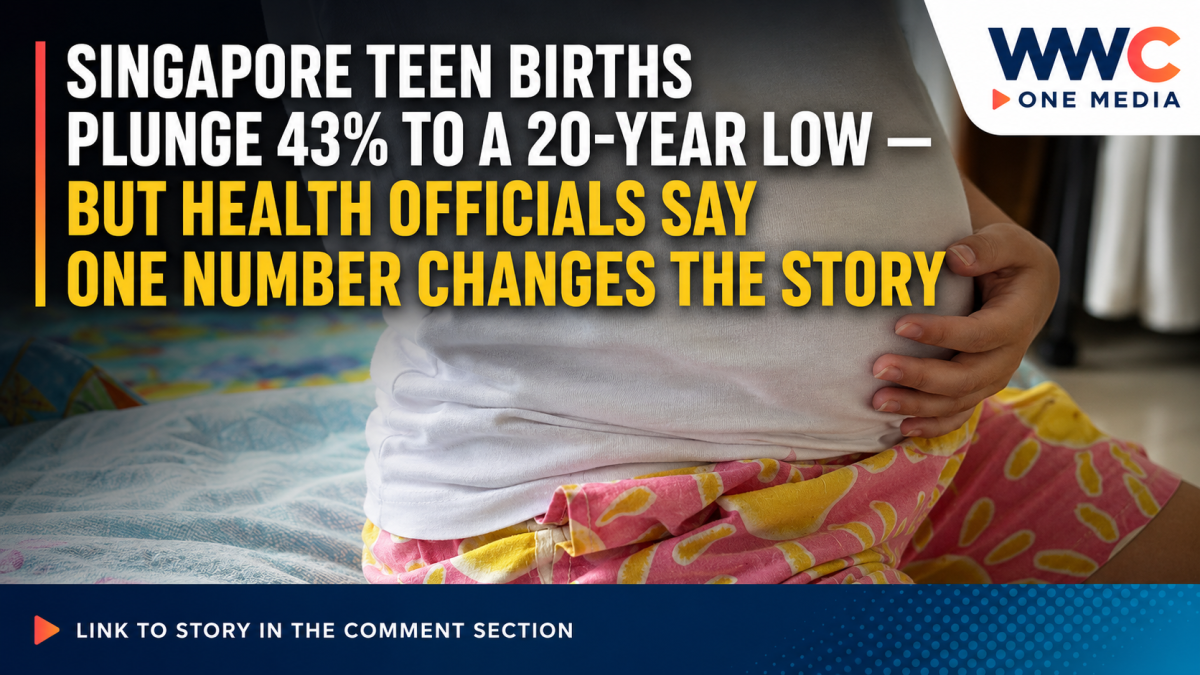
SINGAPORE — Teenage births in Singapore have fallen to their lowest level in more than two decades, marking a dramatic decline that appears encouraging at first glance. But health officials and specialists are urging caution: behind the record-low number are young mothers who may still face isolation, financial pressure, interrupted education and mental-health challenges.
Official figures from the Immigration and Checkpoints Authority show that 140 babies were born to mothers aged 19 or younger in 2025, compared with 244 in 2024. That represents a 42.6% year-on-year decline. ICA defines a teenage birth as one in which the mother is aged 19 or below when the child is born.
The decrease is particularly striking when viewed against the longer-term numbers. ICA recorded 332 teenage births in 2016, followed by 310 in 2017, 289 in 2018, 280 in 2019 and 256 in 2020. The number fell to 224 in 2021 and 218 in 2022 before edging back up to 228 in 2023 and 244 in 2024. Then came the sharp fall to 140 last year.
Channel NewsAsia reported that the latest figure is the lowest in at least 20 years.
But MOH is not calling it a trend yet
There is an important qualification.
Singapore’s Ministry of Health told CNA that teenage live births are already relatively uncommon and that one year of substantially lower figures is not enough to establish a lasting downward trend.
That caution matters because the statistics have fluctuated before. After falling for several years, teenage births rose from 218 in 2022 to 228 in 2023 and then to 244 in 2024 before dropping sharply in 2025.
Another figure complicates the picture: MOH said the incidence rate of abortions among teenagers has remained broadly unchanged over the past five years at about two per 1,000 teenage females. In other words, the fall in live births should not automatically be interpreted as proof that teenage pregnancies themselves have fallen at exactly the same rate.
Earlier MOH data also showed that the number of teenagers aged 19 and below seeking obstetric care declined from about 600 in 2018 to around 500 in 2022, although the ministry said it does not track the total number of pregnancies confirmed across Singapore.
The drop comes as Singapore records fewer births overall
The teenage-birth figures are emerging during a much broader demographic shift.
Singapore registered 29,864 live births in 2025, down 11.4% from 33,703 in 2024 — the first time the annual number fell below 30,000 in the post-independence period.
Singapore’s resident total fertility rate also dropped to a record 0.87 in 2025, adding to long-running concerns over population ageing and the country’s shrinking pool of younger residents.
But experts stress that teenage motherhood poses a very different set of policy and social challenges from Singapore’s broader effort to encourage adults to marry and have children.
Becoming a mother while still growing up
Dr Cassandra Cheong, a consultant in obstetrics and gynaecology at KK Women’s and Children’s Hospital and leader of KKH’s Clinic for Adolescent Pregnancy, told CNA that teenage pregnancy can overlap with problems ranging from unstable relationships and disruptions to education to financial hardship, poor sexual-health knowledge and mental-health difficulties.
Teenagers may also delay seeking medical attention because they do not recognise the signs of pregnancy, are frightened of how their families will react or fear being judged.
That delay can have consequences. Early antenatal care allows doctors to monitor both mother and baby, identify complications and provide nutritional, psychological and social assistance. Waiting until a pregnancy is advanced can reduce the range of interventions available.
The challenge is not simply medical. Teenagers are still developing skills involving independence, planning and decision-making while suddenly having to handle appointments, money, education, childcare and the responsibilities of parenthood.
For young mothers, family reaction can change everything
CNA highlighted the experience of Jannyce Lim, who became a mother at 19.
She faced disapproval from some relatives and experienced postpartum depression, while her husband was still studying and could provide limited support. Her mother, however, helped care for the baby and assisted financially when Ms Lim struggled to maintain stable employment.
Because she married before turning 21, Ms Lim also went through a mandatory marriage preparation programme. That connected her with a counsellor from Fei Yue Community Services, providing another source of support during her transition into motherhood.
Her experience illustrates what specialists say can be one of the biggest dividing lines for teenage parents: whether they have adults around them who respond with support rather than rejection.
More than 200 pregnancy-related enquiries a year
Community organisations are also dealing directly with young people confronting pregnancy.
Babes Pregnancy, which provides crisis support for teenagers, receives more than 200 pregnancy-related enquiries annually through its 24-hour helpline, according to CNA.
Its social workers can help young mothers find temporary housing when returning home is not possible, stay in education, cover transportation expenses and obtain essentials such as diapers and milk powder after childbirth.
The organisation argues that assistance cannot end once the baby arrives. A teenager may still have to rebuild her education, employment prospects, relationships and financial stability while simultaneously learning to raise a child.
That is why advocates are pushing against defining someone entirely by the label “teen mum”.
Sex education remains part of the debate
Prevention is another major part of the discussion.
Dr Cheong said sexuality education should cover not only reproductive biology but also healthy relationships, consent and contraception, while young people need to know they can ask questions without being shamed.
Singapore’s Ministry of Education told CNA that sexuality education is provided through Character and Citizenship Education and, at secondary-school level, through subjects including Science and Biology.
Students are taught about healthy relationships, consent, legal protections, contraception, sexually transmitted diseases, teenage pregnancy, abortion and risks associated with inappropriate online interactions. MOE said the curriculum promotes abstinence before marriage while also providing factual information about contraception and disease prevention.
For teenagers considering terminating a pregnancy, MOH said mandatory pre-abortion counselling is provided by trained counsellors, with additional referrals to family service centres or helplines where further assistance is required.
The number may be historic. The challenge isn’t over.
At 140 teenage births, Singapore has reached a milestone that would have seemed unlikely when more than 300 such births were still being recorded annually less than a decade ago.
But declaring the problem solved would go beyond what the available evidence can support.
MOH’s warning is significant: 2025 is a single year’s figure, and it will take additional data to establish whether the sharp fall represents a sustained structural decline rather than an unusually low year.
For policymakers, doctors and social workers, the more immediate question therefore extends beyond how many teenagers become mothers.
It is what happens to the ones who still do.
And experts say the answer may depend heavily on whether a frightened teenager encounters judgment and isolation — or a safe place to ask for help before her choices become even harder.
WWC ONE MEDIA MJE




Leave a Reply