
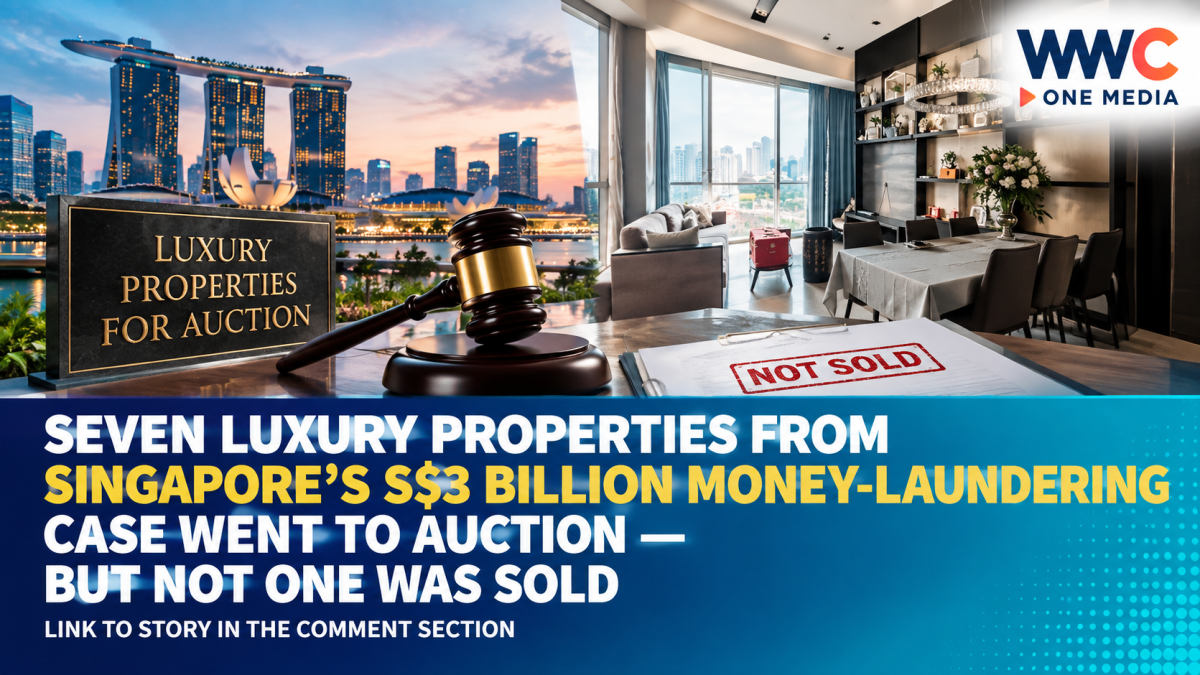
SINGAPORE — September 17, 2026 — The first luxury properties put up for auction from Singapore’s landmark S$3 billion money-laundering case attracted a packed room and dozens of bidders on Thursday — but every single property left the auction unsold.
Seven forfeited assets went under the hammer at Knight Frank’s Ocean Financial Centre office: four luxury apartments at Gramercy Park, two units at Sloane Residences, and a Grade A office at Suntec Tower One. Guide prices stretched from around S$3.6 million to S$11.5 million.
Yet despite 65 members of the public attending, including about 30 registered bidders, none of the seven properties managed to clear its required reserve price.
That is the crucial distinction behind Thursday’s result.
There was interest. There were bids. But a bid does not become a sale unless it reaches a price the seller is authorised to accept.
And that did not happen once.
One S$7.55 Million Gramercy Unit Drew Bids — But Stopped at S$6.7 Million
The closest contest came at Gramercy Park, the 174-unit freehold luxury development along Grange Road.
Four forfeited apartments there carried guide prices ranging from S$3.8 million to S$7.6 million. The development, completed in 2016, features private lifts and sits near Singapore’s Orchard Road luxury residential belt.
A 2,659 sq ft apartment on the 17th floor opened around S$7.55 million.
The first offer came in at just S$4 million, drawing laughter from some people in the room. Bidding then accelerated, eventually climbing to S$6.7 million.
But that still was not enough.
The property was withdrawn because the highest bid failed to reach the undisclosed reserve price.
Another Gramercy Park unit — a two-bedroom-plus-study apartment on the 21st floor — generated one of the afternoon’s liveliest bidding battles.
A bidder started with a counter-offer of S$3.2 million against an opening level of about S$3.82 million. Three bidders then competed, pushing the offer up to S$3.75 million after roughly 10 bids.
Again, the hammer did not fall.
The reserve was not met, although the auctioneer said Knight Frank would take discussions “offline” with the highest bidder.
Other Multi-Million-Dollar Homes Got No Bid at All
Not every property attracted that level of enthusiasm.
A larger Gramercy Park apartment of about 2,691 sq ft opened at S$7.5 million but received no bid.
Another 2,185 sq ft unit, opening at about S$6.3 million, also drew no offers.
The two apartments at Sloane Residences, a boutique 52-unit freehold development on Balmoral Road, had guide prices of roughly S$3.6 million and S$3.7 million.
Each measured 1,249 sq ft and came with a private lift.
Neither received a bid.
That means four of the six residential properties at Thursday’s auction attracted no successful competitive run at all, despite the unusual publicity surrounding their origins.
Even the S$11.5 Million Suntec Office Failed to Sell
The only commercial property tied to the case at Thursday’s Knight Frank auction was a 3,498 sq ft fitted Grade A office at Suntec Tower One.
It carried a guide price of S$11.5 million and opened at S$11 million.
The only counter-offer was S$8 million.
That was rejected as insufficient, and the office was withdrawn.
The result is particularly notable because the auction had attracted considerable attention before it even started.
Knight Frank had warned beforehand that publicity surrounding the criminal case could increase turnout — while stressing that curiosity should not be confused with actual purchasing demand.
Thursday demonstrated exactly that.
The room was crowded.
The sale sheet remained empty.
Why Didn’t the Properties Simply Go to the Highest Bidder?
Because an auction’s guide price and reserve price are not the same thing.
The guide price is broadly a marketing indication designed to attract buyers. It takes into account comparable sales, location, tenure, property condition and market conditions.
The reserve price, by contrast, is the minimum amount the seller has authorised the auctioneer to accept.
If bidding stops below that threshold, the property remains unsold — even if somebody has made the highest offer in the room.
Knight Frank’s Tan Tee Khoon explained ahead of the auctions that an unsuccessful auction does not automatically mean the seller will later accept a lower price. The property can instead be offered again or discussions can continue through a private-treaty negotiation.
That appears to be one of the possibilities now.
Knight Frank auction director Tricia Tan said after Thursday’s event that the agency would seek instructions from the authorities on whether it could negotiate privately with bidders or whether the properties should return to auction.
And Thursday Was Only Round One
The seven properties were just the first wave.
More than 80 forfeited properties connected to the S$3 billion money-laundering investigation are scheduled to be progressively put up for sale between September 2026 and the middle of 2027.
Another 19 properties are due to be auctioned on September 23 through Edmund Tie & Company and SRI.
Those auctions will bring even more expensive homes onto the block.
Among them is a 6,727 sq ft, four-bedroom penthouse at South Beach Residences with a guide price of about S$25.32 million — currently the most expensive of the first batch of seized properties publicly listed for auction.
Five South Beach Residences units have guide prices ranging from roughly S$4.45 million to S$25.32 million.
ETC is also offering two units at 8 Saint Thomas, one unit at Paterson Suites, and a four-storey factory at Shun Li Industrial Park.
SRI, meanwhile, will auction four units at Wallich Residence and six at Martin Modern, with guide prices beginning from S$2.238 million.
So Thursday’s zero-sale result will immediately raise another question:
Will buyers behave differently when even more prestigious — and in some cases dramatically more expensive — assets come up next week?
This Is About Recovering Criminal Assets, Not Just Selling Condos
The properties originate from the massive police investigation launched with islandwide raids in August 2023.
Authorities uncovered an international network involving illicit proceeds from overseas gambling activities, with money routed into assets including Singapore property, luxury vehicles, watches, jewellery, cryptocurrency and cash.
Ten people were prosecuted and received prison sentences ranging from 13 to 17 months.
All 10 were subsequently deported after completing their sentences and barred from re-entering Singapore.
The courts ordered approximately S$944 million of assets linked to those 10 offenders forfeited to the state.
But the asset recovery operation ultimately became significantly larger.
Singapore’s Ministry of Home Affairs said that by the end of December 2024, approximately S$2.79 billion in assets linked to the wider case had been surrendered to the state.
About S$1.54 billion consisted of cash or financial assets, with the remainder comprising non-cash assets such as properties, vehicles and luxury goods.
That explains why liquidation is continuing years after the original raids.
Luxury Handbags and Jewellery Are Being Sold Too
Real estate is only one part of the disposal operation.
More than 1,000 luxury items linked to the case are also being sold, including jewellery, watches and designer handbags.
The first online auctions launched earlier this month included 338 handbags and accessories and 286 pieces of fine jewellery. Among the headline items was a 15.02-carat fancy yellow diamond ring.
Potential buyers had already submitted more than S$1.3 million in bids for luxury goods during the early stage of those auctions, according to The Straits Times.
That creates an interesting contrast with Thursday’s property auction.
Luxury bags and jewellery have attracted active online bidding.
Multi-million-dollar real estate requires a dramatically larger financial commitment — and buyers appear willing to negotiate hard.
Where Does the Money Go?
The proceeds do not return to the convicted offenders.
The Singapore Police Force appointed Deloitte Singapore to manage and realise the forfeited non-cash assets, with proceeds ultimately flowing into the government’s Consolidated Fund.
The Consolidated Fund receives government revenues and is used to finance public expenditure.
So every handbag, diamond, car or condominium successfully liquidated effectively converts a confiscated asset into funds held by the state.
That makes the reserve-price issue important.
Authorities are not simply trying to dispose of the assets as quickly as possible at any price. The auction process also aims to realise appropriate value for property that has already been forfeited.
The First Auction Delivered a Different Message Than Expected
Ahead of Thursday, much of the attention centered on whether Singaporeans would rush to buy luxury homes carrying one of the country’s most notorious criminal backstories.
The answer was more complicated.
People certainly came.
Some bidders were willing to put millions of dollars on the table.
One Gramercy Park apartment drew offers up to S$6.7 million.
Another generated a three-way contest up to S$3.75 million.
But buyers and sellers remained millions — or hundreds of thousands — of dollars apart in some cases.
And several properties received no bids whatsoever.
That supports an observation Knight Frank made before the event: an auction listing does not automatically mean a bargain.
The biggest test now comes on September 23.
With a S$25.3 million South Beach penthouse, Wallich Residence apartments, Martin Modern units and several other luxury homes still coming to market, Singapore’s effort to turn the proceeds of its biggest money-laundering scandal back into public funds is only beginning.
Thursday proved that the assets may be forfeited.
Finding buyers willing to meet the government’s price is another matter entirely.




Leave a Reply