
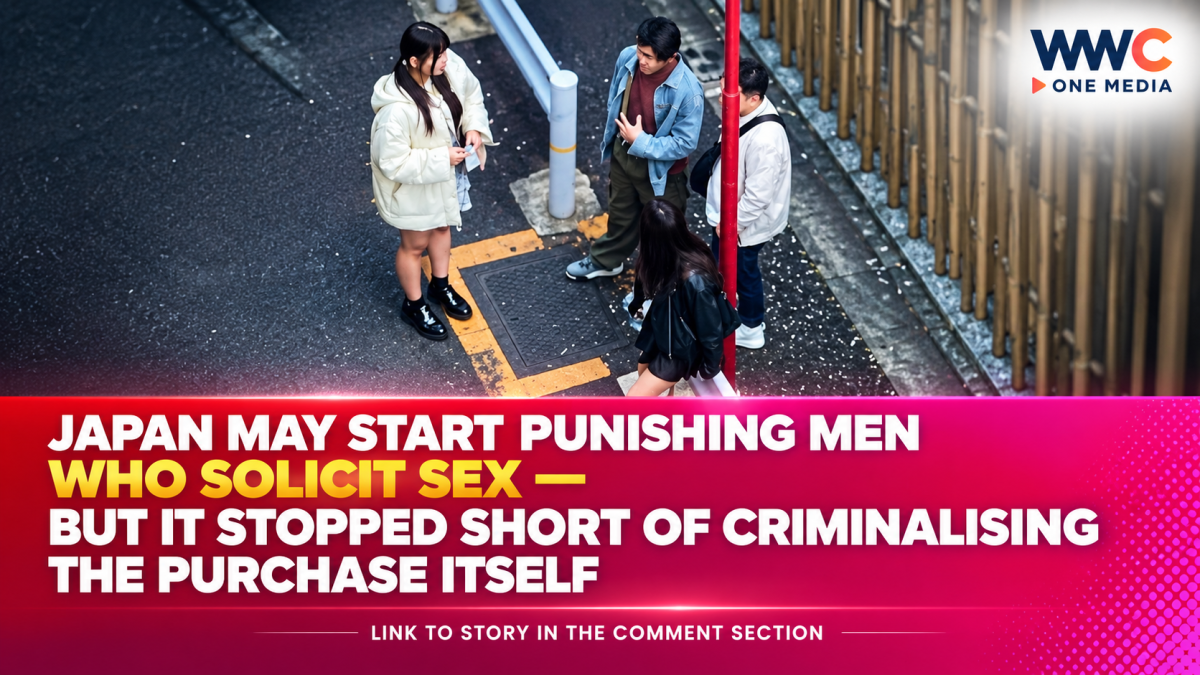
Japan is moving toward one of the biggest changes to its prostitution laws in decades, with a Justice Ministry expert panel recommending that people seeking to buy sex should face punishment for solicitation, ending a system under which street sellers can be prosecuted for seeking customers while buyers generally cannot be punished for doing the reverse.
The panel finalized its report on September 17, concluding that buyer-side conduct such as approaching someone to negotiate paid sex should be regulated. It also said online solicitation could be included under a revised law.
The recommendation comes amid growing concern over highly visible street prostitution in areas including Tokyo’s Kabukicho district, particularly around Okubo Park, as well as exploitation linked in some cases to debt at host clubs.
But the headline needs an important qualification.
Japan is not yet proposing simply to arrest everyone who pays for sex.
The expert panel drew a distinction between soliciting a seller and the act of purchasing sex itself.
A majority of members said criminalizing the transaction itself required greater caution, including because of legal questions surrounding consensual sexual activity between adults and concerns that tougher criminalization could push the industry further underground.
That distinction could ultimately define Japan’s reform.
The Current Law Already Says Both Sides Should Not Participate — But Only One Side Can Be Punished for Soliciting
Japan’s Prostitution Prevention Act was enacted in 1956.
Its basic language is broader than many people realize.
Article 3 says that nobody shall engage in prostitution or become the other party to it.
But the law does not create a straightforward criminal penalty simply for the consensual act of buying or selling sex between adults.
Instead, the criminal provisions target specific conduct surrounding prostitution.
One of those provisions is Article 5.
Under the current statute, someone who publicly solicits customers for the purpose of prostitution, waits for customers in public or uses advertising or similar methods to attract them can face up to six months of imprisonment or a fine of up to ¥20,000.
The problem identified by the government panel is the imbalance.
That provision is structured around someone offering prostitution and soliciting a customer.
There is no equivalent provision specifically punishing the potential customer who walks around looking for a seller, approaches one in public or posts online seeking paid sex.
The panel said that imbalance should be corrected.
Even Walking Around Looking for Sellers Could Come Under Scrutiny
The recommendations potentially go beyond a buyer directly asking someone for sex.
TV Asahi reported that panel members discussed making punishable conduct such as wandering around an area for the purpose of searching for people selling sex, responding to solicitation and approaching sellers.
Online activity could also be covered.
The final report said buyer solicitation conducted through the internet or social media should be considered for regulation alongside approaches made on streets.
That creates a difficult enforcement question.
How would police prove that someone walking through an entertainment district was specifically searching for prostitution?
Panel members themselves warned that legislation would need to define prohibited conduct clearly enough to avoid punishing people who had no intention of buying sex.
That means the eventual statutory wording could be much narrower than the broad concept currently being discussed.
The ¥20,000 Fine Could Also Be Increased
The reform is not limited to customers.
The panel also concluded that existing financial penalties for prostitution-related offenses may be too low to provide a meaningful deterrent.
Under the existing law, solicitation under Article 5 carries a maximum fine of just ¥20,000, alongside the possibility of up to six months in custody.
That amount reflects a statute originating in the 1950s.
The panel said the upper limits on fines should be reviewed and increased, although final new amounts have not yet been established.
That could become another substantial part of the eventual amendment.
What Japan Is Not Doing: Full ‘Nordic Model’ Reform
Some advocacy groups have pushed Japan toward a more radical restructuring commonly associated with the Nordic model.
Under versions adopted in countries such as Sweden, Norway and France, selling sex itself is generally not criminalized while purchasing sex is.
Supporters argue that the approach treats people selling sex primarily as people vulnerable to exploitation and shifts criminal responsibility toward demand.
Critics argue that criminalizing clients can drive transactions into less visible environments and potentially increase risks for sex workers.
Japan’s panel did not recommend fully adopting that model.
CNA reported that members stopped short of recommending decriminalization of seller-side conduct altogether, while also declining to recommend blanket criminalization of buying sex.
The panel therefore appears to be heading toward a more limited reform:
make solicitation rules apply more evenly to both sides while preserving much of the existing legal structure.
Japan Also Chose Not to Expand Its Narrow Legal Definition of Prostitution
Another major issue was left largely untouched.
Japan’s law defines prostitution as having intercourse with an unspecified person in exchange for payment or a promise of payment.
That legal definition has long been criticized as unusually narrow because it does not automatically treat every paid sexual service as “prostitution” under this specific statute.
The panel considered whether the definition should be broadened to cover additional sexual acts but did not recommend doing so.
Members expressed concern about how far the state should intervene in private consensual sexual activity.
So even if the law changes, Japan’s wider adult-entertainment regulatory landscape is unlikely to be transformed overnight.
Why Is Japan Changing the Law Now?
The most visible pressure point has been Tokyo’s Kabukicho entertainment district.
Street solicitation around Okubo Park became increasingly prominent in recent years, drawing stronger police enforcement and national attention.
Tokyo police arrested 140 women for alleged prostitution-related solicitation in Shinjuku in 2023, nearly three times the previous year’s total. The Japan Times reported that 43% of those arrested said they were trying to earn money to pay for host clubs or underground male idols.
The problem persisted.
Separate police reporting cited by Japanese media showed more than 100 women and girls being cited or arrested around Kabukicho during 2025, while enforcement continued into 2026.
Those cases increasingly raised an awkward question:
Why were women standing on the street being arrested while men coming to the same locations looking to purchase sex generally faced no comparable prostitution-law penalty?
That disparity helped push the issue into national politics.
Host-Club Debt Added Another Layer to the Debate
Street prostitution in Kabukicho has also become intertwined with Japan’s crackdown on abusive host-club practices.
Host clubs are entertainment businesses where primarily female customers pay male hosts for conversation, drinks and attention.
Most operate legally.
But authorities have documented cases in which women accumulated enormous unpaid bills and were subsequently pressured to earn money through prostitution or the commercial sex industry.
Japan’s National Police Agency explicitly warns that some malicious host clubs have exploited customers’ emotional attachment, placed them under heavy debt and effectively forced them toward prostitution or sex-industry work.
The Health Ministry has likewise reported receiving consultations from women and families dealing with debts incurred through host clubs and cases involving prostitution to repay those obligations.
Japan tightened regulation of abusive host-club practices in 2025.
By 2026, police said they had pursued dozens of cases involving malicious operators and carried out more than 1,000 inspections of host-club premises during the previous year.
The prostitution-law reform therefore fits into a broader government effort aimed at exploitation surrounding Tokyo’s nightlife economy.
But Advocates Say Punishing Sellers Still Creates a Serious Problem
Some survivor and support groups argue that simply adding penalties for customers does not go far enough.
A woman identified by the pseudonym Risa, speaking through the survivor organization Toka, told AFP that people selling sex may avoid reporting violence or abuse to police if they themselves remain vulnerable to prosecution.
She argued that poverty, trauma, disability and other circumstances can narrow what appears to be a voluntary choice to enter prostitution.
Another survivor advocate quoted by AFP described entering street prostitution as a teenager after experiencing abuse and homelessness.
The panel acknowledged those competing perspectives but ultimately did not support eliminating seller-side solicitation penalties.
According to the earlier draft, some members supported removing those provisions because many people involved in prostitution need social assistance rather than punishment.
A majority, however, supported retaining the prohibition, in part because they feared eliminating it could be interpreted as government acceptance of prostitution.
That means Japan’s reform could reduce one legal imbalance without ending the deeper debate over how the state should treat people selling sex.
The Government Has Been Studying This Since March
The overhaul did not emerge suddenly.
Prime Minister Sanae Takaichi instructed Justice Minister Hiroshi Hiraguchi in November 2025 to examine whether buyers should face penalties, after lawmakers raised concerns over the unequal treatment of buyers and sellers.
The Justice Ministry established an expert panel this year.
Its first meeting was held on March 24, 2026, and subsequent sessions examined Japan’s current law, foreign legal systems, support for people involved in prostitution and possible criminal penalties.
The group included experts from the criminal justice and legal fields.
By August, members had broadly agreed that leaving buyers entirely outside the solicitation provision lacked balance.
September 17’s final report turned that emerging consensus into a formal recommendation.
Prosecutors Were Already Handling Hundreds of Prostitution-Law Cases Before the Reform
Justice Ministry figures cited when the panel began its work show that prosecutors handled 634 suspected violations of the Prostitution Prevention Act in 2024.
Of those, 301 involved solicitation, the largest category.
Another 135 involved providing locations for prostitution, while 133 involved mediation or arranging prostitution.
Those numbers show why the proposed buyer-side rule could matter in practice.
Solicitation is already one of the most frequently used sections of the law.
Changing who can be prosecuted under that provision could materially alter enforcement.
A Bill Could Come as Soon as This Autumn — But Nothing Has Changed Yet
The panel’s September 17 report is a recommendation.
It is not yet law.
Japan’s Justice Ministry will now use the findings to examine amendments to the Prostitution Prevention Act.
Kyodo reported that the ministry is considering moving quickly enough to potentially submit legislation during the extraordinary Diet session this autumn.
Until legislation actually passes and takes effect, however, the current rules remain in force.
That means buyers have not suddenly become criminally liable nationwide simply because the panel released its report.
The exact prohibited conduct, fines and enforcement standards still have to be written into legislation and approved by parliament.
The Biggest Change May Be Who Police Look At
For decades, Japan’s prostitution law has created an unusual enforcement picture.
The statute declares that neither side should participate in prostitution.
But on the street, one side can be arrested for openly searching for customers while the person searching for that seller has no equivalent buyer-solicitation offense.
The Justice Ministry panel now wants that imbalance addressed.
If lawmakers follow through, a man walking around Kabukicho specifically looking to buy sex, directly approaching sellers or posting online to solicit prostitution could eventually face legal consequences similar in principle to those faced by people publicly seeking customers.
But Japan is stopping short — at least for now — of the much bigger step of criminalizing every purchase while decriminalizing every seller.
That makes this less than a complete rewrite of Japan’s sex-work laws.
But after 70 years, it could still fundamentally change which side of a street transaction police are allowed to arrest.




Leave a Reply