
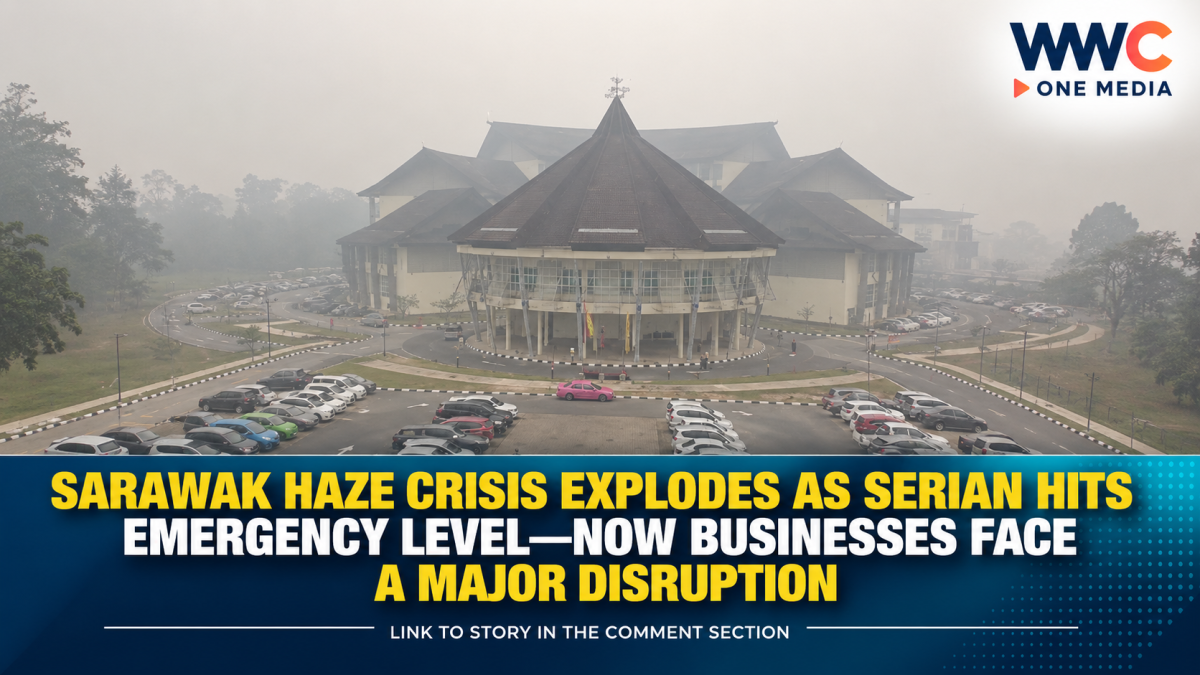
KUCHING, Malaysia — A worsening haze crisis has pushed Malaysia’s Sarawak state into an emergency situation, with Serian Division recording an Air Pollutant Index (API) above 500, forcing authorities to impose extraordinary measures as smoke from fires in neighbouring Indonesian Kalimantan continues to blanket parts of Borneo.
The emergency declaration came after Serian’s API climbed to 515 at 5pm on Sept. 4, after reaching 510 earlier in the day. Under Malaysia’s air-quality classification, readings above 400 are considered very hazardous.
The emergency is limited to Serian Division, rather than the whole of Sarawak.
And authorities are warning residents not to treat the situation as an ordinary bout of seasonal haze.
Emergency measures put businesses on alert
The declaration allows authorities to impose stronger restrictions on activities in the affected area.
Sarawak Deputy Premier Douglas Uggah Embas said government and private-sector offices in Serian would be closed during the emergency, while essential services such as supermarkets, petrol stations, banks and security forces would continue operating.
The emergency is not intended as a COVID-style lockdown, officials stressed. Instead, the objective is to keep people indoors and reduce exposure to dangerously polluted air. The emergency is expected to remain until the API falls below 500 and the federal government lifts the declaration.
For local businesses, that could mean reduced foot traffic, disrupted working hours and continued pressure on employees and customers who must travel outdoors.
Kuching is also being hit
Serian may have crossed the emergency threshold, but the problem extends well beyond the district.
Kuching, Sarawak’s capital, recorded an API reading of about 306 on Sept. 4, while Samarahan reached 292 and Sri Aman 241, according to CNA’s reporting.
Sarawak’s own Natural Resources and Environment Board had already recorded severe conditions across multiple locations, including Lundu at 322 and Lubok Antu at 470 on Sept. 3.
The figures show how widespread the pollution has become across the state.
Schools are closing as the haze worsens
The crisis is also disrupting education.
Schools in 12 Sarawak districts are scheduled to remain closed from Sept. 7 to Sept. 11 because of the hazardous conditions, affecting hundreds of thousands of students. Home-based teaching and learning will be implemented during the closures.
The closures underline how seriously authorities are treating the health risks posed by the polluted air.
Residents describe conditions as unbearable
CNA spoke to residents in Serian who described the current haze as the worst they have experienced in years.
One resident told the broadcaster that she experienced difficulty breathing and eye irritation, while families with respiratory problems have been particularly affected. Demand for protective masks has also surged, with a pharmacy in Serian reporting that supplies, including N95 masks, had sold out.
The impact is therefore reaching beyond government statistics.
Restaurants, shops and other businesses are dealing with fewer customers, while workers and families are being urged to minimize unnecessary exposure outdoors.
Where is the smoke coming from?
The immediate source of much of the haze is forest and peatland fires in Indonesia, particularly in Kalimantan on the same island as Sarawak.
Prevailing winds have carried smoke across the border into Malaysian territory, while haze has also spread to other parts of Southeast Asia.
The ASEAN Specialised Meteorological Centre reported moderate smoke plumes originating from hotspots in southern Kalimantan as well as southern and central Sumatra on Sept. 4.
Indonesia is facing its own serious firefighting challenge.
Authorities have deployed large numbers of personnel to combat fires in affected areas, with West Kalimantan among the hardest-hit regions. Indonesian disaster officials said thousands of hectares have been affected and that smoke has reduced visibility in some areas.
Indonesia says it is stepping up regional cooperation
Jakarta has also emphasized that it is working with neighbouring countries through ASEAN mechanisms to address the transboundary impact of the fires.
Indonesia’s Foreign Ministry said the government continues coordinating with neighbouring countries while implementing measures under the ASEAN Agreement on Transboundary Haze Pollution.
The issue is particularly sensitive because the smoke does not stop at national borders.
Malaysia, Brunei, Singapore and the Philippines have all experienced effects from the regional haze episode.
Malaysia has already tried cloud seeding
Before the emergency declaration, Sarawak launched a three-day cloud-seeding operation beginning Sept. 3.
The operation targeted three hydroelectric dams and 13 water catchment areas, with authorities hoping rainfall would both reduce airborne pollutants and replenish water supplies ahead of potentially hotter and drier conditions.
But cloud seeding has an important limitation: it cannot create rain without suitable clouds and atmospheric conditions.
That makes sustained natural rainfall the more important factor in determining how quickly the haze crisis can ease.
The bigger concern: September could get worse
Perhaps the most worrying development is that authorities are not certain the crisis has peaked.
CNA reported that Indonesia’s Forestry Minister Raja Juli Antoni warned that September could be a crucial month, with meaningful rainfall potentially not returning until early October.
The country’s 2026 fires have already surpassed the area burned during the same period in 2019, although they remain well below the catastrophic scale of the 2015 fire season.
Experts have linked the difficult conditions to a combination of El Niño-related dryness, the seasonal dry period, peatland vulnerability and human-caused fires.
That combination could make the coming weeks particularly challenging.
The haze is becoming a regional problem
The situation is no longer just a Sarawak story.
Air-quality problems have been reported across parts of Malaysia and Indonesia, while haze has also reached Singapore and the Philippines. IQAir reported poor air quality across large areas of Southeast Asia and warned that prevailing winds could continue carrying smoke from Kalimantan toward western Sarawak and the central Philippines.
The Philippines has already reported haze potentially associated with Indonesian fires, with the DENR’s Environmental Management Bureau saying smoke may have been transported toward the country by prevailing winds.
What happens next?
For Serian, the immediate priority is straightforward: keep exposure down and wait for air quality to fall below the emergency threshold.
But the bigger question is whether the region can get enough sustained rainfall to break the cycle of fires and smoke.
Malaysia can restrict activities, close schools and conduct cloud seeding. Indonesia can deploy firefighters and aircraft and strengthen enforcement. ASEAN can coordinate regional responses.
But until the fires are brought under control and weather conditions change, the smoke can keep crossing borders.
For residents of Sarawak, the emergency declaration is therefore not simply a government announcement.
It is a warning that the region’s haze problem has reached a level where daily life, schools and businesses can no longer continue as normal.
And with September potentially bringing even more challenging fire conditions, the most difficult chapter of this haze crisis may not have arrived yet.
WWC ONE MEDIA M.J.E




Leave a Reply