
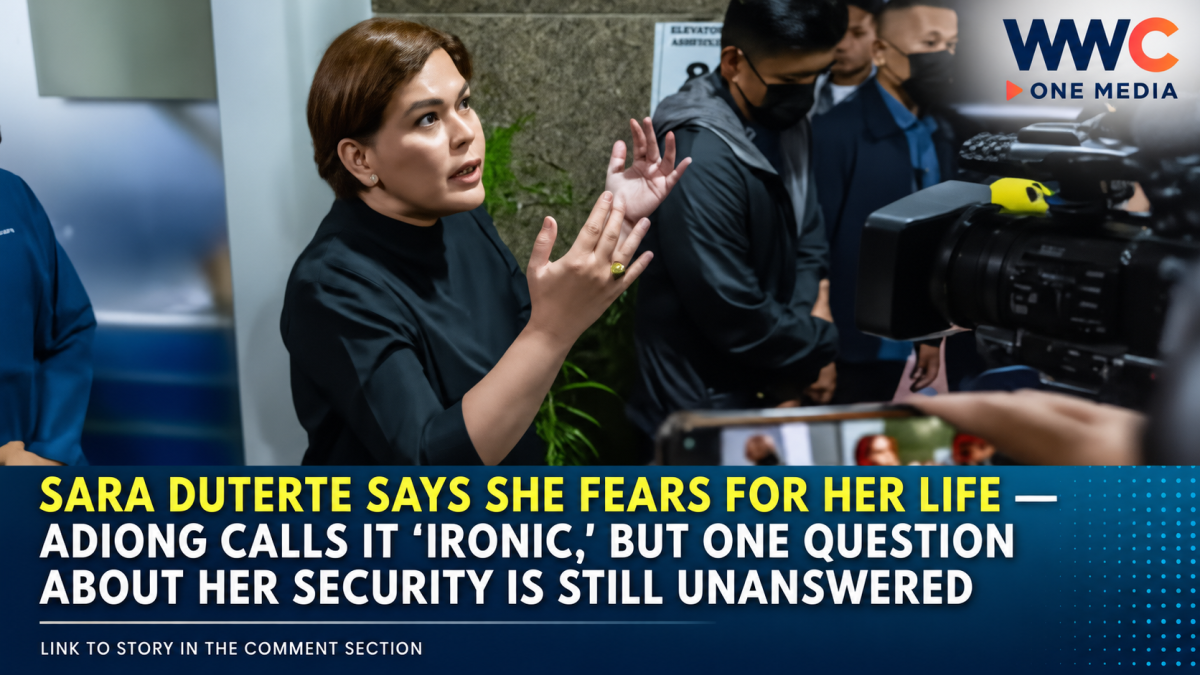
MANILA, Philippines — Vice President Sara Duterte’s declaration that she fears for her life has opened another volatile front in her escalating legal and political confrontation with the Marcos administration, with a House impeachment prosecutor questioning what he described as the “irony” of her security concerns while she herself faces criminal charges involving alleged threats.
Lanao del Sur Rep. Zia Alonto Adiong, spokesperson for the House prosecution panel in Duterte’s ongoing impeachment trial, criticized the vice president on Sunday after she publicly said she did not trust the police or courts and feared for her own safety and that of her children.
Adiong’s argument was pointed: Duterte made her remarks while appearing at the Quezon City Hall of Justice to post bail on three counts of grave threats connected to statements she made about President Ferdinand Marcos Jr., First Lady Liza Araneta-Marcos and then-House Speaker Martin Romualdez.
But while Duterte’s opponents are questioning her narrative, the Philippine National Police says it will continue assessing her security—and Senate President Sherwin Gatchalian says any possible threat against the vice president should be taken seriously regardless of politics.
That distinction is important.
Adiong’s description of Duterte’s position as “ironic” is a political criticism, not a finding that her safety concerns are false.
Why Adiong says the situation is ‘ironic’
Duterte posted ₱360,000 bail on September 5, one day after Quezon City Regional Trial Court Branch 98 issued a warrant for her arrest.
The court set bail at ₱120,000 for each of the three counts after finding probable cause to hold her for trial. An arrest warrant based on probable cause, however, is not a determination of guilt. Duterte retains the presumption of innocence and may challenge the allegations during the proceedings.
The criminal charges trace back to Duterte’s highly controversial November 2024 online press conference.
During that appearance, Duterte said she had spoken with a person and instructed that Marcos, his wife and Romualdez be killed if Duterte herself were killed. Prosecutors later treated the statements as alleged grave threats.
Duterte has denied that she threatened the three officials and has argued that her remarks were taken out of context.
That is the backdrop for Adiong’s criticism.
“How ironic,” Adiong said in a radio interview, pointing out that Duterte had gone to court precisely because of allegations that she had made threats, yet was simultaneously describing herself as someone facing threats.
The lawmaker also questioned Duterte’s demeanor when she spoke about her safety, arguing that she did not appear frightened.
That judgment, however, is necessarily subjective: a person’s appearance or demeanor cannot establish whether a threat exists.
Adiong himself acknowledged that any alleged threats against Duterte should still be investigated.
Duterte: ‘I do not feel safe’
Duterte’s comments outside the Quezon City court were unusually stark.
The vice president said she had documented threats and harassment dating back to 2023 and expressed particular concern about her children.
She also complained that police officers allegedly went to the place where her children were staying even after she had left for court. Duterte did not publicly identify the officers involved or disclose specific details about the alleged threats in the statements reported by GMA News and Philstar.
She further said she did not trust either the police or the courts and asked who would be accountable if she died.
Reuters reported Duterte saying that posting bail would not end what she describes as harassment, while refusing bail could have resulted in police taking her into custody.
Those claims arrive amid an extraordinary breakdown in relations between the two political families that jointly swept the 2022 presidential election.
Marcos and Duterte ran as allies but their coalition subsequently collapsed, turning the president and vice president into political rivals. Duterte is now facing both the criminal grave-threats case and a separate impeachment trial in the Senate.
PNP: No verified threat has been found so far
The Philippine National Police has responded carefully.
PNP chief Gen. Jose Melencio Nartatez Jr. said police had not, as of the weekend, monitored any verified threat against Duterte or her family.
The PNP also said Duterte had not formally reported to the police the threats she says date to 2023.
That does not establish that no threat exists.
It means that, based on the police statements publicly available as of September 6, authorities say they have not independently verified one.
Nartatez said the PNP would continue monitoring the situation and addressing Duterte’s security concerns. Police units have also been instructed to assess potential threats involving the vice president and her immediate family.
Palace tells Duterte: PNP will not be used against you
Malacañang has also pushed back against Duterte’s distrust of law enforcement.
The Presidential Communications Office said the Marcos administration would not permit the PNP to be used as a weapon for violence against Duterte, her family or political allies.
The Palace defended police handling of the case as part of their legal duties and urged Duterte to bring complaints about alleged misconduct through the appropriate legal channels.
Interior Secretary Jonvic Remulla similarly said Duterte had been accorded the respect appropriate to her office while police dealt with the warrant.
Those assurances, however, have not persuaded Duterte, who continues to publicly voice distrust of state institutions involved in her case.
Gatchalian takes a different position: Investigate anyway
Senate President Sherwin Gatchalian offered a more restrained response than some Duterte critics.
Instead of dismissing the vice president’s allegations, he called on police to investigate them independently.
Gatchalian said the state has a responsibility to protect everyone—from the vice president to an ordinary citizen—and that any credible threat to Duterte or her family should be taken seriously.
His position adds an important counterweight to the increasingly heated rhetoric.
Whether Duterte is criminally liable for her own alleged threats and whether someone is threatening her are two separate factual questions.
One does not automatically answer the other.
France Castro also attacks Duterte’s ‘victim’ narrative
Former ACT Teachers Rep. France Castro, a longtime Duterte critic, went further than Adiong and dismissed Duterte’s fears as “pure drama.”
Castro accused the vice president of attempting to reverse the political narrative and present herself as a victim following the issuance of the arrest warrant.
Again, Castro’s comments should be understood as criticism from a political adversary—not independent evidence about Duterte’s actual security situation.
The PNP’s ongoing assessment remains the more relevant factual measure of whether authorities have detected a credible threat.
Criminal case and impeachment are separate
The controversy is particularly sensitive because Adiong is not a neutral observer.
He is a spokesperson for the House prosecution panel seeking Duterte’s conviction in the Senate impeachment court.
The alleged 2024 threats against Marcos, Araneta-Marcos and Romualdez also form part of the impeachment case against the vice president.
But the criminal proceedings and impeachment trial are legally separate.
House prosecutor Terry Ridon has stressed that the arrest warrant does not itself prove Duterte guilty and that she will have an opportunity to present her defenses before the regular court.
Meanwhile, Gatchalian has said the criminal case will not halt the impeachment proceedings, which are moving independently in the Senate.
This distinction matters because an impeachment proceeding determines political and constitutional accountability, while a criminal court determines liability under criminal law.
The political stakes go far beyond one court appearance
The confrontation has become one of the most consequential political battles in the Philippines ahead of the 2028 presidential election.
Duterte is widely regarded as a potential presidential contender, while a conviction in the impeachment trial could remove her from office and potentially disqualify her from holding public office, depending on the Senate’s judgment.
Her legal troubles are unfolding against the broader collapse of the once-powerful Marcos-Duterte alliance.
That history makes virtually every development vulnerable to competing political interpretations.
Duterte and her allies argue that legal proceedings against her form part of a campaign of political harassment.
Her opponents contend that she is being required to answer serious allegations through established institutions.
The courts, rather than either political camp, will ultimately have to determine the criminal allegations.
The bigger question now is security
For all the partisan exchanges, Duterte’s security allegation deserves to be treated separately from the criminal case.
The available evidence currently supports three things at once:
Duterte says she has documented threats and harassment.
The PNP says no verified threat has yet been detected and that those alleged threats have not been formally reported to police.
Senior officials, including Gatchalian and even Adiong, say any actual threat should still be investigated.
That makes the next development potentially more important than the political insults surrounding the controversy.
If Duterte provides authorities with the documentation she says she possesses, police will have something concrete to investigate.
If investigators uncover a credible plot, the controversy changes dramatically.
If they find no substantiation, questions about Duterte’s claims will only intensify.
For now, Adiong’s “ironic” remark may dominate the political headlines—but whether the vice president actually faces a credible security threat remains an unresolved factual question.
WWC ONE MEDIA M.J.E
Leave a Reply