
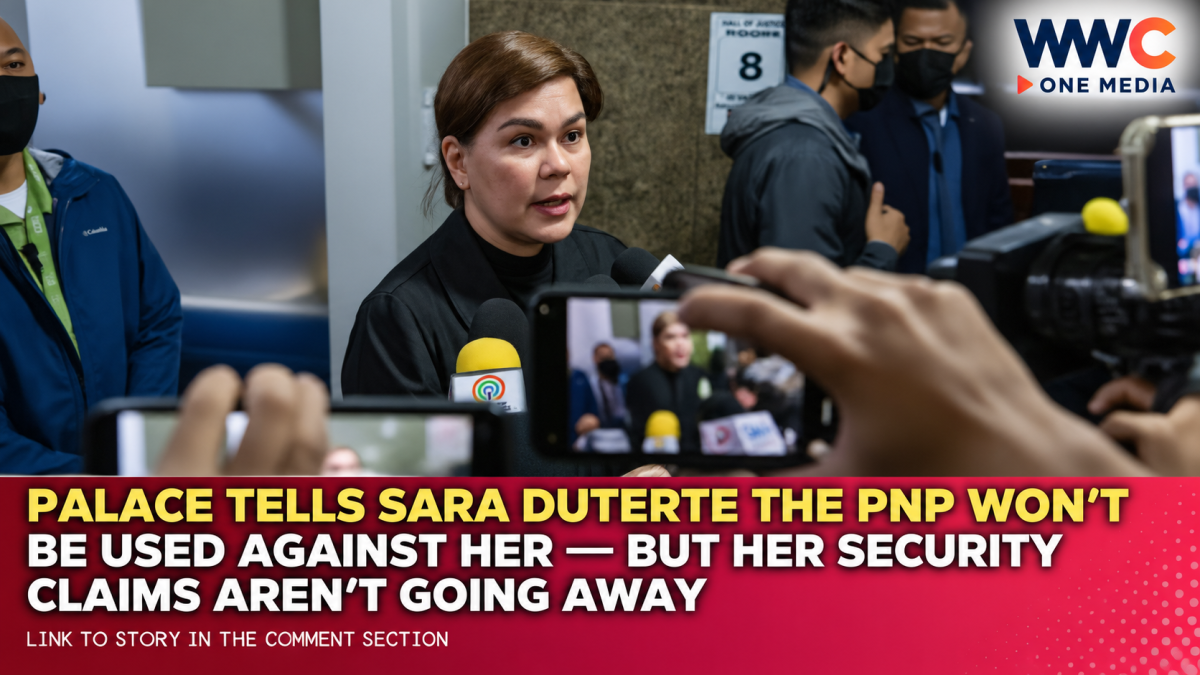
MANILA, Philippines — Malacañang is trying to defuse an increasingly combustible dispute between Vice President Sara Duterte and the country’s police establishment, assuring her and her allies that the Philippine National Police will not be turned into a political weapon against them.
The statement came after Duterte publicly declared that she feared for her life, worried about the safety of her children and did not trust the PNP as she appeared at the Quezon City Hall of Justice on September 5 to post bail in a criminal case involving three counts of grave threats.
Palace Press Officer Claire Castro said the Marcos administration would not allow the police force to be used for violence and maintained that the PNP is carrying out its responsibilities according to law, without political bias.
But the public assurances have not ended the central question raised by Duterte:
Can she trust the same police institution responsible for enforcing the warrant issued against her?
The PNP says yes.
Duterte says she does not feel safe.
And at least one of the country’s highest-ranking senators says police should not simply dismiss her concerns.
Palace: PNP Will Not Be ‘Weaponized’
The Presidential Communications Office said the government has full confidence in the PNP leadership and its roughly 230,000 personnel.
The administration said police officers are expected to respect the rights of people under their care and insisted that any complaints against police actions should be pursued through formal legal channels rather than through allegations the Palace considers unsupported.
Bombo Radyo reported the same message Sunday evening, with Malacañang specifically assuring Duterte that the Marcos administration would not use the PNP as an instrument to harm her or her supporters.
That reassurance is politically significant because relations between Duterte and President Ferdinand Marcos Jr. have deteriorated sharply since their 2022 electoral alliance.
But the dispute has now moved beyond political rhetoric.
Duterte is simultaneously facing a criminal proceeding in Quezon City and an impeachment trial in the Senate.
Why Duterte Says She Feels Unsafe
The immediate confrontation followed a September 4 order from Quezon City Regional Trial Court Branch 98, which found probable cause to hold Duterte for trial on three counts of grave threats and issued a warrant for her arrest.
Judge Maria Angelica De Ramos set bail at ₱120,000 for each count, or ₱360,000 altogether.
Duterte appeared at the court the following day and posted the required bail.
Before entering, however, she told reporters she did not feel safe and said she had documented threats and alleged harassment dating back to 2023. She also expressed fears about what could happen if she were taken into police custody and wanted journalists nearby as a form of public protection.
Her legal team has also argued that the criminal prosecution raises jurisdictional issues while she is a sitting impeachable official.
The DOJ disagrees and maintains that immunity from suit while in office belongs to the President, not the Vice President.
That legal dispute will ultimately be for the courts to resolve.
The Arrest Warrant Is Not a Conviction
This distinction is essential.
The Quezon City court found probable cause to put Duterte on trial.
It did not find her guilty.
A warrant means the court concluded there was sufficient legal basis for the case to proceed. Duterte continues to enjoy the presumption of innocence and may challenge the prosecution’s evidence and legal theories during trial.
Duterte has maintained that her controversial statements were taken out of context and has denied that she was issuing an actual threat.
That qualification should be included prominently in responsible reporting, especially because the criminal charges overlap factually with one of the politically charged allegations being litigated in her impeachment case.
What Triggered the Grave Threats Case?
The charges stem from Duterte’s November 2024 online press briefing.
During that briefing, she said she had made arrangements involving someone who would kill President Marcos, First Lady Liza Araneta-Marcos and then-House Speaker Martin Romualdez if she herself were killed.
The National Bureau of Investigation subsequently investigated the remarks, and prosecutors eventually brought grave-threats charges.
Duterte’s camp argues that the remarks were conditional and were made in the context of threats she believed were directed against her.
Prosecutors take a different view.
That disagreement—not social-media interpretations of the statement—is what the criminal trial is supposed to determine.
DILG Says Police Knew Where Duterte Was — But Did Not Force an Arrest
One detail from Interior Secretary Jonvic Remulla adds important context to the Palace’s assurances.
Remulla said authorities already knew Duterte’s whereabouts on the night of September 4, after the warrant had been issued.
Yet police did not force their way in or immediately take her into custody.
According to Remulla, law enforcement instead allowed Duterte’s planned court appearance to proceed, and police body cameras documented the relevant warrant-enforcement activity.
He said the PNP accorded Duterte the respect appropriate to her office.
Duterte nevertheless remained distrustful and chose to appear voluntarily before the court rather than risk being taken into police custody.
After she posted bail, the arrest warrant was lifted.
PNP: No Verified Threat Detected So Far
PNP chief Gen. Jose Melencio Nartatez Jr. said police have not identified a verified threat against Duterte or her immediate family.
He also said Duterte had not formally submitted to the PNP the threats she says date back to 2023.
The PNP nevertheless instructed relevant police units to continue monitoring the security situation and conducting threat assessments involving the Vice President and her immediate family.
Nartatez said the PNP remains willing to receive documents, statements or other information from Duterte so alleged threats can be validated and investigated.
That means the police position is not simply that no threat exists.
More precisely:
The PNP says it has not independently verified one at this stage.
Those are not the same thing.
Gatchalian: Investigate Anyway
Senate President Sherwin Gatchalian added an important counterpoint Sunday.
He urged the PNP to take Duterte’s claims seriously and investigate independently where any alleged threat might originate.
Gatchalian argued that the obligation to provide security should apply regardless of whether the person involved is the Vice President or an ordinary citizen.
His position effectively avoids choosing between Duterte’s allegation and the PNP’s denial.
Instead, he argues that the allegation itself warrants verification.
That is arguably the most institutionally useful response: determine whether there is evidence rather than assuming either side must be correct.
The Criminal Case and Impeachment Trial Are Separate
Duterte’s legal problems are unfolding on two different tracks.
The Quezon City RTC is handling the criminal grave-threats case.
The Senate, sitting as an impeachment court, is considering separate constitutional allegations concerning whether Duterte should remain in office.
Gatchalian and House prosecution lawyers have stressed that one proceeding does not automatically determine the other.
A criminal court asks whether prosecutors can establish criminal liability under the law.
An impeachment court evaluates whether an official committed impeachable offenses and remains fit to hold office.
They have different rules, purposes and consequences.
So the issuance of a warrant does not prove the impeachment case, while developments in the Senate do not automatically decide whether Duterte committed a criminal offense.
Trust in the PNP Is the Bigger Political Issue
The confrontation is therefore becoming about more than Duterte’s personal security.
It is turning into a test of institutional credibility.
The Palace says police will act professionally.
The DILG says Duterte was treated with restraint.
The PNP says it found no verified security threat but is continuing assessments.
Duterte says she fears the institution itself.
And Gatchalian says her claims deserve investigation.
Those positions are not necessarily impossible to reconcile.
A security threat can be investigated.
Police conduct can be documented.
Alleged harassment can be brought before oversight bodies or courts.
And the criminal case can proceed without assuming guilt.
But the burden on government institutions is unusually high because the person raising the allegations is the sitting Vice President and one of the administration’s most prominent political opponents.
The PNP Also Carries Historical Baggage
The dispute comes against the backdrop of longstanding questions over police accountability.
During former President Rodrigo Duterte’s anti-drug campaign, the PNP was the principal law-enforcement agency conducting operations in which thousands of suspects were killed.
Investigations cited by Inquirer found cases involving police personnel accused of manipulating crime scenes or planting evidence to frustrate investigations.
That history does not establish that today’s PNP intends to harm Sara Duterte.
Nor does it prove her current claims.
But it helps explain why allegations involving police power, custody and political pressure attract heightened scrutiny in the Philippines.
The correct response is evidence—not assumptions about either side.
The Real Test Comes After the Assurance
Malacañang has now given Duterte the assurance she demanded in public:
The PNP will not be used against her or her allies.
Police commanders have said threat assessments will continue.
The DILG says officers exercised restraint when the warrant was issued.
And the Senate president is calling for any alleged threat to be independently investigated.
What happens next will determine whether those assurances carry weight.
If Duterte provides documentation of the threats she says she has recorded since 2023, authorities will be expected to investigate them transparently.
If the PNP finds credible threats, it will have to protect someone who openly says she does not trust it.
And if investigations find nothing, police will need to show how that conclusion was reached.
The Palace has promised that the police will not become a political weapon. In the middle of one of the country’s most divisive political battles, proving that through transparent conduct may matter more than the promise itself.
WWC ONE MEDIA M.J.E



Leave a Reply