
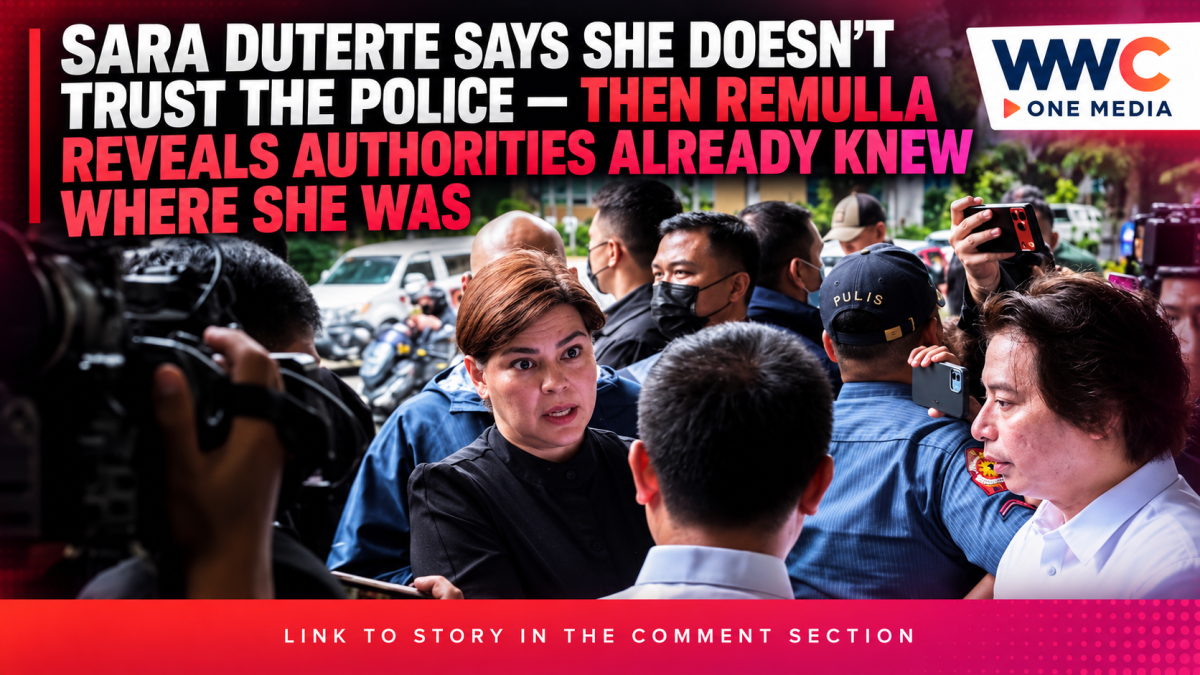
MANILA, Philippines — What began as a routine court appearance to post bail has turned into a far broader confrontation over police trust, surveillance, security and political neutrality at the highest levels of government.
Vice President Sara Duterte says she no longer trusts the police tasked with protecting and enforcing the law around her.
The Philippine National Police says the institution remains professional, impartial and committed to protecting her like any other Filipino.
And now one statement from Interior Secretary Jonvic Remulla—that authorities already knew where Duterte was before she went to court—has opened an entirely new argument over whether the government was merely tracking a person subject to an arrest warrant or conducting the kind of political surveillance Duterte says has targeted her family for years.
Duterte: ‘I do not feel safe’
The confrontation erupted on Sept. 5 when Duterte arrived at the Quezon City Hall of Justice to post bail after Regional Trial Court Branch 98 issued an arrest warrant against her on three counts of grave threats.
Before entering the building, Duterte publicly expressed fear for herself and her children.
She said she had documented threats and harassment dating back to 2023 and told reporters she felt she could be killed.
She also said she did not trust either the court or the police officers deployed around the building.
GMA reported that Duterte was visibly reluctant to enter the Hall of Justice and wanted journalists to accompany her because she believed remaining in public view offered greater protection than being isolated in police custody.
Duterte eventually posted ₱360,000 bail—₱120,000 for each of the three charges—and left the courthouse without being detained.
PNP pushes back: We are professional and impartial
PNP chief Gen. Jose Melencio Nartatez Jr. responded by defending the institution.
He said police operations are required to follow the rule of law, respect individual rights and operate without fear or favor.
Nartatez also framed the dispute as a question of rebuilding public confidence, saying trust must be demonstrated through police conduct rather than demanded automatically.
The PNP’s position is clear:
Duterte is entitled to raise security concerns.
But those concerns, police officials argue, should be supported by information that investigators can verify.
Nartatez said Duterte had not formally reported to the PNP any specific threat against herself or her family, including the threats she said date back to 2023. The PNP also said it had not independently monitored any verified threat against them as of its latest statement.
That does not prove Duterte’s fears are unfounded.
It means only that, according to the PNP, the alleged threats have not yet been formally submitted to the police for verification and have not independently been confirmed by its monitoring systems.
Nartatez orders threat assessment anyway
Despite disputing the existence of a verified threat, Nartatez did not dismiss Duterte’s concerns.
He ordered concerned police units to continue monitoring security conditions involving the Vice President and her immediate family and invited Duterte or her representatives to turn over any documents, reports or evidence connected to the threats she says she has recorded.
That creates a somewhat unusual situation.
Duterte says she distrusts the institution.
The institution is asking her to give it the evidence necessary to protect her.
And the PNP’s own chief acknowledges that rebuilding trust is an ongoing process.
Then Jonvic Remulla made the argument much more complicated
Interior Secretary Jonvic Remulla defended the police operation and said Duterte had been treated with the respect appropriate to her office.
He also said police personnel had recorded their actions with body cameras.
Then came the sentence that immediately attracted attention:
Authorities, Remulla said, already knew Duterte’s whereabouts the night before but chose not to force the implementation of the arrest warrant.
From the DILG’s perspective, that statement was presented as evidence of restraint.
The argument was essentially this:
Police could have moved aggressively to arrest Duterte once they knew where she was, but they did not because her lawyers had indicated she intended to post bail voluntarily.
That interpretation is supported by the timeline. Duterte’s lawyers had already received the warrant and told authorities they intended to post bail as soon as possible.
But Duterte interpreted Remulla’s disclosure very differently.
Duterte: That sounds like surveillance
Duterte said Remulla’s statement reinforced her long-running accusation that police and other government agencies had been conducting surveillance against her and members of her family.
She questioned why officers allegedly went to locations associated with her mother and children if authorities already knew where she herself was.
Her camp has previously raised similar allegations.
During her impeachment defense, her lawyers referred to alleged unauthorized intelligence activity, surveillance of residences and changes involving her security personnel. Those claims were presented by Duterte’s defense but have not been independently established as fact in the material reviewed here.
This distinction matters.
Knowing the whereabouts of a person subject to a court-issued arrest warrant is not, by itself, proof of unlawful political surveillance.
At the same time, Remulla’s admission inevitably gives Duterte new material for her argument that government security agencies have been closely tracking her movements.
Malacañang sides with the PNP
The Palace backed the national police.
The Presidential Communications Office said the PNP was carrying out its legal mandate impartially and without political considerations, and that officers remained professional in protecting the rights of those under their security.
Malacañang also said complaints about police conduct should be pursued through formal legal channels rather than through rumor.
That is the administration’s position.
It does not resolve Duterte’s allegations.
It instead shifts the dispute toward evidence: body-camera footage, police operational records, threat reports and any surveillance documents Duterte says her camp possesses.
Body-camera footage could become important
Remulla’s insistence that police recorded the relevant operations with body cameras could become significant.
He said body-camera footage exists covering the service of the warrant and Duterte’s arrival at the courthouse.
If a formal complaint is eventually filed over police behavior, those recordings could help establish:
what officers actually did;
where they went;
what instructions they received;
how Duterte and her family were approached;
whether police stayed within the limits of warrant implementation;
and whether her accusations of harassment are supported by the recorded encounter.
For now, however, the footage has not been publicly presented in full in the sources reviewed here.
So neither side can responsibly claim that it conclusively settles the controversy.
What is Duterte actually charged with?
The current security dispute cannot be separated from the criminal case that brought Duterte to court.
Quezon City RTC Branch 98 issued the arrest warrant after finding probable cause to hold her for trial on three counts of grave threats.
The charges stem from Duterte’s Nov. 23, 2024 online press briefing, during which she said she had made arrangements for President Ferdinand Marcos Jr., First Lady Liza Araneta-Marcos and then-Speaker Martin Romualdez to be killed if she herself were assassinated.
Duterte has argued that the remarks were taken out of context and were a response to what she described as threats against herself.
Her lawyers have also challenged the case on jurisdictional and constitutional grounds.
The DOJ, meanwhile, maintains that prosecutors found sufficient basis to charge her.
The issuance of a warrant means the court found probable cause for the case to proceed.
It does not mean Duterte has been convicted or legally proven guilty.
The timing makes everything more politically explosive
The criminal case comes while Duterte is also undergoing an impeachment trial in the Senate, making virtually every law-enforcement action surrounding her politically sensitive.
Her allies have accused the Marcos administration of weaponizing government institutions against the opposition.
Administration figures and prosecutors reject that characterization and say courts and law-enforcement agencies are simply carrying out their constitutional duties.
Those competing narratives are now colliding directly inside the PNP controversy.
To Duterte’s supporters, heavy police visibility and knowledge of her whereabouts reinforce suspicions of political pressure.
To the government, the same events demonstrate that police handled a court order carefully, allowed Duterte to surrender voluntarily and avoided an unnecessary confrontation.
The Marcos-Duterte split is the bigger backdrop
The tension would have been almost unimaginable four years ago.
Marcos and Duterte won the 2022 election together under the UniTeam banner.
Their alliance has since collapsed dramatically.
The deterioration has expanded beyond ordinary political disagreement into impeachment proceedings, criminal litigation, investigations and increasingly direct personal accusations. Reuters and AP both describe Duterte’s current legal problems as part of the wider breakdown of the once-powerful Marcos-Duterte political coalition.
That means public trust in institutions is becoming part of the political contest itself.
Police do not merely have to act lawfully.
In a highly polarized environment, they must also convince competing political camps that their actions are lawful.
And that is much harder.
NAPOLCOM itself says public trust remains a reform priority
The National Police Commission has repeatedly described professionalism, accountability and public trust as major reform priorities under Nartatez.
When he formally assumed full command of the PNP, NAPOLCOM leadership said the organization needed stronger discipline, institutional reform and rights-based policing to rebuild public confidence.
NAPOLCOM has also been expanding legal education for police officers on arrest procedures, Miranda rights, evidence handling and lawful interrogation.
That makes Duterte’s accusation especially sensitive.
The Vice President is not simply complaining about one officer.
She is openly saying she does not trust the national police institution.
For a police force publicly trying to rebuild credibility, that is a challenge that cannot be answered by a press statement alone.
The unresolved issue is no longer just Duterte’s safety
There are now two separate questions.
The first is straightforward:
Is there an actual, verifiable threat to Vice President Sara Duterte or her family?
Duterte says yes and claims she has documentation.
The PNP says no verified threat has been established and asks her to submit what she has.
The second question is more politically difficult:
Were police merely performing legitimate security and warrant-related duties—or has Duterte actually been subjected to improper government surveillance?
Duterte says Remulla’s admission supports her case.
Remulla says the police showed restraint.
The PNP says it acted impartially.
The Palace says the law was followed.
And body-camera footage and operational records may ultimately provide the most objective evidence of what happened during at least some of the encounters.
For now, neither side has publicly produced enough independently verifiable evidence to settle the broader surveillance allegation.
That leaves the PNP with a bigger challenge than simply rejecting Duterte’s accusation.
As Nartatez himself acknowledged, trust has to be demonstrated through actions.
And in a political crisis where one of the country’s highest officials publicly says she fears the police, every police action from this point forward will be watched far more closely.
WWC ONE MEDIA M.J.E



Leave a Reply