
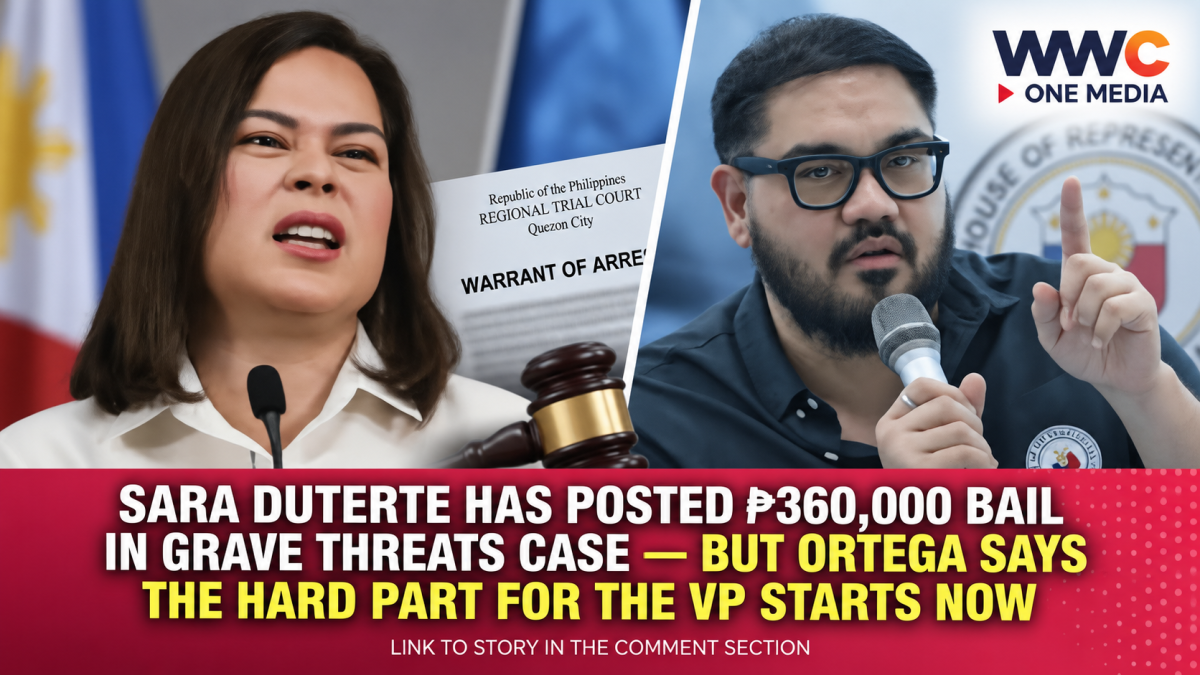
MANILA, Philippines — Vice President Sara Duterte has avoided detention after posting bail over three criminal charges arising from her controversial 2024 remarks about President Ferdinand Marcos Jr., First Lady Liza Araneta-Marcos and former House Speaker Martin Romualdez.
But one of her most persistent critics in the House says the legal battle has now entered a much harder phase.
Answering the allegations in court.
House Deputy Speaker and La Union Rep. Francisco Paolo Ortega V said Duterte, herself a lawyer, should understand exactly what the legal process requires after a Quezon City court found probable cause to put her on trial.
“Bilang abogado at bilang Vice President, alam niya kung ano ang susunod na proseso,” Ortega said, arguing that Duterte should confront the accusations through the judicial system and use the remedies available to any accused person.
But Ortega’s remarks also need political context.
He is not a neutral observer of the Duterte controversy. Ortega endorsed one of the complaints that led to the Vice President’s impeachment and has repeatedly defended the House prosecution’s handling of allegations against her. His statements therefore represent the position of a political opponent and impeachment complainant — not a judicial finding of criminal guilt.
The court will make that determination.
And the Vice President says she intends to fight.
What Actually Happened to Duterte’s Arrest Warrant?
On September 4, Quezon City Regional Trial Court Branch 98 issued an arrest warrant against Duterte after finding probable cause to hold her for trial on three counts of grave threats.
The court set bail at ₱120,000 for each count, or ₱360,000 in total.
Duterte did not appear before the court that Friday.
Her lawyer, Paul Lawrence Lim, nevertheless said she had “no intention of evading the law” and would continue pursuing all available legal remedies.
The following morning, Duterte went to the Quezon City Hall of Justice and posted the full bail.
After the court received her bond and documentary requirements, Branch 98 issued an order lifting the warrant of arrest.
So the accurate status now is:
Duterte is not presently being sought for arrest under that warrant. She is out on bail while the criminal case continues.
The Court Found Probable Cause — Not Guilt
This distinction is especially important given the political intensity surrounding the case.
Branch 98 said that after reviewing the information, supporting evidence and arguments presented by both sides, it found probable cause to hold Duterte for trial on the charges.
Probable cause is not the same thing as proof beyond reasonable doubt.
The ruling means the judge found sufficient basis for the criminal prosecution to proceed.
It does not mean the court has already decided that Duterte committed grave threats.
That question must still be resolved through trial, where her defense can challenge evidence, present witnesses, raise legal objections and seek appropriate remedies.
Ortega himself acknowledged that Duterte will have opportunities to contest the prosecution’s case and that criminal responsibility ultimately belongs to the court to determine.
That is why headlines describing Duterte as already convicted would be inaccurate.
She has been charged, not convicted.
The Case Goes Back to One Explosive Night in November 2024
The criminal proceedings originated from Duterte’s November 23, 2024 online briefing, held during an increasingly bitter political confrontation between the Duterte and Marcos camps.
During that briefing, Duterte said she had spoken to someone and instructed that person to kill Marcos, Araneta-Marcos and Romualdez if Duterte herself were killed.
The remarks were broadcast publicly and rapidly triggered national controversy.
The National Bureau of Investigation subsequently opened an inquiry.
In February 2025, the NBI forwarded complaints involving grave threats and inciting to sedition to prosecutors.
After evaluating the case, the Department of Justice eventually proceeded with the grave-threats prosecution. Duterte’s lawyers said the inciting-to-sedition complaint was dismissed.
The DOJ filed the grave-threats charges before the Quezon City RTC on August 11, 2026.
The criminal case therefore did not suddenly emerge with this week’s arrest warrant.
It is the latest stage in an investigation that began nearly two years ago.
Duterte Says Her Words Were Taken Out of Context
The Vice President disputes the characterization of her remarks as criminal threats.
Her camp has maintained that her statements were conditional, made in the context of fears about her own security and political tensions at the time.
Duterte has said the comments were maliciously removed from their “logical context,” while her lawyers have challenged the criminal proceedings on legal and jurisdictional grounds.
Her defense previously filed a motion to quash, arguing in part that the case raised constitutional questions because Duterte is a sitting impeachable official and the same conduct is also part of her impeachment case.
The RTC nevertheless rejected the attempt to stop or defer the arrest process and found probable cause for trial.
That does not necessarily exhaust every legal argument available to Duterte.
Her lawyers have repeatedly said they intend to pursue the remedies allowed under Philippine law.
Ortega: Being a Lawyer Matters
This is where Ortega’s latest criticism comes in.
The La Union lawmaker argues that Duterte’s legal background makes it difficult for her to portray the judicial process as something unfamiliar or unknowable.
Duterte obtained a law degree and passed the Philippine Bar before entering national politics.
Ortega’s argument is essentially that the Vice President understands that an arrest warrant, bail, probable-cause determination and criminal trial all have specific legal remedies — and that those remedies should be pursued in court rather than through political rhetoric.
“There is now a court that reviewed the complaint and evidence and decided there was probable cause,” Ortega said in Filipino.
But that remains Ortega’s political assessment.
The fact that Duterte is a lawyer neither proves the allegations against her nor removes her right to challenge the government’s case.
Duterte’s Bigger Concern: ‘I Do Not Feel Safe’
When Duterte appeared at the Quezon City Hall of Justice on September 5, her focus was not only on the charges.
It was also on her safety.
The Vice President repeatedly told reporters that she feared something could happen to her and expressed concern for her children.
“I do not feel safe,” Duterte said, adding that she believed she could be killed.
Her lawyers advised her to post bail rather than risk detention under police custody.
Duterte said she believed remaining around civilians would make her safer because people could observe her condition and whereabouts.
She has alleged that government agencies have subjected her and her family to surveillance, harassment and political persecution dating back to 2023.
The Marcos administration and police dispute that characterization.
PNP Says It Has No Verified Threat Against Duterte
The Philippine National Police responded to Duterte’s security concerns by saying it had not monitored a verified threat against the Vice President or her family as of September 5.
PNP chief Gen. Jose Melencio Nartatez Jr. also said Duterte had not formally reported to police the threats she says she has documented since 2023.
The PNP said it remained willing to receive information and investigate any legitimate security threat reported by the Vice President.
That creates another contested issue.
Duterte says she distrusts the very authorities who would ordinarily receive such reports.
Police say they cannot verify threats they have not been given evidence to investigate.
Neither claim, standing alone, resolves whether threats against Duterte actually exist.
Duterte’s Supporters Call the Case Political
The arrest warrant immediately produced strong criticism from the Vice President’s allies.
PDP-Laban figures and Duterte supporters have portrayed the prosecution as another example of political pressure against the Vice President amid the collapse of the once-powerful Marcos-Duterte alliance.
Former press secretary Trixie Cruz-Angeles, for example, said Duterte’s supporters would remember the events surrounding the warrant as political oppression.
International reporting has likewise placed the case inside the wider confrontation between the two political families.
Marcos and Duterte ran together and won overwhelmingly in 2022, but their alliance subsequently disintegrated.
Duterte resigned from the Marcos Cabinet in 2024.
Political hostilities intensified further over congressional investigations, confidential funds, foreign policy, the arrest and transfer of former President Rodrigo Duterte to The Hague, and ultimately Sara Duterte’s impeachment.
The criminal case now adds another layer to that conflict.
But political hostility between the camps does not itself prove that the prosecution is illegitimate.
Nor does the existence of a court case prove Duterte guilty.
Both questions require evidence.
The Same Threats Are Also at the Center of Her Impeachment Trial
The legal situation is unusual because Duterte’s November 2024 remarks are being examined in two different forums.
One is the Quezon City criminal court.
The other is the Senate sitting as an impeachment court.
The alleged threats form a major part of an article of impeachment being prosecuted against Duterte.
During the Senate proceedings, House prosecutors presented NBI witnesses and digital evidence concerning Duterte’s recorded remarks.
An NBI digital forensic examiner authenticated video associated with the November 23 briefing, while other bureau officials discussed how investigators assessed the statements.
Ortega has been particularly vocal about that evidence.
During the impeachment proceedings in July, he argued that the video was difficult to explain away and described the threat allegation as particularly serious because it involved the country’s second-highest elected official.
Duterte’s defense, however, has challenged both the evidence and prosecutors’ interpretation of the remarks.
The impeachment court — like the criminal court — has yet to render a final judgment.
Criminal Trial and Impeachment Are Not the Same Thing
This distinction is critical.
The criminal case asks whether Duterte violated Philippine criminal law.
The impeachment trial asks whether she committed impeachable offenses warranting constitutional punishment.
Those proceedings involve overlapping facts, but they serve different purposes.
A criminal conviction can carry criminal penalties.
An impeachment conviction can lead to removal from office and possible disqualification from holding public office, but impeachment itself does not substitute for ordinary criminal prosecution.
Duterte’s lawyers have raised constitutional arguments about whether criminal proceedings involving the same conduct should proceed while impeachment is pending. The RTC has, for now, allowed the grave-threats case to move forward.
That constitutional and procedural dispute may continue.
And 2028 Is Impossible to Ignore
There is also a massive political backdrop.
Duterte has openly discussed a possible run for president in 2028.
Reuters and AP have noted that her legal and impeachment troubles could therefore have consequences reaching far beyond her current vice-presidential term.
An impeachment conviction accompanied by disqualification could dramatically alter the next presidential race.
A criminal case developing alongside that impeachment battle inevitably carries political significance.
That is precisely why factual precision matters.
The warrant was real.
The probable-cause finding was real.
The bail was real.
The three criminal charges are real.
But so are Duterte’s presumption of innocence and her right to contest them.
The Warrant Was Only the Beginning
The drama surrounding Duterte’s appearance at the Quezon City Hall of Justice may have produced the most dramatic images:
Police waiting.
Reporters surrounding the Vice President.
Duterte publicly questioning whether she was safe.
Then ₱360,000 in bail and the lifting of the warrant.
But legally, those were preliminary steps.
The harder fight comes next.
Prosecutors will eventually have to prove their accusations.
Duterte’s lawyers can attack the evidence, jurisdiction, interpretation and application of the law.
The court must separate political rhetoric from legally admissible proof.
And the Vice President’s impeachment trial continues on a parallel track.
Ortega says Duterte’s legal training means she should know exactly how that process works.
Duterte says the entire situation cannot be separated from years of political harassment.
Those are competing claims.
The courtroom — not either political camp — will ultimately have to decide the criminal case.
WWC ONE MEDIA M.J.E

Leave a Reply