
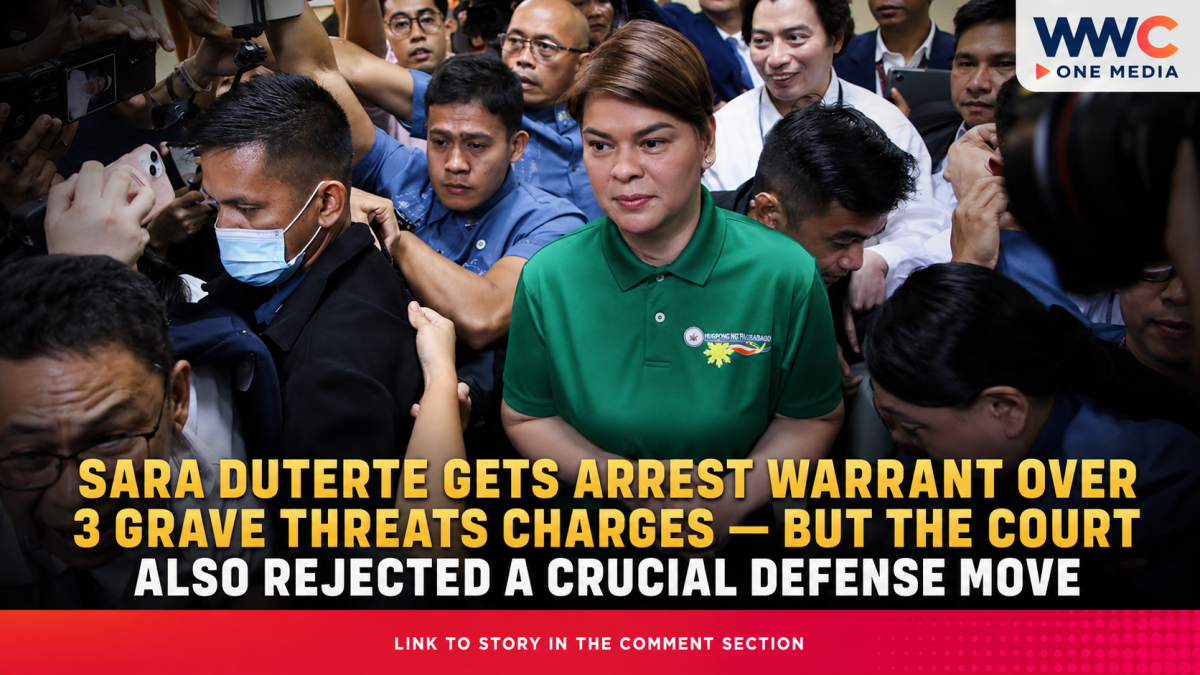
MANILA, Philippines — Vice President Sara Duterte is facing an arrest warrant after a Quezon City court found probable cause to proceed with three criminal charges of grave threats linked to controversial remarks she made against President Ferdinand Marcos Jr., First Lady Liza Araneta-Marcos and former House Speaker Martin Romualdez.
The Quezon City Regional Trial Court Branch 98 issued the warrant on Friday, September 4, 2026, setting bail at ₱120,000 for each of the three counts, or a total of ₱360,000.
But the arrest warrant was only part of a wider ruling that could significantly shape Duterte’s legal battle.
According to the Department of Justice, the court also denied Duterte’s motion seeking to defer or recall an arrest warrant and quash the criminal informations against her.
More importantly, the court found probable cause to hold the Vice President for trial on all three counts of grave threats, clearing another major procedural hurdle for prosecutors.
Duterte camp says VP will not evade the law
Duterte’s lawyer, Paul Lawrence Lim, confirmed the issuance of the warrant and maintained that the Vice President intends to face the proceedings while continuing to pursue available legal remedies.
Lim said that despite their continuing challenge to the court’s jurisdiction, Duterte has no intention of avoiding the legal process.
The statement is significant because Duterte’s legal team had earlier questioned whether a sitting Vice President could be subjected to criminal proceedings while still occupying an impeachable constitutional office.
Her lawyers previously asked the QC court to dismiss the cases for lack of jurisdiction and sought to prevent the issuance of an arrest warrant while that question remained unresolved.
That attempt, however, did not prevent Friday’s warrant.
Lawyers plan to post bail
Interior Secretary Jonvic Remulla said Duterte’s lawyers had already received the arrest warrant and indicated that they planned to post bail as soon as possible.
The three bail amounts would bring the total required to ₱360,000.
The grave threats charges are bailable, meaning the issuance of the warrant does not automatically mean Duterte will remain in detention while the cases are being heard.
As of the latest reports reviewed Friday afternoon, Duterte’s lawyers had announced their intention to post bail, although the initial reports did not yet confirm that the bail process had been completed.
What triggered the grave threats cases?
The criminal cases trace back to Duterte’s highly publicized remarks during an online press conference in November 2024.
During the briefing, the Vice President said she had spoken to someone whom she instructed to kill President Marcos, First Lady Liza Araneta-Marcos and then-Speaker Romualdez if she herself were killed.
The remarks triggered an investigation by the National Bureau of Investigation, which later forwarded its findings to the Department of Justice.
The DOJ eventually filed three counts of grave threats before the Quezon City RTC in August 2026.
The charges involve Article 282 of the Revised Penal Code in relation to Section 6 of Republic Act No. 10175, or the Cybercrime Prevention Act of 2012, because the alleged threats were communicated through an online platform.
Prosecutors also considered an inciting to sedition allegation but ultimately dismissed that portion after finding insufficient evidence to bring it to court.
Court finds probable cause
The latest development goes beyond simply ordering Duterte’s arrest.
According to DOJ spokesperson Polo Martinez, the QC RTC determined that probable cause existed to proceed with a trial on all three grave threats charges.
That finding does not constitute a conviction. Duterte remains presumed innocent unless and until guilt is established beyond reasonable doubt after trial.
It does mean, however, that the trial court found sufficient grounds at this stage for the criminal proceedings to continue.
Malacañang responds
Malacañang said it would respect the court’s action.
Palace Press Officer Claire Castro said the administration respects decisions and orders issued by the judiciary.
The statement avoids directly weighing in on Duterte’s guilt or innocence while putting the Palace on record as recognizing the authority of the court process.
Criminal case unfolds alongside impeachment trial
The arrest warrant arrives while Duterte is also fighting a separate political battle before the Senate impeachment court.
Her alleged threatening statements involving Marcos, the First Lady and Romualdez have also figured in the impeachment proceedings against her.
The two proceedings, however, are legally distinct.
The grave threats charges are criminal cases being heard by a Regional Trial Court, while impeachment is a constitutional process that determines whether an impeachable public official should be removed from office.
An arrest warrant in the criminal case therefore does not, by itself, remove Duterte from the vice presidency or establish her guilt.
What happens next?
The immediate question is whether Duterte will formally post bail and submit to the court’s processes without being physically detained.
After that, attention is likely to shift toward her remaining legal remedies, including how her lawyers will continue challenging the prosecution and the court’s jurisdiction.
For prosecutors, meanwhile, the finding of probable cause means the cases can move toward trial unless a higher court or subsequent ruling changes their course.
That makes Friday’s warrant more than a dramatic political headline.
It marks the point where one of the country’s most closely watched political disputes has moved deeper into the criminal court system — even as an impeachment battle involving the same Vice President continues to unfold.
WWC ONE MEDIA J.M.D
Leave a Reply