
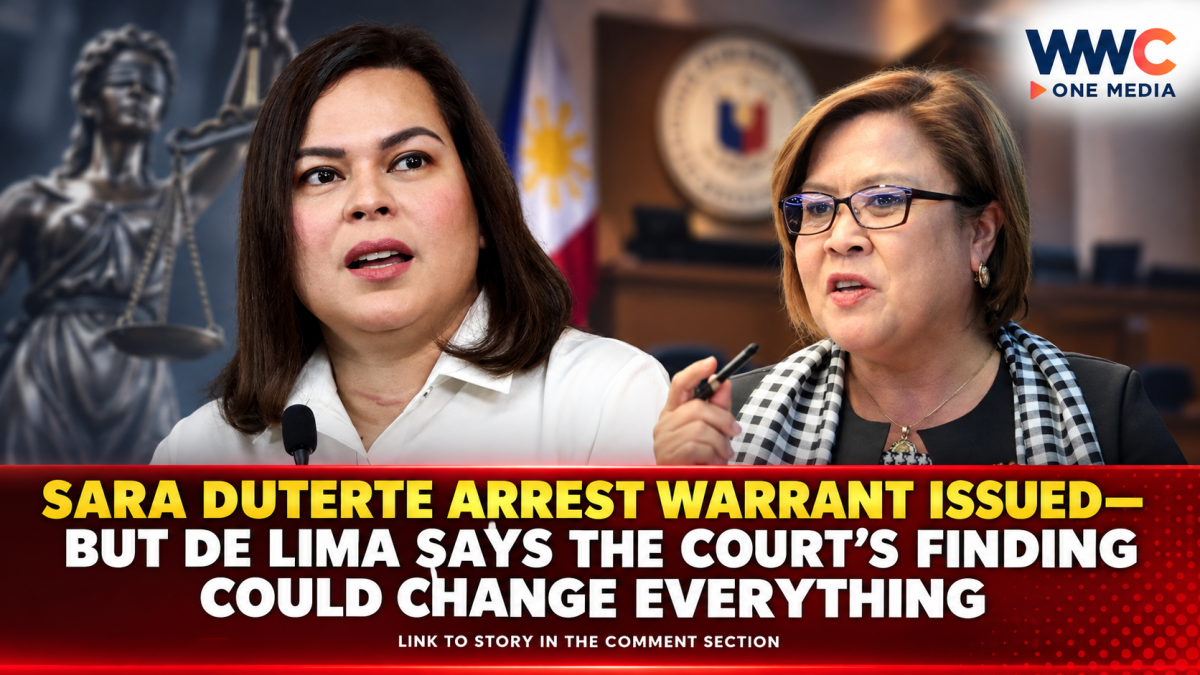
MANILA, Philippines — Vice President Sara Duterte is facing a major legal setback after a Quezon City court issued a warrant for her arrest over three counts of grave threats, with the court finding probable cause to hold her for trial.
The development prompted former senator and now Mamamayang Liberal party-list Rep. Leila de Lima to say that the warrant demonstrates that the court found sufficient basis to move the case forward.
But the legal significance goes beyond the political statements surrounding the case: it was the Quezon City Regional Trial Court Branch 98 itself that determined there was probable cause—not De Lima.
In a September 4 resolution, Branch 98, presided over by Judge Maria Angelica de Ramos, denied Duterte’s request to defer or recall the arrest warrant and her bid to quash the criminal information. The court said its assessment of the evidence and the arguments presented by both sides established probable cause to hold the Vice President for trial on all three charges.
De Lima: Warrant shows the case has moved to another level
De Lima said the warrant underscores that Duterte’s remarks cannot simply be dismissed through political explanations or arguments.
She argued that after examining the evidence on record, the court found sufficient reason for the Vice President to face trial.
However, the issuance of an arrest warrant does not mean Duterte has been found guilty.
Lanao del Sur Rep. Zia Alonto Adiong, a spokesperson for the House impeachment prosecution panel, likewise emphasized that an arrest warrant is not a finding of guilt and that Duterte remains entitled to due process and legal remedies.
That distinction is crucial as the criminal case now moves toward trial.
What is Sara Duterte accused of?
The criminal case stems from Duterte’s controversial online press briefing in November 2024.
During the briefing, Duterte said she had spoken to someone and instructed that President Ferdinand Marcos Jr., First Lady Liza Araneta-Marcos and then-House Speaker Martin Romualdez be killed if she herself were killed.
The remarks were made while Duterte was criticizing the political developments surrounding her office and the detention of her former chief of staff, Undersecretary Zuleika Lopez.
Duterte later maintained that her remarks had been taken out of context and denied that they constituted an actual threat.
The National Bureau of Investigation subsequently recommended the filing of charges. The Department of Justice eventually filed the grave-threat cases in August 2026.
Court sets bail at P120,000 per count
The Quezon City RTC set bail at P120,000 for each of the three counts, meaning the total bail corresponding to the three charges is P360,000.
The charges are considered bailable, and reports indicated that Duterte’s legal team planned to address the warrant and pursue the available remedies.
Her lawyer, Paul Lawrence Lim, said Duterte had no intention of evading the law and would continue pursuing all legal remedies available to her.
Duterte’s office also confirmed that she had been notified of the September 4 warrant issued by Judge De Ramos.
Why the warrant matters to Duterte’s impeachment case
The arrest warrant comes while Duterte is simultaneously facing an impeachment trial before the Senate.
The alleged threats against Marcos, the First Lady and Romualdez are also included among the accusations in the impeachment proceedings.
That overlap has generated a major legal dispute.
Duterte’s lawyers have argued that, as a sitting impeachable official, she should not be criminally prosecuted for conduct that is also the subject of impeachment proceedings.
The Department of Justice has rejected that position, maintaining that presidential immunity from suit applies to the President and does not extend to the Vice President. The DOJ has also argued that the criminal proceedings and impeachment process can proceed separately.
The court’s decision to issue the warrant therefore represents a significant development in that unresolved legal battle.
Duterte’s camp says she will fight the case
Despite the warrant, Duterte’s legal team has signaled that she intends to challenge the government’s case through the courts rather than evade the proceedings.
Her lawyer said the Vice President would continue exercising all legal remedies available to her, regardless of the jurisdictional arguments raised by her defense.
The Palace, meanwhile, said it respects the Quezon City court’s decision.
What happens next?
The immediate consequence of the court’s ruling is that the grave-threat case can proceed toward trial.
The warrant is transmitted for implementation through the appropriate law-enforcement authorities, while Duterte’s lawyers can pursue available legal remedies, including challenges to the court’s ruling and arrangements for bail.
Reports on September 4 also said Duterte did not voluntarily appear at the Quezon City court that day, although her lawyers maintained that she had no intention of evading the law.
For Duterte, the development creates a new front in an already intense political and legal battle.
She is now confronting two parallel proceedings involving the same controversial statements: a criminal case in the Quezon City RTC and an impeachment proceeding in the Senate.
And while the arrest warrant is not a conviction, the court’s finding of probable cause means the allegations have now cleared a significant judicial hurdle and are headed toward the next stage: trial.
Leave a Reply