
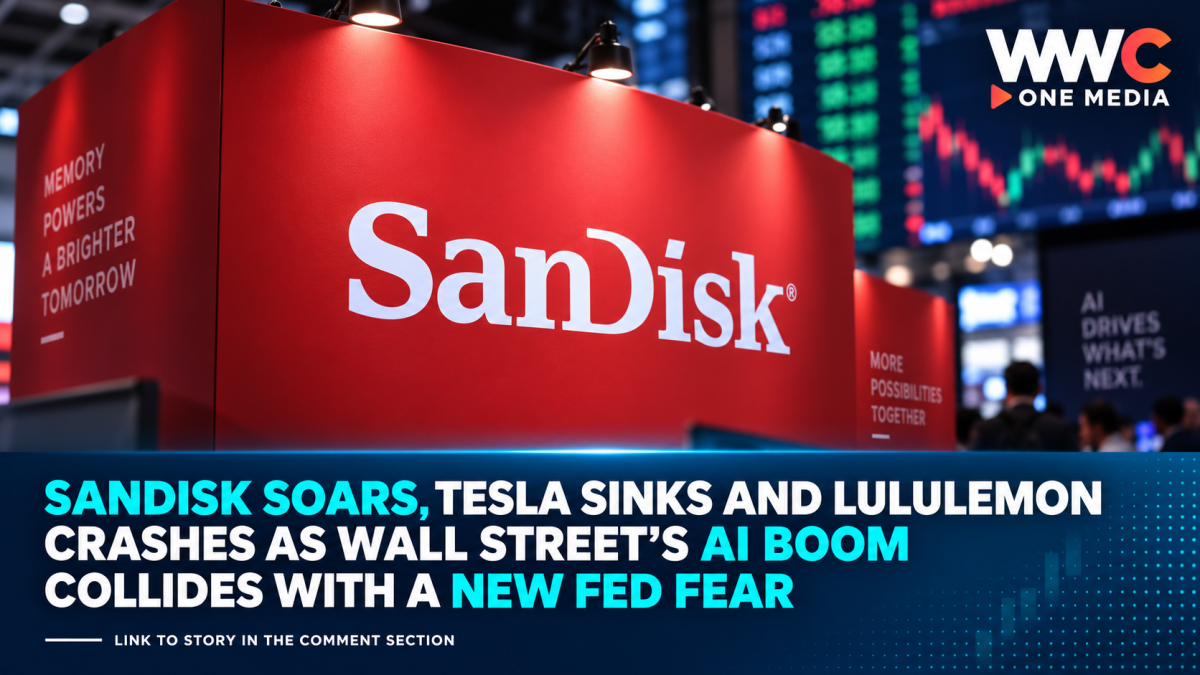
NEW YORK — Wall Street just delivered the kind of trading session that makes a quiet index decline look almost meaningless.
While the major U.S. averages slipped modestly on Friday, September 4, individual stocks were moving violently in both directions: Sandisk surged roughly 12%, Tesla dropped nearly 6%, Lululemon plunged more than 17%, Quanex jumped more than 20%, and AMC rallied as a fight over tokenized stocks exploded into public view.
The bigger story, however, was not any single company.
Investors were trying to digest two competing narratives at once: AI-related businesses are still producing spectacular winners, but an unexpectedly strong U.S. jobs report revived fears that the Federal Reserve could raise interest rates again.
That tension pushed the S&P 500 down 0.38%, the Dow Jones Industrial Average down 0.51% and the Nasdaq Composite down 0.29% by the close.
Sandisk Becomes the Day’s AI Winner
Among the biggest winners was Sandisk, whose shares jumped about 12% by the end of the session as memory and storage stocks became one of Wall Street’s rare pockets of strength. Micron Technology rose about 6%, while several other semiconductor-related names also advanced.
The rally reflects an increasingly important second act in the AI investment boom.
For the past several years, Nvidia and other accelerator-chip makers dominated the AI narrative. But investors are increasingly focusing on the enormous quantities of memory and data storage required to train and operate AI systems and data centers.
That shift has made NAND flash, DRAM and high-bandwidth memory manufacturers increasingly important components of the AI infrastructure trade.
Micron, for example, is expanding high-bandwidth-memory production as demand from AI data centers remains exceptionally strong, with supply still struggling to keep pace.
Sandisk has similarly benefited from expectations that stronger enterprise storage demand and tight NAND supply could support pricing and profitability.
The stock had already produced extraordinary gains before Friday, making its latest rally another sign that Wall Street’s AI trade is broadening far beyond GPUs.
But that also raises an uncomfortable question: how much future AI growth has already been priced into memory stocks after such enormous runs?
Tesla’s Cybercab Dream Runs Straight Into Washington
Tesla was experiencing almost the opposite problem.
Shares fell about 5.9% after the National Highway Traffic Safety Administration opened an audit into Tesla’s newly deployed Cybercab, the company’s purpose-built autonomous taxi.
The regulatory issue goes directly to the vehicle’s unusual design.
Cybercab has no steering wheel, accelerator pedal, brake pedal or conventional mirrors, which puts Tesla into relatively unexplored territory under federal motor-vehicle safety rules originally written around human-driven cars.
Tesla began commercial Cybercab operations in Austin, Texas, before NHTSA announced that it would examine the technical information and process the company used to self-certify the vehicles as compliant with federal standards.
Reuters reported that the audit covers roughly 1,000 Cybercabs, although only 45 Cybercabs were registered in Texas as of Friday morning as part of a broader Tesla autonomous fleet of 420 vehicles in the state.
The distinction is important: federal regulators have not declared the Cybercab illegal or unsafe. They are investigating the basis for Tesla’s certification.
But the scrutiny strikes at the heart of Tesla’s valuation narrative.
CEO Elon Musk has increasingly positioned Tesla not simply as an electric-car company but as an AI, robotics and autonomous-transportation platform. A successful Cybercab rollout could help validate that transformation.
Regulatory resistance could slow it dramatically.
That is why a seemingly technical safety-compliance review was capable of wiping billions of dollars from Tesla’s market value in a single trading session.
The Irony: Tesla Rose Before Cybercab — Then Fell After It
The move was even more striking because Tesla had rallied roughly 6% during the previous session as investors anticipated the Cybercab launch.
Then came the familiar Wall Street phenomenon: buy the rumor, sell the news.
Investors who had driven Tesla higher ahead of the event were confronted with a real-world reminder that autonomous driving does not depend solely on whether the technology works.
It also depends on whether regulators allow it to scale.
The Cybercab dispute could therefore become much bigger than Friday’s stock decline because it may help determine how quickly purpose-built autonomous vehicles without traditional controls can operate legally across the United States.
Lululemon Suffers an Even Bigger Collapse
Tesla was far from Friday’s biggest loser.
Lululemon Athletica plunged roughly 17%, extending a brutal decline for a company that was once among the most celebrated consumer-growth stories on Wall Street.
The athletic-apparel company cut its full-year outlook for the second time, just days before former Nike executive Heidi O’Neill is scheduled to take over as chief executive on September 8.
Second-quarter revenue fell about 4% to $2.42 billion, while revenue in the Americas declined 8%. The company now expects fiscal 2026 revenue of roughly $10.35 billion to $10.5 billion, down substantially from its previous forecast.
One number illustrates the problem particularly clearly: sales of Lululemon’s core leggings category were reportedly down around 20% in the second quarter.
The company is being squeezed by merchandising problems, uneven product launches and aggressive competitors such as Alo Yoga and Vuori, while its cost structure still resembles that of a business expecting rapid expansion.
At least 12 brokerages cut their price targets following the earnings report.
For the incoming CEO, this is no longer just a product-refresh assignment.
It is turning into a full-scale brand turnaround.
Quanex Jumps More Than 20% — And This One Was About Actual Earnings
Away from technology and consumer drama, Quanex Building Products delivered one of Friday’s cleanest earnings-driven rallies.
The stock jumped roughly 22% after reporting quarterly results that beat Wall Street expectations.
Quanex reported fiscal third-quarter net sales of $501.8 million, up 1.3% from $495.3 million a year earlier.
Adjusted diluted earnings came in at 79 cents per share, while adjusted EBITDA rose to $72.7 million. The company also repaid $42.25 million in debt during the quarter.
That combination — better profitability, improving margins, cash generation and debt reduction — gave investors something increasingly valuable in a volatile market: tangible evidence of execution.
It also highlights how selective investors have become.
Companies do not necessarily need an AI story to rally.
They need to outperform expectations.
AMC Jumps as a New Wall Street Fight Explodes
Then there was AMC Entertainment, one of the original meme stocks.
AMC shares finished roughly 4% to 5% higher after CEO Adam Aron publicly attacked Robinhood over tokenized versions of AMC shares being offered outside the United States.
Aron argued that AMC had neither authorized nor endorsed the products and said tokenized representations risk confusing investors because holders do not necessarily receive the shareholder rights associated with owning actual AMC common stock.
He also raised concerns about what tokenization could mean for companies’ ability to raise capital through traditional equity markets.
Robinhood has defended its stock-token initiative, which gives eligible international customers economic exposure to U.S. stocks through blockchain-based products.
The disagreement is significant because tokenization is rapidly becoming one of finance’s biggest experiments.
The New York Stock Exchange, Nasdaq, Robinhood, Coinbase and other financial players have explored ways of moving traditional securities onto blockchain-based infrastructure.
AMC’s challenge introduces a fundamental question:
Can a financial platform create a token tracking a public company’s shares even if that company does not want one?
That fight could eventually matter far beyond meme stocks.
Guidewire Proves That Beating Earnings Isn’t Always Enough
Another brutal move came from Guidewire Software, which fell roughly 21% even though its fiscal fourth-quarter numbers exceeded analysts’ expectations.
Guidewire reported revenue of $411.1 million, up 15%, while non-GAAP earnings reached 99 cents per share.
Annual recurring revenue increased 19% to $1.24 billion.
So why did investors sell?
Guidance.
Guidewire projected first-quarter fiscal 2027 revenue of $372 million to $378 million, below what analysts had been expecting.
It is a classic example of what happens to highly valued growth stocks when expectations become extreme.
Beating yesterday’s numbers is not enough.
The company must also convince investors that tomorrow will be even better.
Credit-Score Stocks Get Hit by a Potential Industry Shake-Up
Another surprising selloff had nothing to do with corporate earnings.
Shares of Fair Isaac, Equifax and TransUnion dropped sharply after Federal Housing Finance Agency Director Bill Pulte discussed expanding the use of competing credit-scoring systems in mortgage lending.
Fair Isaac, the company behind the widely used FICO score, sank roughly 17%, while Equifax and TransUnion also posted steep declines.
The concern is that broader acceptance of VantageScore and potential changes to the existing system in which mortgage lenders rely on multiple credit bureaus could reduce pricing power across the credit-reporting ecosystem.
For decades, these companies benefited from deeply embedded positions in U.S. lending infrastructure.
Friday’s reaction showed what happens when investors begin questioning whether those moats are as permanent as they once appeared.
Adobe Loses Billions After Naming Its Next CEO
Adobe also became an unexpected casualty.
The software giant fell about 6.7% after announcing that Anil Chakravarthy would replace longtime CEO Shantanu Narayen beginning December 1. Narayen, who has led Adobe for more than 18 years, will become executive chairman.
Leadership changes usually create uncertainty.
But this one comes at an especially sensitive moment.
Adobe is attempting to defend Creative Cloud and its other franchises against rapidly advancing generative-AI products while competitors such as Canva and Figma challenge parts of its traditional creative-software empire.
Some investors had also viewed Adobe creative-business executive David Wadhwani as a likely CEO candidate. His decision to depart after Chakravarthy’s appointment added another layer of uncertainty.
So Adobe’s selloff was not simply a judgment on its new CEO.
It reflected the enormous strategic challenge waiting for him.
UiPath Drops as Wall Street Demands More From AI Software
UiPath fell around 14% during Friday trading after its full-year revenue outlook came in slightly below Wall Street expectations.
The automation-software company forecast annual revenue of roughly $1.792 billion at the midpoint, compared with an approximately $1.794 billion analyst estimate.
That difference is tiny.
The stock reaction was not.
And that may be one of Friday’s clearest lessons.
Companies associated with automation and AI are operating in a market where expectations have become so elevated that even relatively small guidance disappointments can trigger dramatic selling.
Behind Every Stock Move Was the Same Bigger Problem: Interest Rates
All these individual corporate stories played out against a much bigger macroeconomic surprise.
The U.S. economy added 162,000 jobs in August, nearly triple the 56,000 increase economists surveyed by Reuters had expected.
The unemployment rate remained at 4.1%.
Normally, stronger job creation sounds like good news.
For Wall Street, it was complicated.
A resilient labor market gives the Federal Reserve more room to focus on inflation. Investors consequently increased bets that policymakers could raise interest rates at their September meeting.
The two-year Treasury yield climbed to around 4.37%, while the 10-year yield moved close to 4.8%.
Higher yields can pressure equity valuations because investors can earn more from comparatively safer government bonds, while companies face higher financing costs.
That dynamic is particularly important for richly valued growth stocks whose valuations depend heavily on profits expected far into the future.
Yet AI Stocks Refused to Cooperate With the Bearish Script
Here is where Friday became especially interesting.
Despite rising Treasury yields and falling major indexes, semiconductor stocks rallied.
The Philadelphia semiconductor index gained more than 3%, while Sandisk, Micron and several AI-related hardware companies moved sharply higher.
That suggests investors remain reluctant to abandon the AI infrastructure story even when the broader macroeconomic environment turns less favorable.
In other words, Wall Street appears to be making a distinction.
Higher rates may hurt speculative valuations.
But companies perceived as direct beneficiaries of enormous AI capital spending can still attract buyers.
Whether that distinction survives another prolonged rise in bond yields is one of the major questions heading into the final months of 2026.
What Friday Really Told Investors
At first glance, September 4 looked like another routine down day.
The S&P 500 lost less than half a percent.
But underneath that number was extraordinary dispersion.
Sandisk: about +12%
Quanex: roughly +22%
AMC: about +4% to +5%
Tesla: about -6%
Lululemon: about -17%
Guidewire: roughly -21%
Fair Isaac: nearly -17%
Adobe: about -7%
UiPath: roughly -14% intraday
Those moves were not random.
They tell investors something about the market entering the final stretch of 2026:
Wall Street is still willing to pay aggressively for AI infrastructure, earnings surprises and improving fundamentals.
But it is becoming ruthless toward weak guidance, uncertain turnarounds, regulatory risks and business models facing technological disruption.
And hanging over all of them is the Federal Reserve.
The next major test will be inflation.
U.S. producer- and consumer-price data are due ahead of the Fed’s September policy decision, and markets are already debating whether Friday’s unexpectedly strong employment report gives policymakers enough confidence to raise rates again.
WWC ONE MEDIA M.J.E



Leave a Reply