
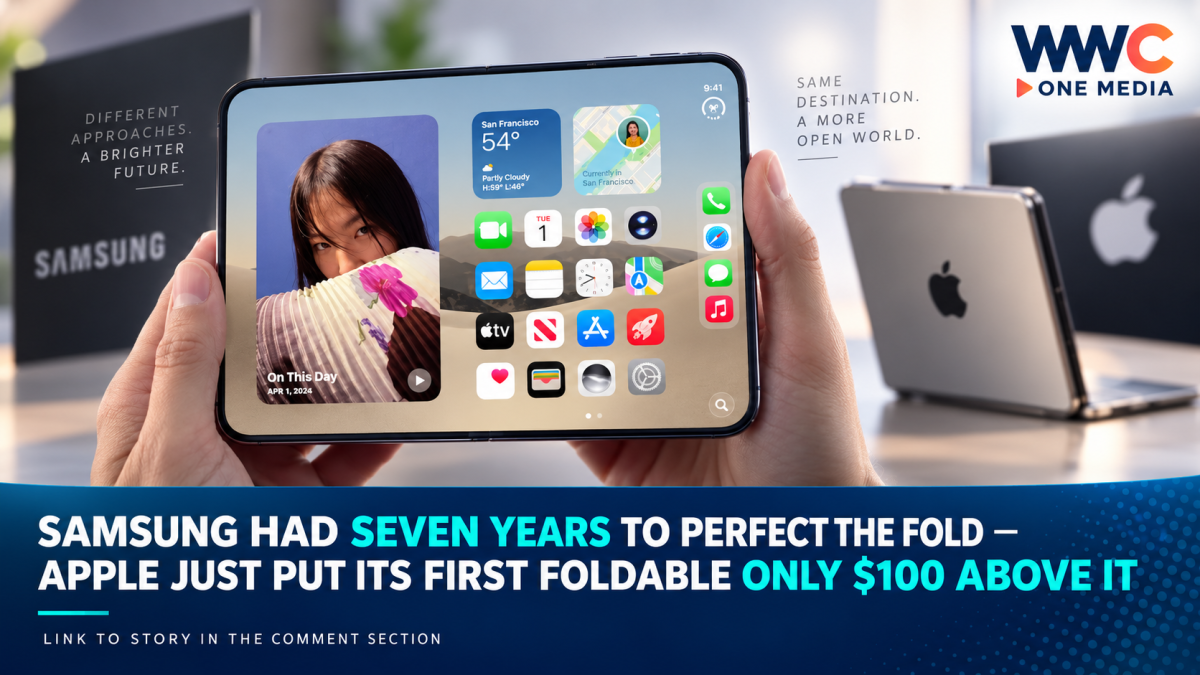
SEOUL — Samsung Electronics spent seven years turning the foldable smartphone from an expensive experiment into a recognizable premium category. Now Apple is entering that category with a first-generation device priced close enough to Samsung’s flagship that buyers may have to make a very different calculation.
Apple’s newly unveiled iPhone Duo starts at $1,999 in the United States for 256GB of storage, while Samsung’s Galaxy Z Fold8 launched at $1,899.99 for the same capacity.
That is a gap of only about $100.
At that price level, the contest may no longer be decided simply by which phone has the more refined hinge, weighs less or has spent more years in development.
It may come down to something much harder for Samsung to counter:
whether millions of affluent iPhone owners would rather buy Apple’s first foldable than switch ecosystems for Samsung’s eighth-generation one.
Apple finally enters Samsung’s territory
Apple unveiled the iPhone Duo on September 9, marking its first entry into foldable smartphones roughly seven years after Samsung launched the original Galaxy Fold.
The book-style Duo uses a 5.4-inch outer display and a 7.6-inch inner screen, allowing users to open two applications side by side and use the device more like a compact tablet when unfolded.
It runs on Apple’s A20 Pro processor and will be offered with 256GB, 512GB, 1TB and 2TB of storage.
Preorders begin October 16, with availability starting October 23 in more than 70 countries and regions, including the United States, South Korea, Singapore, Japan, China, Malaysia and the United Kingdom.
Until those devices actually reach consumers, however, Apple’s claims about performance and durability remain largely untested outside controlled demonstrations and limited hands-on sessions.
Samsung does not have that problem.
It has been building foldable phones since 2019.
Samsung has eight generations of experience
Samsung’s biggest advantage is straightforward: it has already encountered many of the problems Apple is facing for the first time.
The company has spent successive Galaxy Fold generations redesigning hinges, reducing thickness and weight, strengthening flexible displays and adapting Android software to large folding screens.
The Galaxy Z Fold8 weighs just 201 grams, according to Samsung figures cited by the Korea Herald—75 grams less than the original Galaxy Fold from 2019 and significantly lighter than Apple’s roughly 254-gram Duo.
Samsung also has years of experience building multitasking interfaces specifically around folding screens.
Some ideas Apple is now emphasizing—including using an external display for camera previews and optimizing applications for partially folded positions—have existed in various forms across earlier Galaxy Fold generations.
That experience is real.
But it does not guarantee victory.
Apple has something Samsung cannot easily manufacture: its ecosystem
Samsung may understand foldable hardware better.
Apple understands iPhone customers extraordinarily well.
That difference could prove decisive.
Premium smartphones represented a record 29% of global smartphone sales during the first half of 2026, according to Counterpoint data cited by the Korea Herald.
Apple controlled 65% of that premium segment, compared with Samsung’s 19%.
Those customers already own some of the world’s most expensive phones.
Many also use Apple Watches, AirPods, Macs, iPads, iCloud subscriptions and other Apple services.
For an iPhone Pro Max owner considering an even more expensive handset, buying an iPhone Duo does not require leaving any of that behind.
Switching to Samsung does.
That makes the $100 US price gap particularly important.
At nearly $2,000, $100 represents only around 5% of the purchase price.
Samsung therefore cannot assume that a modest price advantage will be enough to persuade affluent Apple users to abandon their existing ecosystem.
The Duo may be targeting Apple users before Samsung users
That could reveal Apple’s real strategy.
Its first priority may not be stealing Galaxy Fold customers.
It may simply be persuading existing high-end iPhone owners to spend more money.
Samsung Securities analyst Lee Jong-wook told the Korea Herald that Apple’s immediate opportunity is moving customers from the iPhone Pro Max tier into the even more expensive Duo category.
That would allow Apple to build a major foldable business without necessarily convincing millions of Android users to switch platforms.
And there is evidence that some consumers have specifically been waiting for Apple.
IDC research cited by the Korea Herald found that more than 32% of consumers in a global survey said they would definitely buy a foldable if Apple produced one.
Whether that stated interest converts into $1,999 purchases is another question.
But market researchers expect Apple’s arrival to reshape the category quickly.
Apple could grab about a quarter of the foldable market immediately
Counterpoint Research forecast shortly before Apple’s unveiling that the company could capture approximately 25% of global foldable smartphone shipments in 2026.
Samsung is projected to remain No. 1 with around 38%, while Huawei could hold roughly 22%.
Counterpoint expects cumulative global foldable shipments to pass 100 million units by the end of 2026.
TrendForce arrived at a similar Apple estimate through a different forecast.
It expects roughly 5 million iPhone Duo shipments in 2026, equivalent to about 24.8% of the global foldable market.
TrendForce estimates total 2026 foldable smartphone shipments at around 20.2 million units.
Forecast methodologies differ, so these figures should not be treated as guaranteed sales.
But the direction is striking.
Apple could potentially go from selling zero foldable phones to becoming the world’s second-largest foldable brand within months.
Samsung is still expected to remain No. 1
That does not mean Apple instantly takes Samsung’s crown.
Counterpoint still projects Samsung as the global foldable leader in 2026.
Samsung also enjoys manufacturing scale, years of carrier relationships and one of the broadest foldable lineups in the industry.
Its timing advantage has allowed it to learn from problems that plagued early folding phones, including fragile screens, thick bodies and complicated software.
The Z Fold8 is the product of those lessons.
And Samsung has already turned Apple’s late entry into a marketing opportunity.
Reuters reported that Samsung responded to the Duo launch with a global “Welcome to Foldables” campaign, emphasizing that Galaxy devices had been doing many of these things for years.
There is an irony, though.
Apple is now entering the market partly through a supply chain that Samsung helped build.
Samsung Display is among the suppliers involved in foldable panels for Apple, according to Reuters.
So even as Samsung Electronics fights Apple for customers, another part of the broader Samsung ecosystem can benefit from Apple making foldables more popular.
In Korea, the price gap looks completely different
The fight becomes even more interesting when prices are compared outside the United States.
In South Korea, Apple’s iPhone Duo starts at approximately 3.29 million won, while the Galaxy Z Fold8 starts around 2.28 million won.
That leaves a difference of more than 1 million won—far larger than the $100 separating the phones in America.
That gives Samsung a much stronger home-market defense.
Samsung already has a massive Korean installed base, strong carrier distribution and years of familiarity with foldable phones.
Its latest models also produced extraordinary preorder numbers.
Samsung said its Galaxy Z8 series generated a record 1.44 million Korean preorders during its seven-day preorder period.
The Korea Herald reported that roughly 70% of those orders went to the standard Fold8.
Apple therefore faces two very different battles.
In America, it enters almost at price parity with Samsung.
In Korea, it must convince buyers that the Apple ecosystem is worth paying dramatically more for.
The US may matter more than Korea
For the global competition, however, America could be the more important battlefield.
IDC data cited by the Korea Herald indicate that South Korea accounted for less than 2% of global foldable shipments during the first half of 2026, while the United States represented roughly 10%.
That puts the $100 US price difference back at the center of the story.
Samsung spent years establishing foldables as an ultra-premium Android category.
Apple can now enter the largest relevant Western market at virtually the same price.
And unlike a smaller challenger, Apple already has one of the world’s largest premium smartphone customer bases waiting inside its ecosystem.
China could be an even harder test for Apple
Samsung is not Apple’s only serious foldable competitor.
China has developed a much more mature foldable market, with Huawei particularly dominant.
IDC said Huawei controlled 79.4% of foldable unit shipments in China during the second quarter of 2026 and more than 82% of the segment’s value.
Apple therefore enters China facing an established domestic rival rather than an undeveloped market.
IDC nevertheless expects iOS foldables in China to generate significant value if Apple executes well on durability, software and industrial design.
That means the global foldable contest is not simply Apple versus Samsung.
Samsung leads internationally.
Huawei dominates an enormous Chinese segment.
And Apple is now arriving with a user base large enough to disrupt both.
Apple may be expanding the market, not merely stealing it
One important possibility is that the iPhone Duo grows the overall foldable category rather than simply taking buyers away from Samsung.
Foldables remain a relatively small part of the worldwide smartphone business.
Counterpoint expects the market to accelerate in 2027, forecasting 37% growth as Apple’s supply increases and new Samsung devices continue expanding the category.
Counterpoint’s display research also shows the market shifting strongly toward book-style inward-folding devices like the Fold8 and Duo rather than smaller clamshell models.
In-fold panel shipments are forecast to more than double in 2026.
That could ultimately help Samsung.
Apple has enormous influence over consumer expectations.
If it convinces millions of users that a folding phone is no longer experimental, every major manufacturer of book-style foldables benefits from greater awareness.
Samsung could lose market share while still selling more foldable phones.
Those two outcomes are not contradictory.
The real test starts October 23
For all the forecasts, comparisons and marketing campaigns, one important fact remains:
Apple’s first foldable is not yet in consumers’ hands.
It has not accumulated years of hinge cycles.
It has not endured millions of pockets, drops, dusty environments or real-world multitasking habits.
And Apple has not yet demonstrated that ordinary premium-phone buyers will pay nearly $2,000 simply because the device folds.
Samsung has already answered many of those engineering questions.
Apple is trying to answer a different one:
Can the strength of the iPhone brand make foldables mainstream at the very top of the smartphone market?
Samsung had seven years to establish the category.
Apple is entering it with almost no US price disadvantage, a dominant premium customer base and forecasts suggesting it could capture roughly a quarter of foldable shipments almost immediately.
So the biggest threat to Samsung may not be that Apple built a technically better foldable on its first attempt.
It is that Apple may not need to.
If enough iPhone owners decide that the foldable they were waiting for simply had to carry an Apple logo, Samsung’s seven-year head start will finally face the test it could never run against itself.




Leave a Reply