
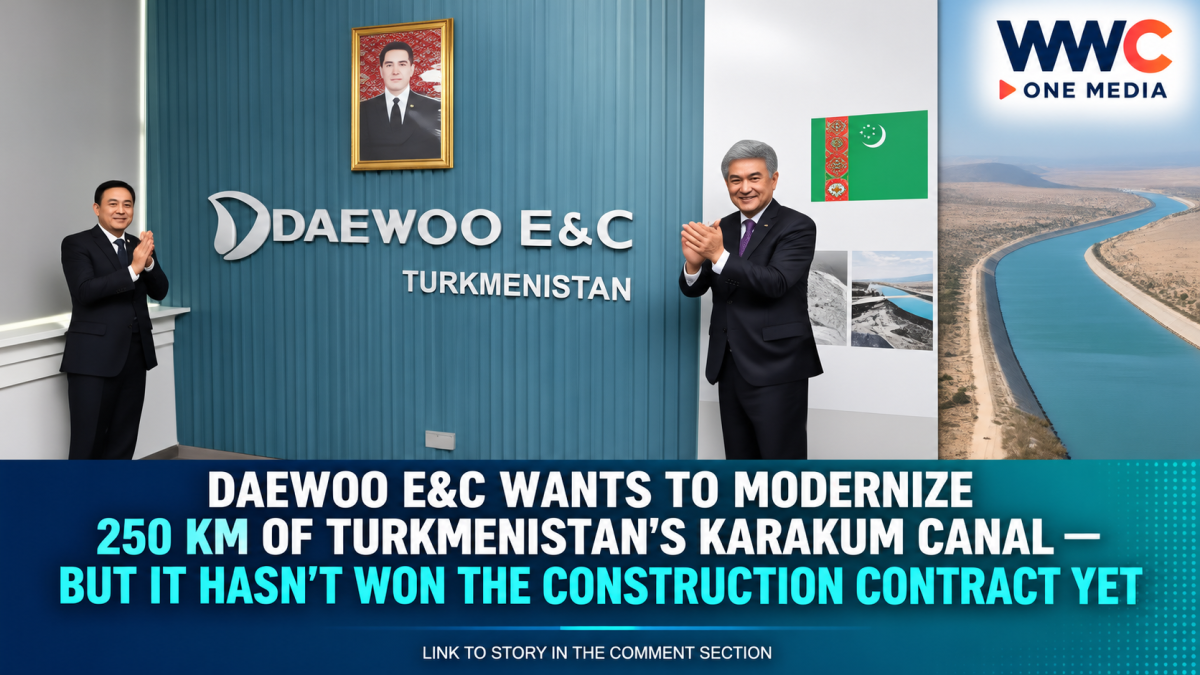
SEOUL — South Korea’s Daewoo Engineering & Construction is trying to turn its first major Turkmenistan project into something much bigger — this time by targeting one of Central Asia’s most important and water-hungry pieces of infrastructure.
Daewoo E&C signed a memorandum of understanding with Turkmenistan’s State Committee for Water Management on September 15 to explore cooperation on modernizing roughly 250 kilometers of the lower Karakum Canal, the company said. The agreement was signed during the Korea-Turkmenistan Business Forum at Lotte Hotel Seoul.
The potential project could mark Daewoo’s expansion from industrial plants into Turkmenistan’s water and environmental infrastructure sector, giving the Korean contractor another foothold in a Central Asian market it only entered commercially last year.
But the headline needs an important qualifier.
This is not yet a construction award.
The two sides have signed an MOU establishing cooperation and laying groundwork for possible Daewoo participation. Neither a final contract value nor a detailed construction timetable has been announced.
That makes the 250-kilometer canal plan potentially significant — but still several steps away from becoming another billion-dollar overseas order.
Why the Karakum Canal Matters So Much
The Karakum Canal is not an ordinary irrigation ditch.
Running across Turkmenistan from the Amu Darya River through the arid Karakum region, the system stretches for more than 1,000 kilometers and supplies water used by households, farms and industries. Daewoo and Korean media describe it as one of the world’s largest irrigation and water-supply canals.
Its importance also explains why modernization has become increasingly urgent.
A recent World Bank assessment of Central Asian irrigation systems says the Karakum Main Canal now delivers only about half of the water diverted from the Amu Darya at its intake, illustrating the scale of losses associated with aging and inefficient water infrastructure. The World Bank has separately said it has initiated a preliminary feasibility study for modernization of the Karakum Main Canal as part of its current engagement with Turkmenistan.
That means Daewoo is not simply chasing another construction project.
It is entering a sector where water efficiency has become an increasingly important economic and environmental issue.
Water Losses Are the Bigger Story Behind the Concrete
Central Asia already faces severe pressure over how water from rivers such as the Amu Darya is divided and used.
The World Bank says average irrigation conveyance efficiency across Central Asia remains about 60 percent, meaning a large share of diverted water can be lost through seepage and other inefficiencies before reaching farms. It specifically identifies the Karakum Canal as an example of the problem.
Older United Nations assessments have also documented substantial losses from the canal and linked inefficient irrigation to waterlogging and soil salinization.
Historically, large-scale diversions from the Amu Darya for irrigation — including through the Karakum system — were among the pressures that contributed to the dramatic decline of flows reaching the Aral Sea. FAO reporting has documented how extensive irrigation withdrawals from the Amu Darya and Syr Darya transformed river systems and damaged downstream ecosystems.
Modernization, therefore, could involve much more than simply repairing concrete.
Better canal lining, flow measurement, control systems and water-management technology could potentially reduce losses and improve the amount of usable water reaching communities and agriculture.
Exactly what Daewoo would build, however, has not yet been disclosed.
Daewoo Already Has a $784 Million Project in Turkmenistan
The canal MOU follows a much more concrete win.
In May 2025, Daewoo E&C signed a $784 million contract with Turkmenistan’s state-owned chemical company Turkmenhimiya to design and construct a large fertilizer complex in Turkmenabat. Yonhap described it at the time as Daewoo’s first major project in Central Asia.
The plant is designed to produce about 350,000 metric tons of phosphate fertilizer and 100,000 tons of ammonium sulfate annually. Construction is scheduled to take roughly 37 months from the start of work.
That project has already moved beyond paperwork.
Turkmen reporting said the foundation-laying ceremony took place in October 2025, while South Korea’s ambassador inspected the construction site in June 2026. The facility is currently targeted for completion in 2028.
For Daewoo, that fertilizer plant is important because it gives the company an operating track record inside Turkmenistan — something that could help as it pursues additional government-backed infrastructure work.
The Canal Could Be Daewoo’s Next Major Turkmen Bet
At the September 15 business forum, Daewoo E&C Chairman Jung Won-ju met Turkmen President Serdar Berdimuhamedov and outlined the company’s interest in additional projects, according to the builder.
The company has said it wants to expand into industrial facilities, infrastructure and environmental projects in Turkmenistan rather than remain dependent on a single fertilizer-plant contract.
The Karakum Canal fits that strategy neatly.
A successful water-infrastructure project would diversify Daewoo’s Turkmen business from chemicals into civil engineering while also putting the company in position for follow-on work in water treatment, irrigation, environmental engineering or urban infrastructure.
But again, the MOU is best understood as market positioning, not guaranteed revenue.
Daewoo is considering participation.
The detailed project still has to be developed.
The Deal Is Part of a Much Bigger Korea-Turkmenistan Push
Daewoo’s announcement came during an unusually active week for South Korean-Central Asian economic diplomacy.
South Korea hosted its first Korea-Central Asia Summit in Seoul on September 16, bringing together the leaders of Kazakhstan, Uzbekistan, Turkmenistan, Tajikistan and Kyrgyzstan. The South Korean government said one goal was to connect Central Asia’s resources and growth needs with Korean technology, infrastructure and industrial capabilities.
Ahead of the wider summit, President Lee Jae Myung and Berdimuhamedov held bilateral talks on September 15.
The two countries exchanged 13 agreements and memorandums of understanding covering areas including investment, infrastructure, chemicals, transportation and water resources. Korean officials specifically highlighted the modernization of the Karakum Canal as one of the areas where cooperation could expand.
South Korean Prime Minister Han Seong-sook also told the Korea-Turkmenistan business forum that cooperation could move beyond traditional energy and industrial projects into water management, shipbuilding, transportation, smart logistics and infrastructure.
That gives Daewoo’s canal proposal wider government backing — though commercial terms would still need to be finalized separately.
Turkmenistan Wants More Than Korean Construction
The relationship is also broadening beyond traditional engineering.
Companies from the two countries announced plans during the same business forum to establish Ýerli Tor, described by participating firms as the first Turkmen-Korean joint venture focused on producing servers, data-storage systems and networking equipment in Turkmenistan.
Other bilateral discussions have touched on smart cities, logistics, ports, rail transport and industrial technology.
For Seoul, Central Asia offers access to resources, infrastructure projects and emerging markets.
For Turkmenistan, Korean companies offer engineering experience, technology and another source of foreign investment beyond the country’s traditional partners.
The Karakum Canal could become one of the clearest examples of that shift because it sits at the intersection of infrastructure, agriculture, water security and climate resilience.
But Modernizing 250 Kilometers Will Not Be Simple
Even if Daewoo eventually wins a construction contract, modernizing part of the Karakum Canal would be a very different challenge from building a new industrial facility.
The canal is already operating.
Millions of people and significant areas of agricultural production depend on the wider water system.
Work would therefore have to improve infrastructure without unnecessarily disrupting water delivery.
Engineering solutions would also need to account for seepage, sediment, aging structures, extreme heat and the management of water across a very long network.
And because the Amu Darya is a transboundary river shared across Central Asia and Afghanistan, water efficiency in Turkmenistan has implications beyond the country’s borders. The World Bank has identified water security and more efficient irrigation as a major regional development priority.
That makes the project commercially attractive but technically and environmentally sensitive.
There Is Still No Price Tag
One number is conspicuously missing from the announcement:
the cost.
Daewoo has not disclosed how much modernization of the 250-kilometer section might require.
There is also no announced financing package, start date or final construction scope.
That differs sharply from last year’s fertilizer project, where the company eventually signed a definitive $784 million engineering and construction contract.
Investors and industry watchers therefore should not treat the canal MOU as equivalent to an order added to Daewoo’s construction backlog.
It could ultimately become one.
But first the two sides will need to define the project, financing, technical specifications and contractual terms.
The Bigger Opportunity Is What Comes After the Canal
Daewoo’s strategy appears to be straightforward.
The fertilizer plant opened the door.
The Karakum Canal could widen it.
And if the Korean contractor successfully establishes itself in both industrial plants and water infrastructure, Turkmenistan could become a base for pursuing additional work across Central Asia.
South Korea’s government is explicitly trying to help its companies win more infrastructure and plant projects in the region, while the first Korea-Central Asia Summit has elevated that effort to the presidential level.
For now, though, the most accurate description of Daewoo’s latest move is also the most important one:
the company has secured a place at the table, not the construction contract.
The next question is whether a 250-kilometer MOU turns into Daewoo E&C’s second major Turkmenistan project — and how large that project might ultimately become.

Leave a Reply