
SEOUL — South Korea’s tourism boom is producing an unexpected financial-services race: how do you let millions of foreign visitors spend like locals when many of them cannot bank like locals?
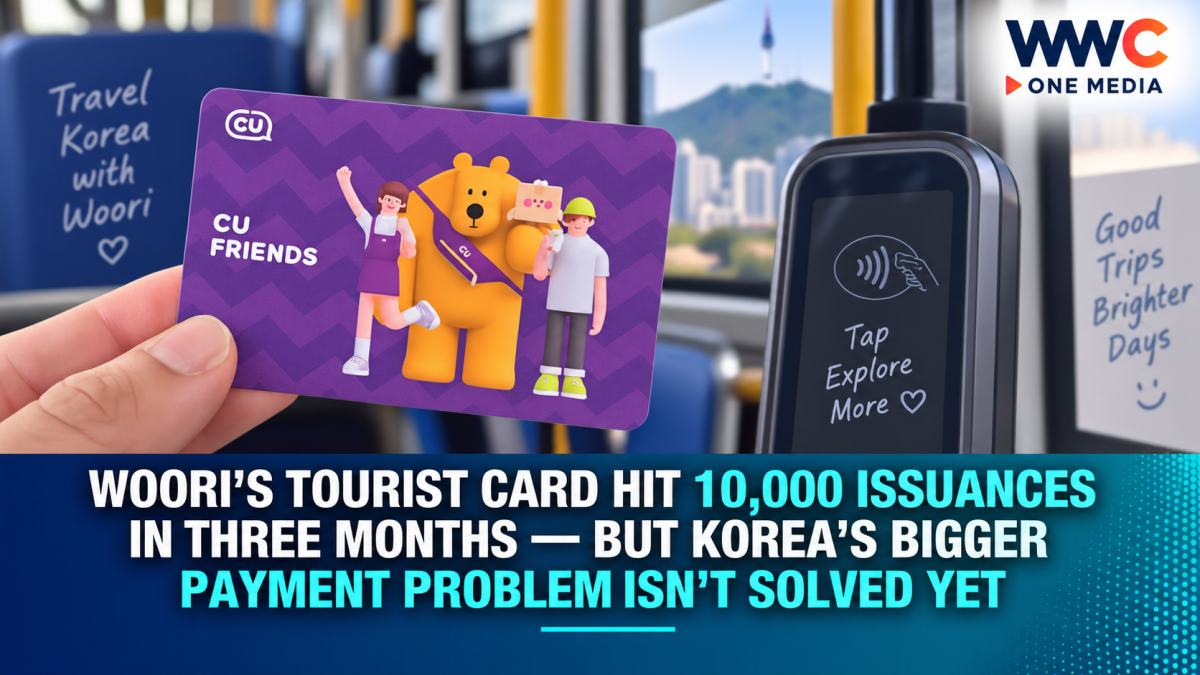
Woori Bank’s NOL World Card, a prepaid payment card designed specifically for international visitors, has surpassed 10,000 issuances roughly three months after its airport rollout, according to Woori and partner NOL Universe.
Developed by Woori Bank, travel-platform operator NOL Universe and fintech company KONA I, the card lets foreign visitors exchange currency, load funds, make payments and withdraw cash in South Korea without first opening a conventional Korean bank account.
Visitors can collect the card after arriving at Incheon International Airport, while Woori’s nationwide branches, ATMs, automated foreign-exchange machines and participating kiosks provide additional services for loading or withdrawing funds.
That sounds like a relatively straightforward travel product.
But its early growth comes as Korea confronts a more complicated contradiction: the country has become one of Asia’s hottest tourist destinations and one of the world’s most highly digitalized consumer economies, yet some of the services Koreans use most easily can still be awkward for tourists without a Korean bank account, phone number or locally issued card.
And with inbound tourism already breaking records in 2026, fixing that friction is becoming more valuable.
First, an Important Distinction: 10,000 Cards, Not Necessarily 10,000 Active Users
The Korea Herald headline describes the card as drawing 10,000 foreign users, but the underlying announcements use a more precise measure: more than 10,000 cards have been issued.
Those numbers are not necessarily identical.
A card being issued confirms distribution, but publicly available announcements reviewed for this story do not provide data on how many cardholders remain active, how frequently they use the product or how much money has moved through the cards.
The 10,000 milestone should therefore be reported as issuances, rather than interpreted as 10,000 regularly active customers.
That distinction becomes especially important when evaluating whether NOL World Card is becoming a mainstream tourism-payment platform or is still in its early adoption phase.
For now, the evidence supports the latter description: it is growing quickly from a relatively recent launch, but neither Woori nor NOL Universe has disclosed transaction volumes or active-user figures.
The Airport Rollout Started in May
Woori began distributing the card at Incheon International Airport on May 13, following a three-way partnership established with NOL Universe and KONA I in March.
Korea JoongAng Daily reported that the product itself had been launched on April 23, while the May 13 rollout marked the start of airport distribution — the point at which arriving international travelers could pick one up immediately.
That helps reconcile slightly different descriptions of the card being “launched” in spring.
NOL Universe’s latest announcement refers to it as having launched in May, while contemporary reporting distinguishes the April product launch from the May airport issuance program.
Either way, reaching 10,000 issuances by September means the product reached the milestone within only a few months of becoming readily available to arriving travelers.
Why Would a Tourist Need a Korean Prepaid Card?
At first glance, the product might appear unnecessary.
South Korea already has extensive card-payment infrastructure, and major international credit and debit cards work at many restaurants, department stores, hotels and retailers.
The problem becomes more noticeable when visitors move from ordinary physical purchases into Korea’s tightly integrated digital economy.
A Korea JoongAng Daily analysis published in May documented foreign travelers encountering difficulties with online purchases, reservations and domestic payment processes that sometimes expect a locally issued card or Korean banking credentials. One pair of New Zealand tourists interviewed by the newspaper said they were unable to complete an online movie booking without a Korean card or bank account and ultimately had to purchase tickets in person.
The Korea Herald similarly noted that foreign visitors can face difficulty opening Korean bank accounts or acquiring domestic credit and debit cards, leaving some more dependent on cash or cards issued overseas and potentially limiting their access to certain Korean apps.
So the selling point of NOL World Card is not that foreign Visa and Mastercard cards suddenly stop working throughout Korea.
They generally do not.
The value proposition is that a locally usable prepaid product can reduce some of the financial friction associated with arriving without Korean banking infrastructure.
Korea Is Already Trying to Tear Down Those Digital Walls
The financial industry is not acting alone.
Korean technology companies have also begun changing services that historically proved difficult for international visitors.
In June, Naver introduced passport-based identity verification for foreigners, allowing travelers with non-Korean passports to access functions including bookings, orders and payments through Naver Map without first obtaining a Korean mobile-phone identity verification.
That is significant because Korean online services have traditionally relied heavily on domestic identity-verification systems.
Naver said the new system was specifically intended to make services more accessible to foreign tourists and plans further expansion of supported services and languages.
Taken together with prepaid tourist cards, the changes point to a wider shift:
Korea is gradually redesigning parts of a digital ecosystem built primarily for residents so that temporary visitors can participate more easily.
There Are Now More Than 10 Million Reasons to Do It
The commercial incentive has become enormous.
South Korea welcomed 10.71 million international visitors during the first half of 2026, according to the Ministry of Culture, Sports and Tourism.
That was 21.3 percent more than a year earlier and about 26.9 percent above the corresponding pre-pandemic period in 2019.
June alone brought approximately 1.99 million international visitors, a 23.1 percent year-on-year increase.
China supplied roughly 650,000 visitors that month, followed by Japan at about 350,000 and Taiwan at around 220,000.
But the recovery is increasingly broad.
The Culture Ministry said first-half arrivals from the Americas reached approximately 1.08 million, up 12.7 percent year over year, while European arrivals climbed 20.2 percent to about 740,000.
That gives Korean banks, travel platforms and retailers an increasingly large international customer base to compete for.
Those Tourists Are Spending Record Amounts
The bigger number may be what happens after visitors arrive.
Foreign-tourist card spending in South Korea exceeded ₩10 trillion in the first half of 2026, reaching roughly ₩10.03 trillion according to government-linked data reported in July.
The Korea Times reported that this was the first time foreign tourist card spending had exceeded ₩10 trillion over a six-month period.
Separate reporting based on tourism data put first-half international tourism receipts at approximately US$13.61 billion, with estimated spending per visitor above US$1,270.
That changes the economic calculation.
A payment company that makes the tourist experience slightly easier is no longer merely providing a convenience to a niche group.
It is competing for part of a rapidly expanding multibillion-dollar flow of foreign spending.
Woori Isn’t Just Offering Payments — It Is Linking the Card to Shopping
NOL World Card also comes with benefits attached to brands international tourists are likely to recognize.
The partners have offered promotions involving Olive Young, Musinsa and GS25, covering categories such as beauty, fashion and convenience retail.
At launch, travelers exchanging specified amounts could also qualify for promotional benefits such as Musinsa-related beauty gifts, while NOL has advertised shopping discounts and other partner perks.
That shows how the product differs from a plain prepaid bank card.
The strategy is to place the financial product inside the broader tourist journey:
arrive, exchange currency, obtain the card, load won and then use it at Korean brands tourists already came intending to visit.
For Woori, that means foreign-exchange business and potential relationships with overseas customers.
For NOL Universe, the payment product connects its online travel platform with what travelers spend after arriving in Korea.
And for participating retailers, it creates another channel aimed directly at inbound tourists.
The Card Has Already Been Redesigned After Only a Few Months
NOL Universe marked the 10,000-issuance milestone by introducing new designs featuring recognizable Korean imagery.
The new card incorporates symbols including Namsan Seoul Tower, the Taegeukgi and Gyeongbokgung Palace.
That is not just cosmetic branding.
NOL says it ultimately wants the card to become more than a financial tool, using K-content intellectual property and additional designs to give the physical card souvenir value.
The company is also running a social-media promotion tied to its planned NOL Festival in October, with festival tickets available through a draw for selected participants sharing the card-design campaign.
Its longer-term plan is even more revealing.
NOL Universe says it wants to integrate payments directly with its NOL World online service and expand partnerships with popular Korean brands.
That suggests the eventual objective is a travel ecosystem rather than simply a plastic prepaid card.
Woori Is Already Looking Beyond Tourists at Incheon Airport
The next growth target is people staying longer.
After passing 10,000 issuances, Woori said it plans to expand distribution through bank branches located at universities, targeting exchange students and other short-term foreign residents who may also struggle to use conventional Korean banking services.
That potentially broadens the addressable market considerably.
A tourist might stay five days and need payments mainly for restaurants, shopping and transportation.
An exchange student staying several months needs a much deeper set of financial services — potentially repeated currency conversion, cash withdrawals, everyday purchases and more stable access to the domestic payment network.
Serving that group could also give Woori an entry point into relationships with foreigners who later become conventional banking customers.
Korea Has Also Made Tourist Prepaid Cards More Useful
The regulatory environment has been changing as well.
In January, South Korea’s Financial Services Commission approved an increase in the permitted balance for prepaid cards designed for foreign visitors, doubling the ceiling to ₩1 million under an innovative financial-services program.
That gives products in this category greater practical usefulness for travelers making larger purchases or staying in Korea for longer periods.
The policy itself illustrates how seriously Seoul now views financial accessibility as part of tourism infrastructure.
Airports, hotels and attractions are no longer enough.
A modern destination also has to make sure international visitors can pay, book, authenticate themselves and use apps without running into unnecessary digital barriers.
The 10,000 Milestone Is Promising — But the Real Test Is Usage
For Woori and NOL, 10,000 cards issued in a few months provides evidence that at least some travelers see value in the service.
But several important numbers remain undisclosed.
The companies have not publicly reported:
how many cardholders use the card repeatedly;
average spending per card;
total transaction volume;
which nationalities account for the most users;
or how many cards remain active after the traveler leaves Korea.
Those metrics would provide a much clearer picture of whether the product is becoming a durable part of Korea’s tourist-payment infrastructure.
Issuing a card at an airport is one challenge.
Convincing a traveler already carrying Visa, Mastercard or another travel card to keep using it throughout the trip is another.
The Bigger Competition Is for the Entire Tourist Journey
That is what makes NOL World Card more interesting than its 10,000-card headline suggests.
Korea’s inbound-tourism market is expanding rapidly.
Foreign visitors are spending record amounts.
Technology companies are dismantling some identity-verification barriers.
Banks and fintech firms are developing products specifically for travelers who do not belong to the traditional Korean banking system.
And travel platforms increasingly want to connect the moment someone books a trip with everything they purchase after landing.
The winners may ultimately be the companies that make those steps disappear into one seamless experience.
For NOL Universe, that ambition is explicit: it says it wants NOL World Card to link its online travel services with travelers’ offline experiences in Korea.
So 10,000 issuances are the first visible milestone.
The bigger test is whether Korea can make paying as a foreign visitor almost as effortless as paying as a Korean resident.
And with more than 10 million international arrivals in only six months, there has rarely been a better time to solve it.




Leave a Reply