
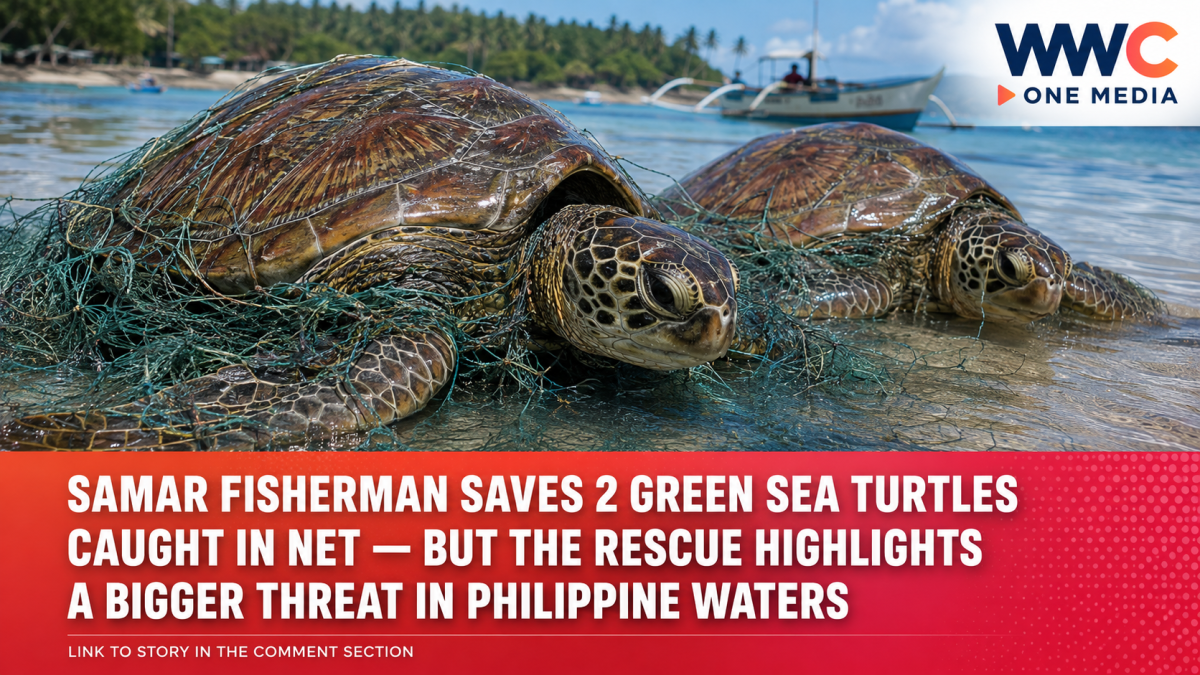
Two green sea turtles accidentally caught near Basey, Samar were examined, tagged and returned alive to the sea after a fisherman chose to surrender them to authorities rather than keep them. The successful rescue comes amid continuing concern over fishing-gear entanglement and other threats facing marine turtles across the Philippines.
TACLOBAN CITY, Philippines — What could have ended as another fatal encounter between endangered wildlife and fishing gear instead became a successful rescue after a fisherman turned over two green sea turtles accidentally trapped in his net off Samar.
Fisherman Rendel Amarilla, a resident of Rawis-Anibong in Tacloban City, was fishing near Barangay Amandayehan in Basey, Samar, at around 4:20 p.m. on Monday, August 31, when two green sea turtles became caught in his net, according to a September 1 report by the Philippine Daily Inquirer.
Instead of keeping or harming the turtles, Amarilla brought them the following morning to the Fishery Law Enforcement Team (FLET), allowing wildlife authorities to assess whether they were healthy enough to be returned to the sea.
‘Bea’ and ‘Heaven’ Get a Second Chance
The turtles were later named “Bea” and “Heaven.” The Inquirer reported that they measured about 46 centimeters and 44 centimeters in length, respectively.
Personnel from the Department of Environment and Natural Resources (DENR) examined the pair and found both turtles to be healthy and in good condition.
Before their release, authorities documented the animals and attached identification tags that may help researchers and conservation officials recognize them if they are encountered again.
Once the assessment, documentation and tagging were completed, Bea and Heaven were released safely back into the sea.
The episode may appear small beside the Philippines’ much larger environmental challenges, but encounters like this can make a measurable difference for long-lived marine species whose survival depends partly on what fishermen do when animals accidentally enter their nets.
Pawikan Encounters With Fishing Gear Are Far From Rare
The Samar rescue was not an isolated example of green sea turtles becoming entangled in fishing equipment.
On August 4, 2026, GMA News reported that three sea turtles were rescued in separate incidents in Zamboanga del Norte and Capiz, including a female green sea turtle accidentally caught in a fisherman’s net in Jose Dalman, Zamboanga del Norte. The animal was assessed by DENR personnel before being returned to the wild.
A few months earlier, on May 31, a fisherman in Pagudpud, Ilocos Norte, accidentally caught a 10.4-kilogram female green sea turtle in his net. Wildlife volunteers helped release it after the encounter, according to the Philippine News Agency.
Eastern Visayas has recorded similar cases as well. Daily Tribune reported in January that green sea turtles caught accidentally in fishing nets around Basey and Tacloban waters were surrendered, assessed and released rather than kept by the fishermen involved.
The repeated encounters underline one of the continuing threats facing marine turtles: incidental capture or bycatch in fishing gear.
Historical observations collected by the Southeast Asian Fisheries Development Center have also documented green turtles, hawksbills and other marine turtles becoming caught in fish corrals and gillnets in Philippine waters.
The Green Turtle’s Status Has Changed Globally — But Not Under Philippine Rules
There is an important distinction in describing the conservation status of the green sea turtle, or Chelonia mydas.
In October 2025, the International Union for Conservation of Nature announced that the species’ global status had improved from Endangered to Least Concern after decades of conservation work. IUCN said the global green turtle population had increased by roughly 28 percent since the 1970s.
That does not, however, mean green turtles are no longer protected or considered threatened everywhere.
The IUCN continues to identify some regional populations as Vulnerable, Endangered or Near Threatened, showing that recovery has been uneven across the species’ enormous range.
More importantly for the Samar incident, the Philippines continues to classify the green sea turtle as an Endangered species under DENR Administrative Order No. 2019-09. DENR offices were still citing that national classification in 2026 conservation operations.
That national status remains relevant to how pawikan are protected and handled in Philippine waters.
Keeping a Pawikan Is Not the Same as Rescuing One
Marine turtles are protected by Republic Act No. 9147, or the Wildlife Resources Conservation and Protection Act.
The law generally prohibits unauthorized acts including killing, injuring, trading, collecting, hunting, possessing or transporting protected wildlife.
Amarilla was not accused of illegally capturing the turtles. According to the report, the turtles entered his fishing net accidentally and he voluntarily surrendered them to authorities — exactly the kind of response environmental officials have repeatedly encouraged when fishermen encounter protected wildlife.
DENR has urged coastal communities to report accidentally caught or stranded turtles promptly so trained personnel can assess their condition and determine the proper course of action.
Why Green Sea Turtles Still Matter
The Philippines hosts five of the world’s seven recognized marine turtle species: green, hawksbill, olive ridley, leatherback and loggerhead turtles.
Green turtles are particularly important because of their role in coastal ecosystems. IUCN describes them as a keystone species associated with habitats including seagrass meadows and coral reefs.
Their global recovery is one of conservation’s encouraging recent stories, but the dangers have not disappeared.
Fishing-gear entanglement, degradation of nesting and feeding habitats, pollution, harvesting and other human pressures continue to affect turtles in different parts of their range. IUCN itself stressed when announcing the species’ improved global status that sustained conservation remains necessary.
That makes the decision of one fisherman in Samar more than a feel-good wildlife story.
Bea and Heaven survived because an accidental catch was treated as a rescue rather than an opportunity for exploitation.
The bigger question is how many other turtles entering nets across thousands of kilometers of Philippine coastline will be just as fortunate.




Leave a Reply