
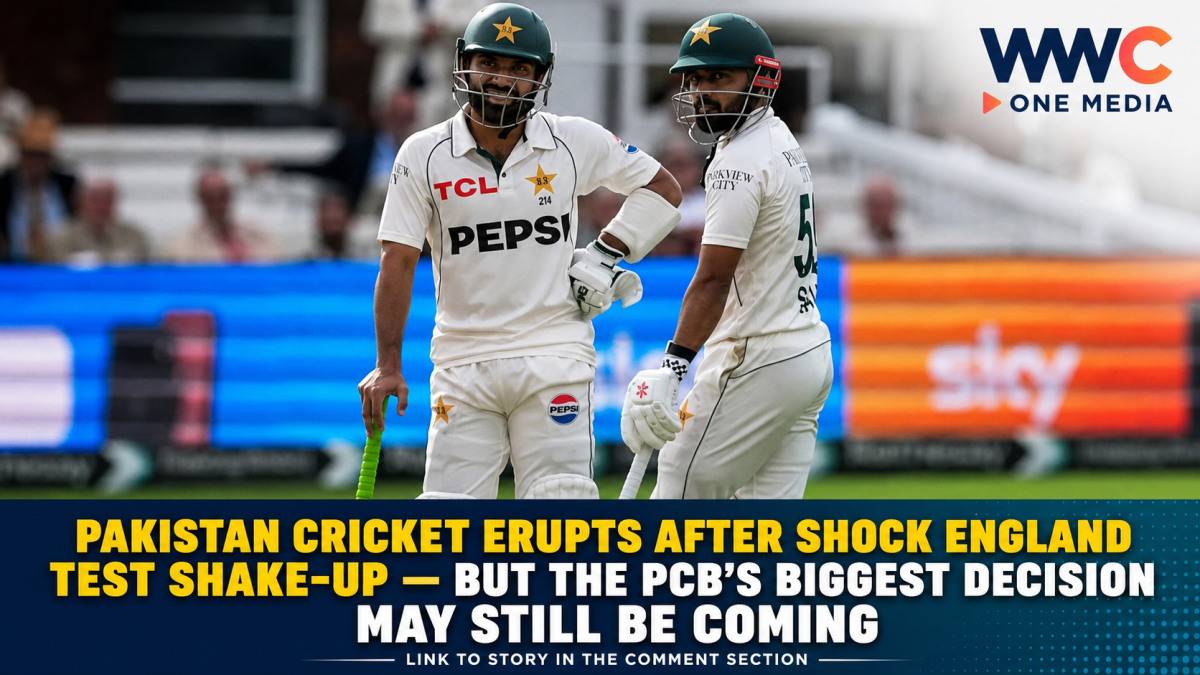
Pakistan cricket has descended into another storm of controversy after the Pakistan Cricket Board (PCB) made sweeping changes to its Test squad and coaching staff following two heavy defeats against England.
With the three-match Test series already lost, the PCB has released seven players and two coaches ahead of the final Test at Edgbaston, a move that former Pakistan captains and coaches have described as panic-driven and lacking stability.
The dramatic overhaul comes after Pakistan were beaten by an innings and 103 runs in the first Test at Headingley and then suffered a 194-run defeat at Lord’s. England now lead the series 2-0, with the final Test scheduled to begin in Birmingham on September 9.
Seven players sent home
The PCB confirmed that Mohammad Rizwan, Imam-ul-Haq, Salman Ali Agha, Ali Usman, Aamir Jamal, Muhammad Awais Zafar and Khurram Shahzad have all been released from the Test squad.
Imam was injured during the second Test, while Rizwan and Salman Ali Agha were among the senior players removed despite their experience at international level. Salman had captained Pakistan in the first Test.
The scale of the changes is particularly striking because they have been made between Tests during an ongoing overseas series, rather than after the tour has concluded.
Two coaches also removed
The PCB has simultaneously released head coach Sarfaraz Ahmed and bowling coach Umar Gul.
Sarfaraz, who had only been appointed as Test head coach in April, will be replaced for the final Test by Pakistan’s white-ball head coach Mike Hesson. Former Australia seamer Ashley Noffke will replace Gul as bowling coach.
The decision has immediately raised questions about continuity and long-term planning within Pakistan cricket.
Former Pakistan captain and PCB chairman Ramiz Raja was particularly blunt, describing the move as evidence that Pakistan cricket had “hit a panic button.” He questioned whether such dramatic changes in the middle of a series could actually improve performances or instead damage player confidence.
Shahid Afridi questions the logic
Former Pakistan captain Shahid Afridi also criticized the decision, questioning the selection strategy behind the replacements.
Afridi specifically raised concerns about players with limited Test experience being brought into an England series and questioned why a coach appointed only months earlier had been removed after such a short tenure.
His criticism reflects a broader concern: whether the PCB is responding strategically to a poor series or reacting emotionally to two disastrous results.
Former Pakistan coach Mickey Arthur was similarly scathing, calling the decisions “absolutely ridiculous” and arguing that Pakistan’s repeated changes to players, coaches and selectors have contributed to a lack of stability.
His central argument is straightforward: sustained international success requires planning, structure and continuity rather than constant upheaval.
A radically different squad for Edgbaston
The PCB has named seven replacements, including five players who have never played a Test match.
The newcomers are:
- Arafat Minhas
- Mohammad Imran Jnr
- Saad Baig
- Mohammad Imran, also known as Imran Randhawa
- Razaullah
Two players returning to the Test setup have previous experience: Saim Ayub, who has played eight Tests, and Abdullah Fazal, who has played two.
The new-look squad will be led by Babar Azam for the Edgbaston Test.
That means Pakistan could enter the final match of the series with a significantly different combination from the team that began the tour.
Why the criticism is so intense
Pakistan’s batting collapse provides the immediate backdrop.
Across the first two Tests, Pakistan failed to reach 200 in any of their four innings. The team was dismissed for 194 and 176 in the first Test before suffering another major collapse at Lord’s while chasing 389.
Yet critics argue that replacing such a large portion of the squad after two matches could create another problem: instability.
The question now is whether the PCB’s radical intervention can produce an immediate response—or whether it will leave an inexperienced group facing an even greater challenge against an England side that has already secured the series.
Misbah-ul-Haq adds another twist
The turmoil has also reached the selection committee.
Former Pakistan captain Misbah-ul-Haq, who is part of the national selection setup, has reportedly offered his resignation. The PCB had not accepted the resignation at the time of the latest reports.
That development adds another layer to an already extraordinary sequence of events surrounding the Pakistan team.
Kevin Pietersen adds a touch of sarcasm
Former England batter Kevin Pietersen also weighed in on the extraordinary turnover, joking that Pakistan captain Babar Azam might need to begin the toss earlier simply to explain all the changes.
The comment captured the wider reaction to a situation that has rapidly become one of the most dramatic mid-series shake-ups in recent Pakistan cricket history.
The bigger question facing Pakistan
The PCB clearly needed to respond after two emphatic defeats. But the debate is no longer simply about whether changes were necessary.
The bigger question is whether making so many changes at once—and during an ongoing Test series—is the right way to rebuild a struggling team.
Pakistan have now effectively traded experience for a younger, less-tested group. Five of the seven replacements have yet to play a Test, while two senior coaches have been removed.
That could turn into a bold rebuilding move if the newcomers perform at Edgbaston.
But if Pakistan suffer another heavy defeat, the PCB will face an uncomfortable question: was this a genuine rebuild—or simply a panic reaction to two bad Tests?
And with Pakistan’s cricket leadership already facing fresh uncertainty, the result at Edgbaston may determine whether this dramatic shake-up becomes the beginning of a new era—or another chapter in the country’s long-running cycle of instability.




Leave a Reply