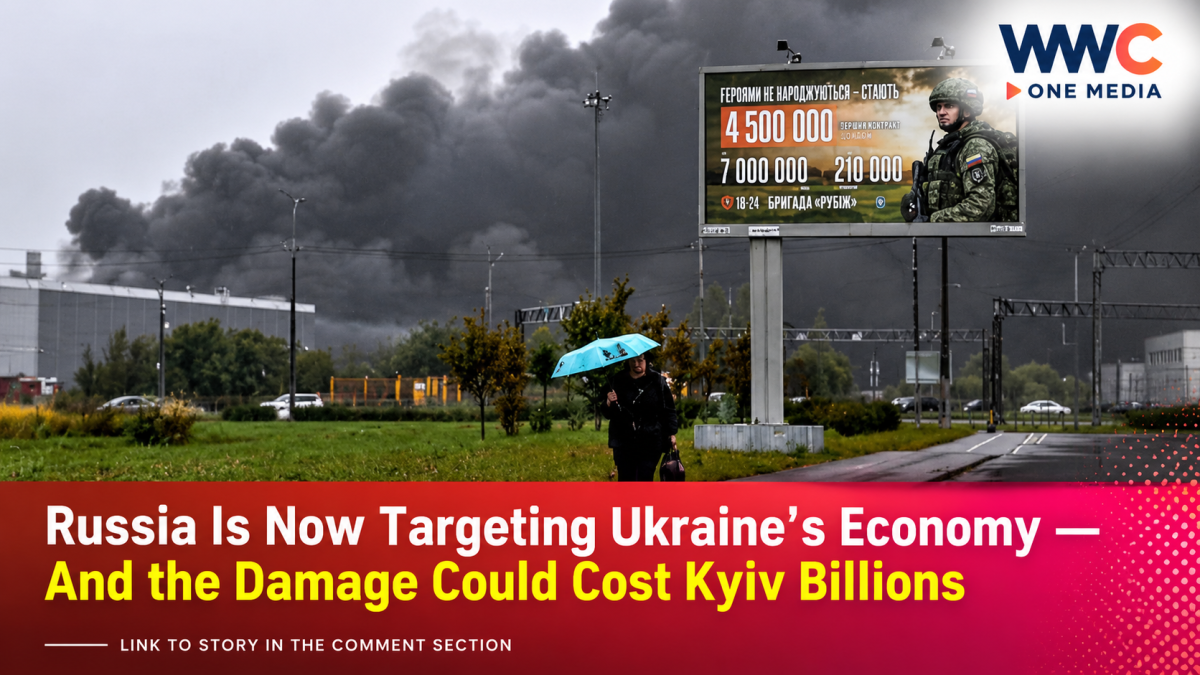
KYIV — Russia’s war against Ukraine is increasingly moving beyond the traditional battlefield and into the infrastructure that keeps the Ukrainian economy running.
In recent weeks, Russian missiles and drones have struck warehouses, distribution centres, steel plants, railway infrastructure, ports, petrol stations and other industrial sites, disrupting supply chains and threatening some of Ukraine’s most important sources of jobs, exports and tax revenue.
The Financial Times reports that the campaign is creating shortages in parts of Kyiv and has disrupted major retailers, logistics companies, pharmaceutical businesses and manufacturers.
Ukrainian officials say the economic consequences could be enormous.
Prime Minister Serhii Koretskyi has estimated that attacks on businesses could deprive the state budget of around $1.5 billion in tax revenue, a figure that could increase if the strikes continue.
The attacks come as Ukraine is already struggling with a large wartime financing gap.
The question now is whether Russia’s escalating air campaign can inflict enough economic damage to weaken Ukraine’s ability to finance the war — even without capturing large amounts of territory.
Warehouses Have Become A New Battlefield
One of the clearest signs of the changing campaign is the growing number of attacks on logistics facilities.
The FT reports that approximately 2.1 million square metres of Ukraine’s modern warehouse space — out of roughly 5 million square metres — has been destroyed, according to Ukrainian entrepreneur Ruslan Shostak.
Around 900,000 square metres of that destruction has occurred during the latest wave of attacks, according to the same estimate.
That damage has immediate consequences.
Warehouses are not simply buildings where products sit.
They connect manufacturers with retailers, online businesses with customers and importers with distribution networks.
Destroying them can interrupt the movement of food, medicines, clothing, household goods and other essential products even when the factories producing those goods remain operational.
A strike on a warehouse can therefore create an economic effect far beyond the physical value of the building itself.
Kyiv Supermarkets Are Already Feeling The Impact
The effects have reached ordinary consumers.
The FT reported that some Kyiv supermarkets have experienced shortages, with empty shelves appearing in stores operated by Novus.
The shortages represent a striking change from the early stages of Russia’s 2022 full-scale invasion, when supply chains were severely disrupted across the capital.
Retailers are now being forced to rethink how they store and distribute goods.
For businesses operating under constant air-raid threats, concentrating inventory in one large distribution centre creates an obvious vulnerability.
The alternative is decentralisation — keeping smaller quantities of products in multiple locations.
But that strategy is more expensive.
It requires additional warehouses, more transport, more workers and more complicated inventory management.
Those costs ultimately have to be absorbed by companies or passed on to consumers.
Ukraine’s Steel Industry Has Taken A Major Blow
The damage is even more serious in Ukraine’s industrial heartland.
Russian ballistic missile attacks have disabled the country’s three major remaining steel plants, according to the FT.
Two are owned by Metinvest, while the third is operated by ArcelorMittal in Kryvyi Rih.
Together, the facilities previously accounted for about 90% of Ukraine’s steel production, according to the companies and Ukrainian industry officials cited by the FT.
The attacks have reportedly left the plants idle.
More than 15,000 workers are connected to the facilities, making the consequences extend well beyond the factories themselves.
Steel production supports mining, rail transportation, energy consumption, engineering, ports and thousands of smaller suppliers.
When a major steel plant stops operating, the economic shock can spread through an entire industrial ecosystem.
Metinvest executive Oleksandr Vodoviz told the FT that the company could not yet determine whether repairs would take days, weeks, months or years.
The Goal Is Bigger Than Destroying Buildings
Ukraine’s government has increasingly described Russia’s attacks as an attempt to weaken the country’s economic capacity.
President Volodymyr Zelenskyy has said Russia wants to damage the Ukrainian economy and, through that pressure, weaken resistance.
The FT’s reporting describes the campaign as an economic war of attrition, occurring alongside Ukraine’s own attacks on Russian refineries, warehouses and other economic assets.
The strategy is relatively straightforward.
A functioning economy generates:
- Tax revenue
- Export earnings
- Employment
- Foreign currency
- Industrial output
- Supplies for the military and civilian population
Damage those systems and the government has fewer resources available for everything else.
But whether the strategy can produce the political or military outcome Russia may seek remains uncertain.
Russia Is Also Hitting Railways And Fuel Infrastructure
The attacks are not limited to warehouses and factories.
Russian drones have also targeted railway infrastructure in western Ukraine, including routes used to transport people and goods.
The FT reported that one recent wave involved approximately 800 drones over a 24-hour period, with attacks also hitting petrol stations.
Earlier Reuters reporting documented Russian strikes against ports, industrial sites, retailer distribution facilities, energy infrastructure and other economic targets.
On Aug. 27, Ukrainian officials said a Russian barrage included ballistic missiles and 258 drones, with attacks affecting grain storage, ports, energy and industrial infrastructure.
The expanding target set creates a cumulative problem.
Even if individual attacks fail to destroy a major facility, repeated disruption can make transportation slower, insurance more expensive and businesses less willing to operate at full capacity.
Ukraine’s Black Sea Exports Are Also Under Pressure
Ukraine’s economy depends heavily on its ability to export agricultural products, metals and other goods.
That makes the Black Sea particularly important.
Ukraine’s economy minister said earlier this month that Russia’s attacks and the effective disruption of Ukraine’s ports were costing the country around 1.5 percentage points of GDP, while approximately $40 billion of export revenue was at risk, according to Reuters.
The government also estimated that damage to infrastructure and fixed assets from Russian airstrikes had approached $10 billion in 2026.
Agriculture and steel are particularly exposed because both industries rely heavily on maritime exports.
When ports become unsafe or inaccessible, companies have to search for alternative routes through neighbouring countries.
Those routes are generally more expensive and have limited capacity.
Alternative Routes Are Already Struggling
Ukraine has developed alternative export corridors since Russia’s invasion, including routes through the Danube and neighbouring European countries.
But those routes cannot fully replace the capacity of Ukraine’s traditional Black Sea ports.
Ukraine’s agriculture minister Taras Vysotskyi told the FT that alternative routes were allowing the country to export only about 40% of normal agricultural volumes.
That creates another problem for farmers.
When grain cannot be exported quickly, it has to be stored.
Some agricultural companies are now using large temporary silo bags placed in fields because conventional storage capacity is becoming increasingly constrained.
For farmers, that means higher storage costs and greater exposure to weather, logistics disruptions and further attacks.
The Budget Problem Is Getting Worse
The economic attacks are happening at a particularly difficult time for Ukraine’s government.
Reuters reported that Ukraine’s domestic revenue underperformed by approximately $1.35 billion during the first eight months of 2026, with about a quarter of that shortfall occurring in August alone.
The country’s defence spending has also increased dramatically.
Ukrainian parliamentary budget committee head Roksolana Pidlasa said Ukraine spent about $42 billion on defence during the first eight months of the year, excluding in-kind military assistance.
Domestic revenue and local borrowing generated around $39 billion during the same period, according to her figures.
That leaves little room for economic shocks.
Every factory that closes, warehouse that burns or export route that is disrupted potentially reduces the government’s ability to raise revenue.
The $1.5 Billion Tax Warning
Prime Minister Koretskyi’s estimate that Ukraine could lose around $1.5 billion in tax revenue from attacks on businesses is therefore particularly significant.
The figure is an estimate rather than a final accounting.
Koretskyi said the assessment was made at the beginning of September and warned that it could increase because attacks were continuing.
The Ukrainian government is attempting to limit the damage.
Officials have discussed providing businesses with alternative production and warehouse locations, decentralising logistics and creating mechanisms for war-risk insurance.
Koretskyi said the government was considering a separate budget allocation of roughly $1 billion for war-risk insurance, with the goal of attracting additional international funding.
The United Nations Is Also Moving Supplies Away From The Air War
The threat to warehouses extends to humanitarian operations.
Reuters reported that the United Nations was considering moving humanitarian supplies into underground facilities after Russian strikes hit 10 UN warehouses in Ukraine during 2026.
One attack struck a major World Health Organization warehouse containing medical supplies.
Other attacks destroyed hygiene kits and school materials.
UN humanitarian coordinator Matthias Schmale said the attacks were creating additional costs that had not been included in the organisation’s original 2026 aid budget.
The UN is also investing in additional protective equipment, including armoured vehicles and drone-detection systems.
The development shows how the economic consequences of the air campaign are extending into humanitarian operations.
Ukraine Is Fighting Back Against Russia’s Economy
The economic war is not one-sided.
Ukraine has increasingly targeted Russian oil refineries, warehouses, logistics facilities and other infrastructure using long-range drones.
Kyiv says the goal is to reduce Russia’s ability to generate revenue and support its military operations.
Russia has also suffered consequences.
Reuters reported on Sept. 20 that a major Ukrainian drone attack struck the Moscow region, damaging part of the Moscow oil refinery and contributing to pressure on Russia’s already strained fuel market.
Russian authorities said more than 1,600 drones had been intercepted since Saturday, including 450 headed toward Moscow. Those figures are Russian government claims and have not been independently verified.
Two people were reported killed in the wider Moscow region.
Russia’s Energy System Is Also Under Pressure
The Ukrainian campaign against Russian energy infrastructure has become an increasingly important component of the war.
Repeated attacks have knocked out portions of Russia’s refining capacity, contributing to fuel shortages and higher prices in some regions.
The Moscow refinery alone processed approximately 11.6 million metric tonnes of crude in 2024, producing around 2.9 million tonnes of gasoline and 3.2 million tonnes of diesel, according to data cited by Reuters.
This creates a dangerous feedback loop.
Russia attacks Ukrainian economic infrastructure.
Ukraine attacks Russian energy infrastructure.
Each side tries to impose costs on the other’s economy while maintaining its own ability to finance the war.
Ukraine Faces A Difficult Winter
The timing of the escalation is particularly significant.
Ukraine is approaching another winter while its energy system, industrial base and public finances remain under pressure.
Reuters reported that Ukrainian officials expect a difficult winter as Russian attacks continue to damage infrastructure.
Economy Minister Oleksandr Kravchenko said the combination of infrastructure damage, port disruption and budget constraints was creating a particularly difficult economic environment.
For Ukrainian households, the consequences could eventually appear through higher prices, shortages and employment losses.
For businesses, the challenge is keeping operations running while moving inventory, protecting employees and repairing damaged facilities.
For the government, the challenge is maintaining defence spending while tax revenues and economic output come under pressure.
The Economic Battle Could Become As Important As The Front Line
More than four years after Russia’s full-scale invasion began, the battlefield remains only one part of the conflict.
The latest attacks suggest that economic infrastructure itself has become a central target.
Warehouses are being destroyed.
Steel plants are shutting down.
Railways are being disrupted.
Ports are under pressure.
Petrol stations are being hit.
Humanitarian supplies are being moved underground.
And businesses are being forced to redesign their entire logistics networks.
The objective appears to be broader than simply destroying individual facilities.
It is about making the Ukrainian economy more expensive to operate.
That matters because Ukraine’s ability to resist depends not only on soldiers and weapons, but also on whether factories can produce, trucks can move, ports can operate, workers can earn and the government can collect taxes.
The question now is how much economic damage Ukraine can absorb while continuing to sustain its war effort.
And with Russia continuing its air campaign and Ukraine striking deeper into Russia, the economic battlefield may become one of the most consequential fronts of the war.