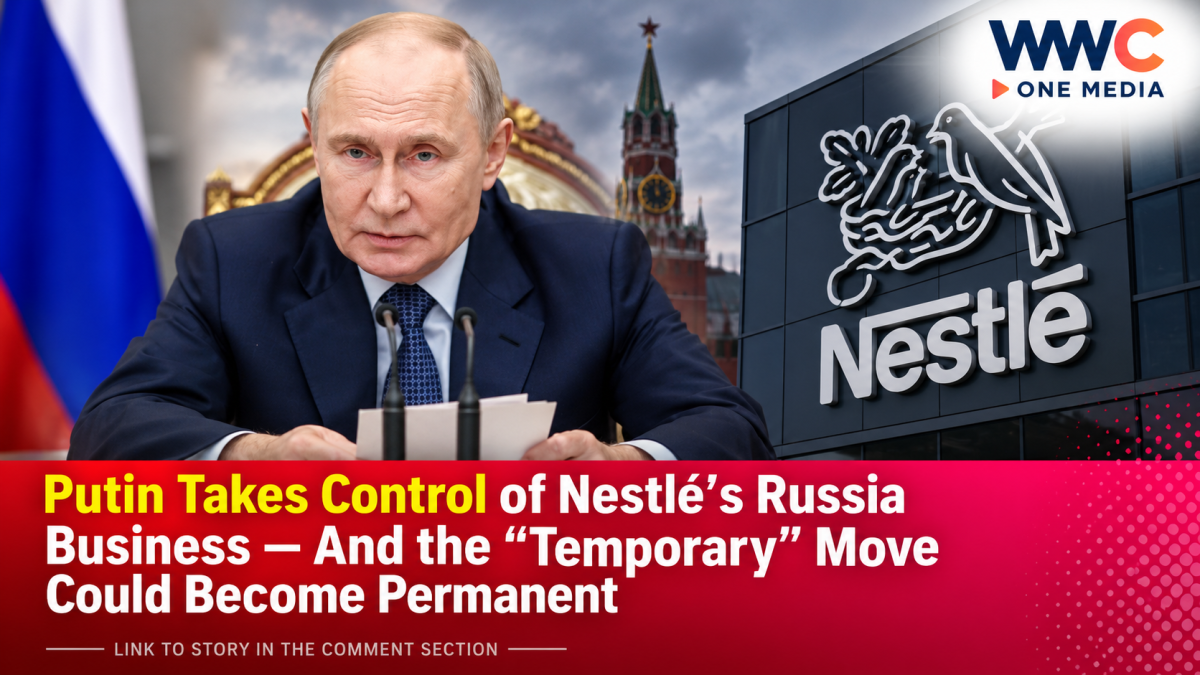
MOSCOW/VEVEY — Nestlé has been forced into an increasingly difficult position in Russia after President Vladimir Putin ordered the Swiss food giant’s local operations placed under temporary external administration, transferring management control to a little-known Russian company.
Nestlé said it is assessing the situation and its options and pledged to take the necessary steps to protect its rights and maintain business continuity for employees and other stakeholders.
The move does not formally amount to a completed permanent confiscation of Nestlé’s Russian assets. But it gives Moscow control over the company’s local operations and raises the possibility that Nestlé could ultimately lose those assets altogether.
The development marks another escalation in Russia’s campaign against Western-owned businesses that remained in the country following the full-scale invasion of Ukraine in 2022.
And Nestlé is far from the only multinational caught in the latest crackdown.
Putin’s Decree Puts Nestlé Under External Administration
Putin signed the decree on Sept. 17, placing the Russian businesses of Nestlé and several other Western companies under temporary administration.
The Nestlé entities affected include Nestlé Russia and Nestlé Kuban, with management transferred to L.E.V. Management, a relatively obscure Russian company. The decree also covers businesses connected to French retailer Auchan, the former Leroy Merlin operation now known as Lemana Pro, and French logistics company FM Logistic.
Nestlé confirmed the development the following day.
“Nestlé takes note of Russia’s presidential decree.”
The company said it was assessing its options and would take steps to protect its rights and ensure continuity of operations.
That wording is significant.
Nestlé has not announced that it is voluntarily leaving Russia.
Instead, the company is now responding to a decision made by Russian authorities that effectively removes its control over its local businesses.
Russia Says Western Sanctions Justify The Move
Kremlin spokesman Dmitry Peskov said Russia considered the affected companies to be associated with countries it regards as “unfriendly.”
He pointed to European countries’ sanctions against Russia and their support for Ukraine as factors behind the decision.
Switzerland is not a member of the European Union, but it has adopted sanctions against Russia following the invasion of Ukraine.
The Kremlin has argued that companies from countries imposing sanctions should not be treated in the same way as companies from neutral jurisdictions.
Russia’s explanation, however, does not mean that ownership of Nestlé’s assets has already been permanently transferred.
The current legal status is temporary administration.
That distinction matters.
“Temporary” Does Not Necessarily Mean Safe
Russia introduced its temporary-administration mechanism after the invasion of Ukraine as Moscow tightened restrictions on Western companies operating in the country.
In previous cases, temporary administration has preceded permanent changes in ownership.
One of the clearest examples is Danone.
Russia took control of Danone’s local business in 2023. The French company eventually sold the operation in 2024 at a substantial loss.
Carlsberg faced a similar intervention involving its Russian brewery business.
Those precedents are why analysts are treating Nestlé’s situation as more than a temporary management change.
The Kremlin, however, says that no decision has yet been made beyond temporary administration.
That means the eventual outcome remains uncertain.
Nestlé Still Has Six Factories In Russia
Nestlé’s Russian business is not an empty corporate shell.
The company operates six factories in the country, producing products including coffee, pet food and infant formula.
It employs roughly 7,000 people in Russia.
The company’s presence dates back decades, making Russia an established manufacturing and distribution market for Nestlé rather than a recently created operation.
After the 2022 invasion, however, Nestlé significantly reduced the scope of its Russian business.
The company stopped most non-essential sales, imports and exports, advertising and capital investment while continuing to supply what it described as essential everyday food products.
Nestlé has also said it continues to comply with applicable international sanctions.
Russia Is Much Smaller For Nestlé Than It Used To Be
The Russian business was more significant before the war.
Nestlé generated about 2 billion Swiss francs, or roughly $2.4 billion, in Russian sales in 2021, according to Reuters.
That represented about 2% of the group’s global sales at the time.
Because Nestlé subsequently reduced its Russian activities, analysts now estimate Russia accounts for approximately 1% of group sales.
That means the direct financial hit may be manageable for a company of Nestlé’s global scale.
But the potential loss of assets is still significant.
It could affect the value of factories, inventory, cash generated by the Russian operation and other assets that Nestlé can no longer freely control.
Nestlé Shares Fell After The Announcement
Investors reacted negatively when news of the Kremlin’s decision emerged.
Nestlé shares fell by roughly 2% to 2.4% in trading following the announcement, according to market reporting.
Analysts generally viewed the direct earnings impact as relatively limited because Russia represents only a small portion of Nestlé’s current global revenue.
But the bigger concern is the uncertainty surrounding the assets.
If Russia ultimately forces a sale at a steep discount or permanently takes control, Nestlé could have to recognize an impairment or other financial loss.
The precise impact cannot yet be calculated because the company has not disclosed a final valuation of what could ultimately be lost.
The Real Problem Is Control
For investors, the biggest issue may not be Russian revenue.
It is corporate control.
Nestlé can own an asset on paper while being unable to determine how that asset is operated, sold or transferred.
That distinction becomes particularly important when dealing with a government that has already intervened in other Western-owned companies.
Temporary administration can therefore create a situation in which the parent company remains the legal owner while losing practical control over its local operations.
That is exactly why Nestlé says it is now assessing its legal and strategic options.
L.E.V. Management Emerges As The New Operator
The Russian company taking temporary control is called L.E.V. Management.
It is not a major multinational or a well-known Russian industrial group.
According to reporting based on Russian corporate records, the company was registered in Moscow in 2024 and had little visible business activity before being placed in charge of the affected assets.
Its sudden appearance at the centre of several major Western businesses has attracted additional scrutiny.
Some reports have raised questions about the identity and background of its management, although claims about specific individuals should be treated cautiously where they have not been independently verified.
The important confirmed point is that L.E.V. Management has been designated to exercise temporary control over the affected businesses.
Auchan And Lemana Pro Were Hit Too
Nestlé is only one piece of the decree.
French retailer Auchan was also placed under temporary administration.
The company operates around 230 stores and an online business in Russia, employing approximately 30,000 people, according to Reuters.
The decree also covers Le Monlid, which operates the Russian business formerly known as Leroy Merlin and now branded Lemana Pro.
The former Leroy Merlin operation was already transferred to local management in 2023.
It now faces another layer of Russian government intervention.
The scale of the combined businesses means the decree affects tens of thousands of employees and a significant network of factories, stores, logistics facilities and other commercial assets.
Russia Has Already Used This Playbook
The Nestlé case is part of a much broader pattern.
Since the 2022 invasion, Russia has increasingly restricted the ability of Western companies to freely exit the country.
Foreign companies seeking to sell Russian assets face government approval requirements, restrictions on buyers and significant discounts.
Some have also been required to pay exit taxes.
Reuters cited a 2025 estimate from Moscow law firm NSP that the Russian state had seized more than $50 billion worth of private property, including foreign-company assets, since the beginning of the war.
The figure is an estimate rather than an official Russian government accounting of all seized property.
But it illustrates the scale of the economic conflict surrounding foreign businesses.
Danone And Carlsberg Offer A Warning
Nestlé’s situation is particularly notable because of what happened to other major consumer brands.
In 2023, Russia seized control of local operations belonging to Danone and Carlsberg.
Danone later sold its Russian business to a buyer approved by Moscow.
The transaction resulted in a major loss for the French food company.
Carlsberg similarly lost control of its Russian brewery assets after Moscow intervened.
These precedents explain why the word “temporary” is being treated cautiously by investors.
It does not guarantee that Nestlé will eventually recover full control.
Why Nestlé Stayed In Russia
Nestlé’s continued presence in Russia has been controversial since the invasion began.
Ukrainian officials and critics have repeatedly pressured Western companies to leave Russia completely.
Nestlé has defended maintaining production of certain essential food products, arguing that its responsibility includes providing food to civilians and protecting employees.
At the same time, the company has significantly reduced its Russian product portfolio and halted most non-essential commercial activities.
That approach allowed Nestlé to maintain a limited Russian presence while complying with sanctions.
The latest Kremlin intervention changes the equation.
The company now faces the possibility of losing control of even the reduced business it decided to retain.
The Swiss Government Is Watching Closely
Switzerland has expressed concern over Russia’s decision.
The Swiss government has also supported Nestlé’s efforts to challenge or reverse the intervention, according to Reuters reporting.
The case highlights an unusual geopolitical situation.
Switzerland traditionally emphasizes neutrality, but it has adopted sanctions against Russia in response to the invasion of Ukraine.
Moscow has increasingly rejected Switzerland’s claim to neutrality in its dealings with Russia.
That broader deterioration in relations appears to be one of the factors behind the Kremlin’s treatment of Swiss-owned assets.
Could Nestlé Actually Get Its Assets Back?
That remains unclear.
Nestlé has not publicly announced a specific legal strategy.
The company has said only that it is assessing the situation and its options.
Potential avenues could include legal challenges, negotiations with Russian authorities or diplomatic efforts involving Switzerland.
But the experience of other Western companies suggests that reversing Russian intervention can be difficult.
Even if a company remains the legal owner of its Russian assets, sanctions, Russian regulations and government control can make it extremely difficult to exercise those ownership rights in practice.
A Small Revenue Problem With A Much Bigger Strategic Warning
For Nestlé’s global financial results, Russia is no longer a dominant market.
At roughly 1% of group sales by current analyst estimates, the Russian business is unlikely by itself to fundamentally change the trajectory of the world’s largest food companies.
But the strategic implications are much larger.
Nestlé is one of the world’s most recognizable consumer brands.
If Moscow ultimately converts temporary administration into permanent ownership or a forced sale, it would send another warning to multinational companies that remaining in Russia carries the risk of losing control over assets.
And that risk does not disappear simply because a company has reduced its Russian operations.
The Next Move Could Determine The Final Cost
For now, Nestlé’s Russian business remains in a legal and commercial gray zone.
The Kremlin has taken control of management. Nestlé is assessing its options. A permanent transfer has not yet been formally announced.
That leaves several possible outcomes.
Russia could eventually restore Nestlé’s control.
The company could negotiate an exit.
A Russian buyer could acquire the assets.
Or the temporary arrangement could evolve into a much more permanent loss of ownership.
The financial consequences will depend heavily on which path emerges.
But the geopolitical message is already clear.
For Western companies that remained in Russia after the invasion of Ukraine, the question is no longer simply whether they can operate there.
It is whether they can still control what they own.
And for Nestlé, that question has suddenly become very real.