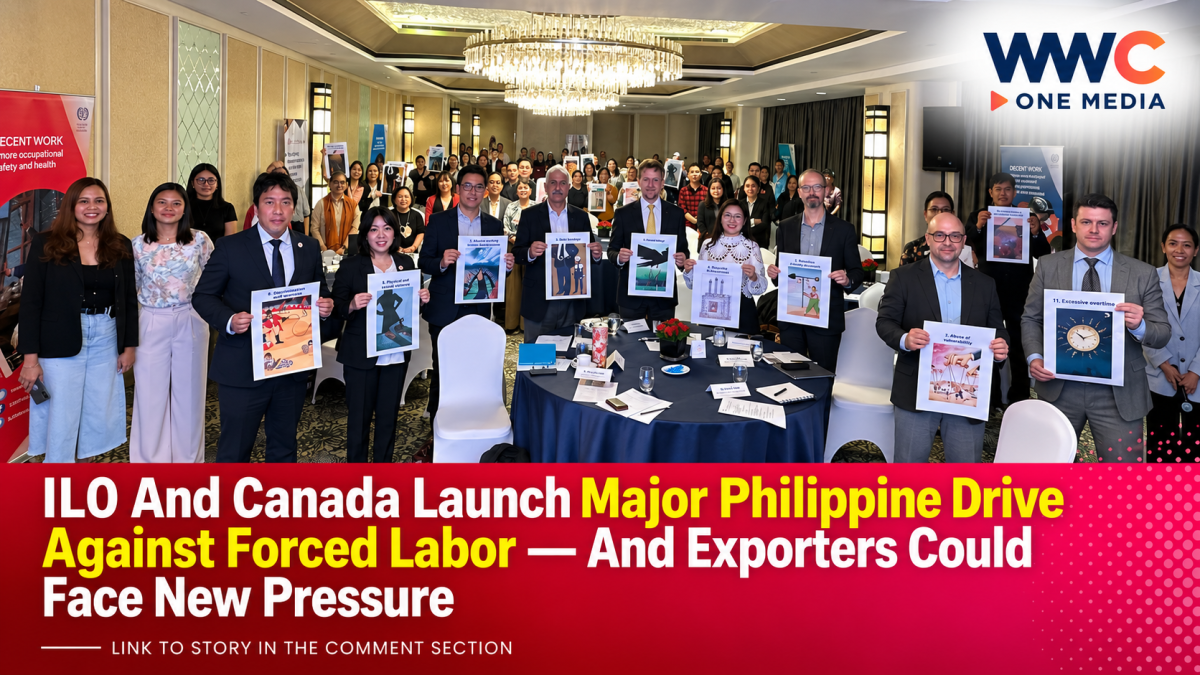
MANILA, Philippines — The International Labour Organization (ILO) and the Canadian government have launched a four-year initiative aimed at tackling forced labor in the Philippines, strengthening worker protection and putting greater pressure on businesses to address labor risks throughout their supply chains.
Called Promoting Responsive Institutions and Mechanisms to Eliminate Forced Labour in the Philippines, or PRIME PH, the project will run through February 2030 and is funded by Canada’s Employment and Social Development Canada through its Labour Program.
The initiative brings together the Philippine government, workers’ and employers’ organizations, civil society, businesses, development partners and other stakeholders.
Its objective goes beyond identifying forced-labor cases. The program will work on prevention, enforcement, victim protection, access to justice, responsible business practices and stronger institutions capable of detecting exploitation that often remains hidden.
Why The Philippines Is Facing A New Forced-Labor Push
The ILO said forced labor remains particularly difficult to detect in the Philippines because it can occur in informal employment arrangements and vulnerable sectors where workers may have limited access to protection or legal remedies.
The organization identified agriculture, manufacturing and mining among the tradeable sectors where forced-labor risks are particularly relevant.
BusinessMirror reported that Philippine labor officials also pointed to difficulties in recognizing exploitation, particularly when workers view excessive overtime, salary advances or other abusive arrangements as normal because of financial pressures.
That makes the problem more complicated than simply finding workplaces where workers are being openly coerced.
Some forms of exploitation can remain hidden because workers may be reluctant or unable to report them, while other cases occur outside conventional employer-employee arrangements.
PRIME PH Will Target More Than Enforcement
According to the ILO, PRIME PH has five broad areas of work.
These include strengthening prevention, advocacy and research, improving the country’s governance framework, enhancing victim protection and enforcement, supporting supply-chain due diligence, and building partnerships among government, businesses, workers and other organizations.
The project is also expected to generate more evidence about forced labor in high-risk sectors and adapt ILO indicators so they can be applied more effectively in the Philippine setting.
Another goal is improving the ability of government agencies and social partners to identify potential forced-labor cases, protect victims and support investigations that could lead to prosecution.
Philippine Agriculture And Manufacturing In The Spotlight
Agriculture and manufacturing are particularly important because they are among the Philippine sectors connected to international trade.
The ILO said these sectors are among those covered by the initiative because they export products to Canada.
That creates an important business dimension.
Companies increasingly face expectations from governments, customers and investors to demonstrate that their products are not being produced through abusive labor practices.
Under PRIME PH, businesses are expected to strengthen due diligence in their supply chains, including at lower levels where labor abuses can be harder to identify.
The project also calls for stronger grievance mechanisms and greater cooperation between employers and workers.
Canada Is Tightening Its Own Forced-Labor Rules
The Philippine initiative comes at a significant time for Canada.
Canada already prohibits the importation of goods produced wholly or partly with forced labor. In June 2026, the Canadian government introduced legislation designed to establish a standalone framework and strengthen enforcement of that import ban.
The proposed Canadian framework would give the government greater authority to identify high-risk goods and require enhanced supply-chain information from importers dealing with certain high-risk products.
That means supply-chain transparency is becoming increasingly important for companies that want to access the Canadian market.
The Canadian government said the proposed legislation would also encourage businesses to strengthen their own due-diligence systems and identify forced-labor risks before products reach the border.
The Philippines Already Has Laws Against Forced Labor
The new project does not mean the Philippines has no existing legal framework.
The Philippines has ratified the ILO Forced Labour Convention, 1930 (Convention No. 29) and the Abolition of Forced Labour Convention, 1957 (Convention No. 105).
Human trafficking for the purpose of forced labor is also prohibited under Philippine law.
The country has additional policy frameworks addressing trafficking and child labor, including the 2023–2027 National Strategic Action Plan Against Trafficking in Persons and the 2023–2028 Philippine Program Against Child Labour.
The challenge, according to the ILO, is strengthening implementation — particularly identifying cases, protecting workers and making enforcement mechanisms more effective.
Migrant Workers Face Another Layer Of Risk
The forced-labor issue also extends beyond workers employed inside the Philippines.
BusinessMirror reported that the Department of Migrant Workers has identified vulnerabilities affecting Filipinos during recruitment and deployment for overseas employment.
Reported concerns include applicants being required to perform unpaid work while waiting for deployment, contract substitution and abusive employment conditions.
Online recruitment has added another risk.
Authorities have warned jobseekers about fraudulent employment offers that promise attractive salaries or benefits before placing applicants in potentially exploitative situations.
The development is particularly relevant to the Philippines because millions of Filipinos participate in overseas labor markets, making ethical recruitment and worker protection an important part of the country’s broader labor policy.
Philippines And Canada Are Also Strengthening Migrant-Worker Protections
The forced-labor initiative is part of a broader expansion of labor cooperation between Manila and Ottawa.
In July 2026, the Philippines and Canada signed a Joint Declaration of Intent on Labour and Migration Cooperation aimed at promoting ethical recruitment and strengthening protections for migrant workers.
The declaration includes principles such as protecting workers from recruitment fees that are not authorized by law, improving recruitment regulation, protecting freedom of movement, preventing deception and coercion, providing workers with information about their rights and ensuring access to grievance mechanisms.
Canada’s government also announced in July that the two countries were deepening their broader strategic partnership, including cooperation on trade and labor mobility.
Canada Wants Worker Protection To Keep Pace With Trade
The timing is significant because the Philippines and Canada are also pursuing closer economic ties.
The Canadian government said in July that the two countries were working toward a potential Canada-Philippines free trade agreement, while Canada and ASEAN were also negotiating a regional trade agreement.
For Philippine exporters, that means labor standards could increasingly become part of the commercial conversation.
Companies seeking access to international markets may face growing demands to demonstrate that their products are produced under acceptable labor conditions.
PRIME PH is designed partly to help address that challenge by improving responsible business practices and supply-chain due diligence.
What The New Initiative Could Change
The project is expected to focus on five practical areas:
Better detection: Building evidence and tools to identify forced-labor risks that may otherwise remain hidden.
Stronger enforcement: Improving institutional capacity to investigate cases and pursue appropriate action.
Greater victim protection: Strengthening referral, rehabilitation, reintegration and access-to-justice mechanisms.
Supply-chain accountability: Helping businesses identify and address forced-labor risks deeper in their supply chains.
Stronger cooperation: Bringing government agencies, employers, workers, civil society and other stakeholders into a coordinated response.
The ILO said the initiative is intended to help ensure that workers can work in freedom and dignity while also supporting responsible business practices.
The Bigger Test For Philippine Businesses
The launch of PRIME PH signals that forced labor is increasingly being treated not only as a labor-rights issue but also as a trade and supply-chain issue.
For Philippine businesses selling into markets such as Canada, stronger documentation, recruitment practices, worker grievance systems and supply-chain checks could become increasingly important.
But the initiative does not establish that Philippine exports generally are produced using forced labor, nor does it mean that businesses covered by the program have been accused of wrongdoing.
Instead, it is designed to strengthen the systems used to identify, prevent and address risks before exploitation becomes entrenched.
For the Philippines, the challenge will be turning existing labor protections into effective enforcement on the ground.
For businesses, the pressure will increasingly be to show not only where products come from, but also how the people producing them are treated.