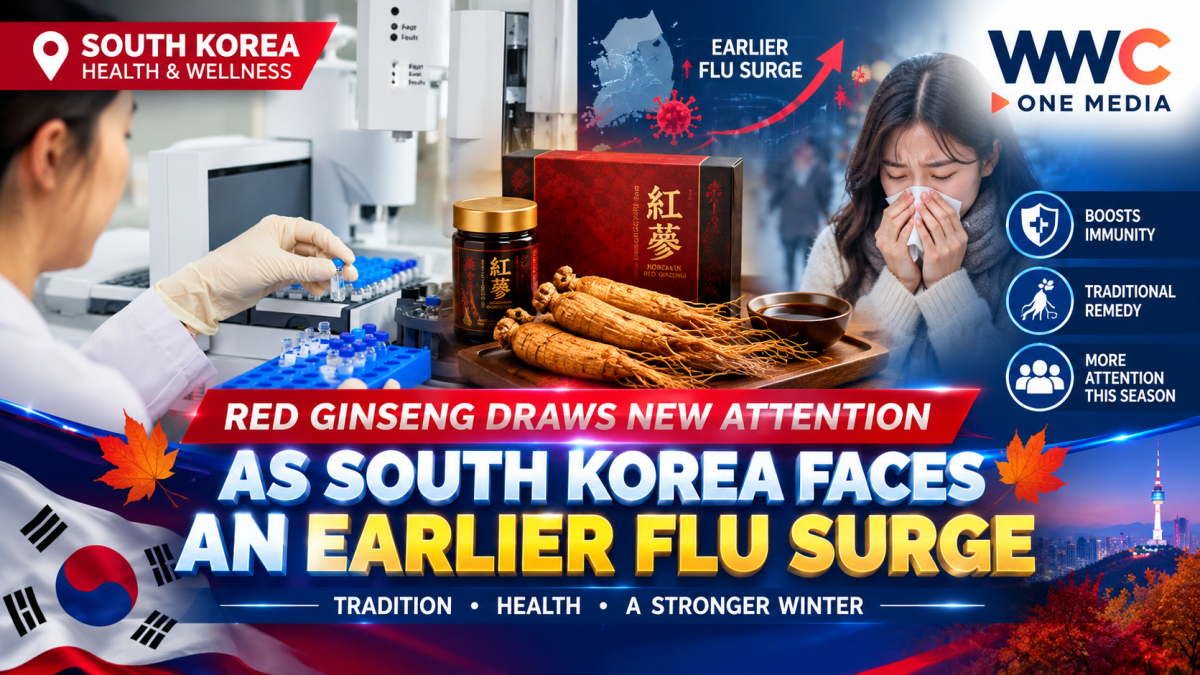
South Korea is facing an unusually early respiratory illness season — and red ginseng is emerging as one of the traditional health products drawing renewed public attention.
According to the Korea Disease Control and Prevention Agency, influenza-like illnesses reached 25.3 cases per 1,000 outpatients during the first week of September, nearly twice the epidemic threshold of 12.9 and a sharp increase from 13.3 in late August.
COVID-19 is also circulating at the same time. During that week, 193 patients were hospitalized with COVID-19, more than three times the number recorded four weeks earlier.
The earlier-than-usual spread has prompted greater interest in preventive health measures, including vaccination and products marketed or recognized for supporting immune health.
Why Red Ginseng Is Getting Attention
Red ginseng has a long history in South Korea as a functional food, and the country’s Ministry of Food and Drug Safety recognizes seven potential health functions for it, including immune-system support, blood circulation, fatigue reduction and antioxidant activity.
Researchers have also been examining whether red ginseng could influence immune responses when used alongside vaccination.
A study led by researchers at Sungkyunkwan University found that laboratory subjects receiving red ginseng together with a pneumococcal vaccine produced an antibody response about 25 percent higher than those receiving the vaccine alone. The experiment also reported faster bacterial clearance and reduced inflammation.
Another study from Georgia State University examined red ginseng in mice infected with H1N1 influenza. The researchers reported higher survival among mice that received both vaccination and red ginseng than among the comparison groups. Because this was an animal study, however, the findings do not by themselves establish the same effect in humans.
Scientists Are Looking at How It Could Work
Research from the Ulsan National Institute of Science and Technology (UNIST) has also investigated a possible molecular mechanism involving red ginseng and influenza A.
The study, published in the Journal of Microbiology, examined how Korean red ginseng affected the ZBP1 antiviral pathway in laboratory models. Researchers reported that red ginseng enhanced ZBP1-mediated cellular responses and reduced viral protein expression in their experiments.
That research adds to a growing body of laboratory and animal evidence, but it should not be interpreted as proof that red ginseng can prevent or treat influenza in people.
The U.S. National Institutes of Health notes that research on ginseng and immune function includes laboratory and animal findings, while effects can vary depending on the type and preparation of the product.
An Earlier Flu Season Changes the Conversation
The timing is particularly notable this year.
South Korea issued its flu advisory on September 11, considerably earlier than last year’s October 17 advisory, and began its vaccination program on September 21.
That earlier warning has pushed immune health higher on the public agenda as consumers look at multiple ways of reducing their risk of illness.
Still, red ginseng should be viewed as a potential component of overall health rather than a substitute for established preventive measures. Research on individual foods and supplements does not mean they provide complete protection against infection, and evidence can differ substantially between laboratory studies, animal experiments and human clinical trials.
For now, scientists continue to investigate exactly how red ginseng may interact with immune responses — while South Korea’s early flu surge gives the traditional ingredient a fresh spotlight.
The bigger question is whether ongoing human research will eventually show that the traditional Korean remedy can deliver measurable benefits beyond the laboratory — or whether its reputation will remain ahead of the evidence.
WWC ONE MEDIA G,A