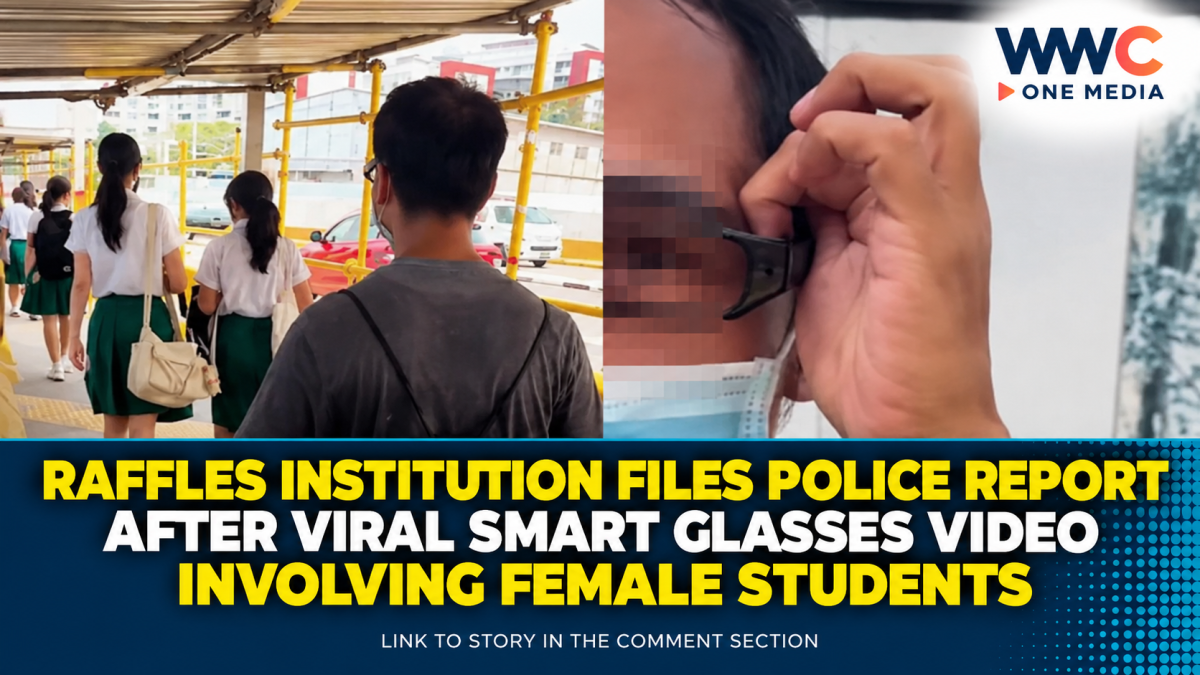
Raffles Institution has lodged a police report and increased security around the school after a viral video showed a man allegedly following female students while wearing glasses believed to be capable of recording video.
The video circulated online this week and appeared to show a man walking closely behind two female students wearing uniforms resembling those of Raffles Institution. The footage was reportedly taken along a pedestrian walkway near Marymount MRT station, although the exact date and circumstances of the recording have not been established.
In the footage, the man is seen holding a mobile phone close to his chest while walking behind the students. At one point, he appears to press the frame of his black-rimmed glasses. When the person filming him approaches, he turns around and walks in the opposite direction.
Online posts alleged that the glasses were smart or artificial-intelligence-enabled glasses capable of recording video. However, the footage itself does not establish whether the glasses were actually recording, nor has authorities publicly confirmed the model or capabilities of the device.
Singapore police confirmed that a report had been lodged and that investigations are ongoing. The original video was reportedly posted on Reddit on Sept. 21 before being removed, and was subsequently reposted on social media.
Raffles Institution principal Aaron Loh said the school takes students’ safety and well-being seriously. The school has since deployed security personnel outside the campus during dismissal periods as an additional precaution.
The incident has also renewed attention on the privacy implications of smart glasses. Such devices can incorporate cameras, microphones and other recording functions into ordinary-looking eyewear, raising questions about when recording people in public could cross legal boundaries.
Legal experts cited in coverage of the incident have noted that filming someone in a public place is not automatically illegal in Singapore, where people generally have a lower expectation of privacy. The circumstances and purpose of any recording can nevertheless become relevant under applicable laws.
For now, police have not publicly established that an offence was committed or confirmed that the students were recorded. The investigation will determine what happened and whether any laws were breached.
With the school adding security measures and authorities examining the circumstances behind the viral footage, the incident is putting a growing issue in the spotlight: how schools and law enforcement should respond as wearable cameras become increasingly difficult to distinguish from ordinary glasses.