
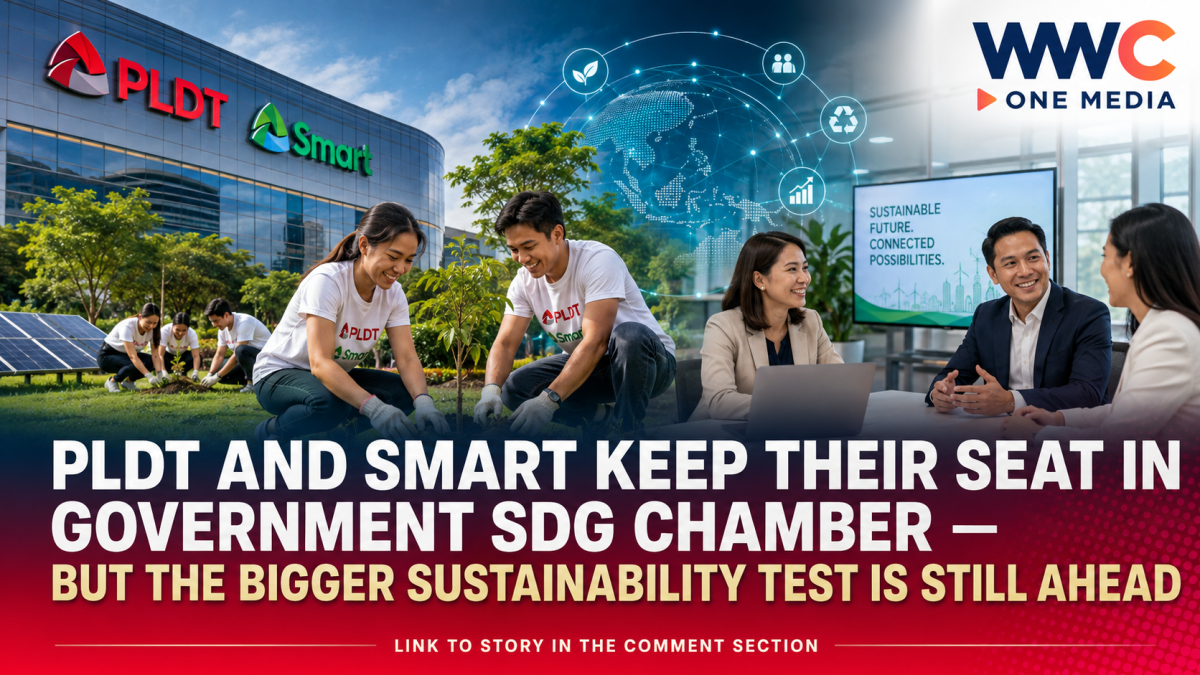
MANILA, Philippines — PLDT Inc. and its wireless arm Smart Communications are strengthening their sustainability commitments after remaining part of a key government-led platform helping shape the Philippines’ drive toward the United Nations Sustainable Development Goals — but the clock is increasingly becoming part of the story.
With less than four years before the 2030 deadline for the global SDGs, the telecommunications group’s continued membership in the Stakeholders’ Chamber on the Sustainable Development Goals puts it in a position to work directly with government, businesses and civil society groups on programs ranging from digital inclusion and infrastructure to climate resilience and responsible consumption.
The Stakeholders’ Chamber is administered by the Department of Economy, Planning, and Development, or DEPDev, the government department that replaced the National Economic and Development Authority following the enactment of Republic Act No. 12145 in 2025.
PLDT and Smart remain listed in DEPDev’s current Stakeholder Partnership Accelerator for Convergence and Engagement, or SPACE, platform.
That continued presence carries more significance than a ceremonial membership.
Under the Chamber’s rules, membership is subject to annual assessment, with renewal evaluated based partly on participation in meetings and contributions to the organization’s agenda. PLDT and Smart were among the inaugural organizations admitted when the Chamber was launched in 2022.
The platform was created to give non-government organizations, private companies and other stakeholders a formal channel to coordinate with government on the Philippines’ implementation of the 2030 Agenda.
PLDT and Smart’s sustainability push goes beyond telecom networks
The group’s continued participation comes as PLDT attempts to integrate environmental, social and governance goals more deeply into its core operations.
In its latest disclosures, PLDT said it scored 77 out of 100 in the 2025 S&P Global Corporate Sustainability Assessment, securing its second consecutive appearance in the S&P Global Sustainability Yearbook in 2026.
The score placed PLDT within the top 15% of companies in the global telecommunications industry covered by the assessment.
Its environmental strategy also includes a decarbonization roadmap targeting a 40% reduction in Scope 1 and Scope 2 greenhouse gas emissions by 2030, alongside initiatives involving renewable energy, energy efficiency, water management and biodiversity.
More recently, PLDT and Smart expanded their blue-carbon work with the University of the Philippines Marine Environment and Resources Foundation. The initiative builds on research across 17 marine protected areas and is designed to improve understanding of the carbon-sequestration potential of coastal ecosystems.
The companies are also integrating sustainability deeper into their supply chain, including training procurement teams to incorporate ESG considerations into supplier management.
Digital inclusion has become another major part of the equation
For PLDT and Smart, sustainability is not confined to emissions and environmental programs.
Digital access has become a major component of the group’s SDG strategy, particularly as the Philippine government tries to improve connectivity in geographically isolated and disadvantaged areas.
The government’s 2025 Voluntary National Review of the Sustainable Development Goals highlighted PLDT and Smart’s IDEATe program as one example of private-sector participation in advancing SDG 17, which focuses on partnerships.
Programs associated with the group have also covered education, digital skills, livelihoods, disaster resilience, cybersecurity, accessibility and connectivity.
DEPDev’s SPACE database currently lists numerous PLDT and Smart initiatives, including Connected Mangroves, renewable-energy programs for VITRO data centers, emergency communications training through the Ligtas Kit, accessibility initiatives and major telecommunications infrastructure projects.
The database also lists sustainability-related upgrades to existing and future VITRO data centers aimed at reducing power, water and other resource consumption.
There is another government council — and PLDT is involved there too
The Stakeholders’ Chamber should not be confused with President Ferdinand Marcos Jr.’s Private Sector Advisory Council, or PSAC.
PLDT is also represented separately in PSAC’s Digital Infrastructure Sector.
In July 2026, PLDT chief operating officer Menardo “Butch” Jimenez Jr. joined other technology and telecommunications executives in presenting recommendations to Marcos covering cybersecurity, artificial intelligence, fiber deployment and rural connectivity.
Among the issues being pushed by the sector are stronger cybersecurity-response capabilities, expanded connectivity for universities and health facilities and more resilient submarine cable infrastructure.
That parallel role means PLDT is participating in two different areas of government-private sector cooperation: one focused broadly on achieving sustainable development goals and another focused specifically on the country’s digital infrastructure and technology agenda.
The bigger question is what happens before 2030
Remaining inside government sustainability platforms gives PLDT and Smart another channel to influence — and participate in — the Philippines’ development agenda.
But maintaining membership and earning ESG recognition are only part of the equation.
The harder benchmark will be whether environmental targets translate into measurable reductions in emissions and resource consumption, while digital investments reach communities that remain underserved.
That challenge is becoming more urgent as 2030 approaches.
For one of the Philippines’ biggest telecommunications groups, the next phase of sustainability will therefore be judged less by promises and memberships — and increasingly by whether the numbers show that those commitments produced lasting results.

Leave a Reply