
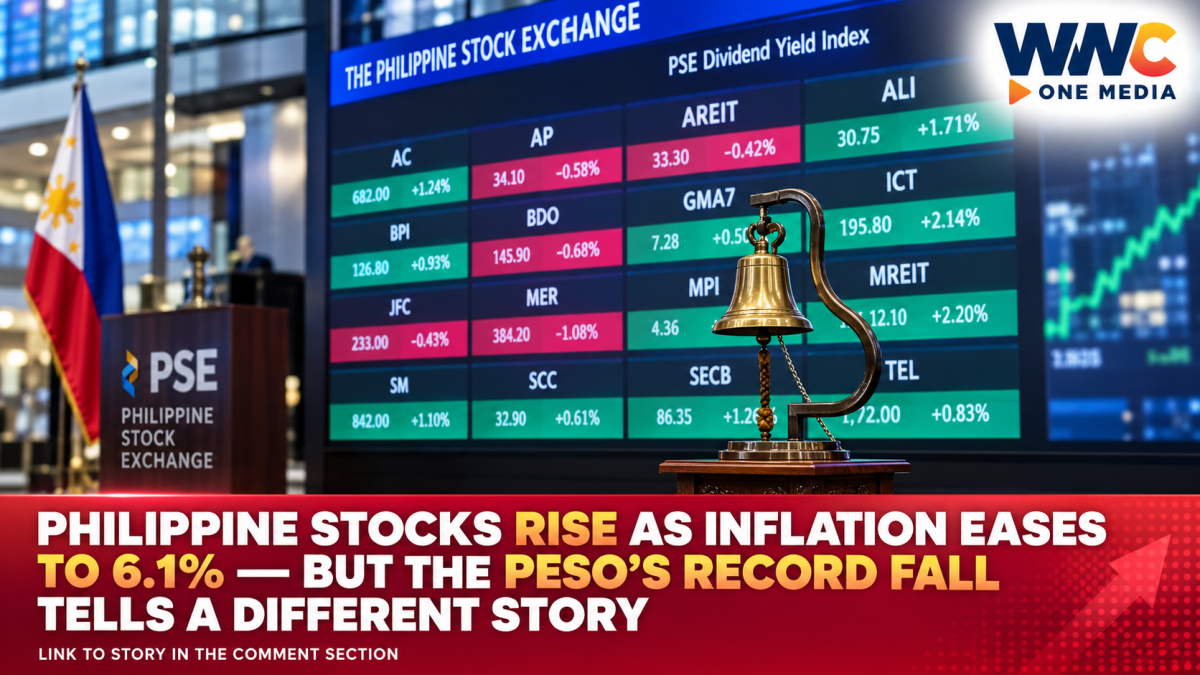
MANILA — Philippine stocks finally received a piece of economic news investors could cheer.
But underneath Friday’s modest rally was a far more uncomfortable message.
The Philippine Stock Exchange index (PSEi) gained 21.18 points, or 0.35%, to close at 6,090.60 on September 4, extending its advance for a second straight session after government data showed inflation easing for a fourth consecutive month.
The broader All Shares index increased 0.23% to 3,377.44. Mining and oil led sectoral gains, rising 0.75%, while all major sectors except industrials finished higher. Advancers beat decliners 108 to 93.
At first glance, it looked like exactly the signal investors had been waiting for.
Philippine inflation slowed to 6.1% in August from 6.2% in July.
But look beneath that number and Friday’s rally suddenly becomes much less reassuring.
Inflation remains painfully high.
Rice prices are still accelerating.
The poorest Filipino households are experiencing inflation of 8.2%.
The peso simultaneously collapsed to another historic low.
And the Bangko Sentral ng Pilipinas had raised interest rates only eight days earlier.
So the real question for investors is not whether inflation has finally peaked.
It is whether 6.1% is the beginning of a meaningful descent—or merely a temporary pause before oil, rice and a weaker peso push prices higher again.
Inflation Fell—but Only by 0.1 Percentage Point
The Philippine Statistics Authority reported that headline inflation declined from 6.2% in July to 6.1% in August.
That was its fourth consecutive monthly moderation and the lowest headline rate in five months.
But the improvement was small.
Inflation averaged 5.2% during the first eight months of 2026, well above the BSP’s 3% midpoint target and its 2%–4% tolerance band. Core inflation, which strips out selected volatile food and energy components, eased only slightly to 4.1% from 4.2%.
That makes the headline “inflation eases” technically correct but potentially misleading if read as meaning the Philippines’ cost-of-living problem has been solved.
It has not.
Prices are still climbing quickly.
They are simply climbing at a marginally slower annual pace.
Food Helped Bring Inflation Down
The largest reason for the August moderation was food.
Inflation for food and non-alcoholic beverages slowed to 4.6% from 5.2% in July, while food inflation by itself eased to 4.6% from 5.3%.
Vegetables provided one of the biggest improvements.
Prices for vegetables, tubers, plantains, cooking bananas and pulses swung to a 3.4% annual decline, compared with an 8.4% increase the previous month.
Fish inflation eased to 6.6% from 7.8%, while corn inflation slowed to 18.2% from 21.9%.
Housing, water, electricity, gas and other fuels also slowed, to 7.9% from 8.2%.
Those declines were enough to pull the national headline number slightly lower.
But another staple was moving aggressively in the opposite direction.
Rice Inflation Surged to 19.4%
Perhaps the most troubling number inside the August CPI report was rice.
Rice inflation accelerated to 19.4% from 17.1% in July.
That matters enormously in the Philippines because rice has a disproportionately large impact on household budgets, particularly among lower-income families.
The Department of Agriculture acknowledged that although overall food inflation moderated, the improvement remained uneven, with rice among the categories continuing to accelerate.
This means the national 6.1% headline rate does not necessarily describe what many households are experiencing at the grocery store.
And nowhere is that divide clearer than among poorer Filipinos.
For the Poorest Households, Inflation Isn’t 6.1%—It’s 8.2%
The PSA publishes a separate consumer-price index tracking households in the bottom 30% income group.
For them, inflation did not ease in August.
It remained at 8.2%, unchanged from July and dramatically above the national headline rate. Their average inflation during January through August reached 6.2%.
Food alone accounted for about half of their overall inflation.
That creates an important economic divide.
For investors, a 0.1-percentage-point decline in headline inflation can be interpreted as encouraging.
For families spending a large percentage of their income on food, electricity and transportation, the lived experience can look completely different.
That is why Friday’s inflation report simultaneously contained good news for the stock market and bad news for household purchasing power.
Transport Inflation Is Still Running at 13.5%
There was another warning buried inside the CPI data.
Transport inflation accelerated from 11.9% in July to 13.5% in August.
Transport contributed roughly 1.2 percentage points, or 20.1%, of the overall August inflation rate.
The Philippines is particularly vulnerable to energy shocks because it imports most of its petroleum requirements.
That vulnerability has become much more important in 2026 as geopolitical tensions in the Middle East have driven oil prices higher.
Reuters reported earlier this year that the energy shock helped push Philippine inflation sharply upward and forced the central bank back into monetary tightening.
So even as vegetable and some food prices improved in August, oil remains capable of undoing much of that progress.
And then there is the currency.
While Stocks Rose, the Peso Hit Another Record Low
Friday produced one of the strangest combinations in Philippine markets:
Stocks went up.
Inflation went down slightly.
And the peso fell to its weakest closing level ever.
The Philippine currency ended at ₱62.59 per U.S. dollar, down from ₱62.52 the previous session and surpassing its previous record-low close. It weakened to as much as ₱62.65 intraday.
UnionBank chief economist Ruben Carlo Asuncion attributed the move mainly to external forces, including a strong dollar, elevated U.S. Treasury yields and investor caution ahead of major U.S. economic data. Domestic political developments may also have contributed to short-term volatility.
That is significant because peso weakness can eventually feed directly back into inflation.
A weaker currency makes dollar-priced imports more expensive.
That includes oil.
Fuel then feeds into transportation, electricity, manufacturing, agriculture and logistics costs.
Those increases can eventually show up in everything from supermarket prices to corporate margins.
In other words, the very currency weakness happening alongside August’s inflation improvement could become one of the forces threatening the next inflation reports.
The Stock Rally Wasn’t Exactly a Stampede
The PSEi’s 21-point advance should also be kept in perspective.
Trading remained relatively quiet.
Total value turnover declined to about ₱3.86 billion from ₱5.24 billion the previous session.
The index traded between roughly 6,058 and 6,094 before closing at 6,090.60.
So Friday was positive—but hardly a full-blown risk-on explosion.
It looked more like investors cautiously buying after receiving one piece of better-than-feared economic data.
Luis Limlingan of Regina Capital said the softer inflation reading encouraged some buying, but investors remained cautious about both monetary policy and continuing peso weakness.
That caution makes sense.
Because Philippine investors are now trapped between two opposing forces.
Falling inflation is bullish.
High interest rates and currency weakness are not.
BSP Has Already Raised Rates Three Times
Just one week before the inflation report, the Bangko Sentral ng Pilipinas raised its benchmark rate another 25 basis points to 5%.
It was the central bank’s third consecutive quarter-point increase, following hikes in April and June.
The BSP said tighter policy was necessary to anchor inflation expectations and prevent high prices from spreading more broadly throughout the economy.
That creates an awkward situation for Philippine equities.
Higher rates can help stabilize inflation and the currency.
But they also make borrowing more expensive for households and businesses.
Property companies can face higher financing costs.
Consumers carrying loans and credit obligations have less disposable income.
Businesses may delay expansion.
And bonds become more competitive against equities as yields rise.
August’s 6.1% CPI print is therefore important partly because investors are looking for evidence that the BSP might eventually stop tightening.
One report, however, probably isn’t enough.
The Economy Can Hardly Afford Much More Tightening
That is where the story becomes more complicated.
The Philippines is fighting high inflation at the same time that economic growth has already weakened dramatically.
GDP expanded only 2.3% year over year in the second quarter, the slowest pace since 2021 and below economists’ expectations.
First-half growth was just 2.6%, far beneath the government’s revised 3.5%–4.5% target for 2026.
Construction contracted 14.8% in the second quarter, investment fell 9.2%, and household consumption growth weakened to 2.8% as inflation eroded purchasing power.
That leaves policymakers confronting the classic central-bank dilemma:
Keep raising rates to fight inflation and risk weakening an already sluggish economy.
Or:
Stop tightening too early and risk another inflation surge, particularly if oil and the peso move against the Philippines.
The stock market is trying to price both possibilities at once.
Philippine Businesses Are Getting More Nervous Too
Another BSP report released on September 4 added to the cautious picture.
The central bank’s Business Expectations Survey showed the overall business-confidence index plunging to -20.3% in July from zero in June.
A negative reading means pessimistic businesses outnumbered optimistic ones.
Companies cited Middle East tensions, high oil prices and persistent inflation among their concerns.
That creates another reason not to treat Friday’s 21-point stock-market gain as proof that investors believe the economic danger has passed.
Markets often move before economies do.
But sometimes a small rally is simply a small rally.
Why Mining and Oil Led the Market
The mining and oil index gained 0.75%, making it Friday’s strongest sector.
That performance makes sense in the present environment.
Companies exposed to commodities and energy can potentially benefit from higher global commodity prices, while some exporters and dollar earners may receive a translation advantage from a weaker peso.
By contrast, businesses dependent on imported inputs, domestic consumption or heavy borrowing can face greater pressure from currency weakness and elevated interest rates.
One notable individual performer was Semirara Mining and Power Corp., which gained 3.16% to ₱17.64 on September 4 after rising 5.56% the day before.
The contrasting sector performance illustrates how the same macroeconomic environment can create winners and losers.
High oil prices hurt consumers.
But they can benefit certain energy-related companies.
A weak peso raises import costs.
But it can improve peso-denominated earnings for businesses generating substantial dollar revenue.
That is why the index can rise even while the economic backdrop remains uncomfortable.
The Biggest Number May Not Be 6.1%
For Friday’s market, 6.1% was the headline.
But investors may want to remember several other numbers:
19.4% — rice inflation.
13.5% — transport inflation.
8.2% — inflation experienced by households in the bottom 30% income bracket.
₱62.59 — the peso’s record-low closing level against the dollar.
5% — the BSP policy rate after three consecutive hikes.
2.3% — second-quarter Philippine GDP growth.
Put those numbers together and Friday’s market story changes.
Yes, inflation is easing.
Yes, Philippine stocks rose.
But neither development means the macroeconomic pressure has disappeared.
The Philippines is still dealing with an unusually difficult mix of high food prices, expensive fuel, weak growth, elevated interest rates and a historically weak currency.
What Investors Should Watch Next
The next several inflation reports may determine whether Friday’s rally becomes the beginning of a more durable recovery or simply another short-lived bounce.
A continued slowdown in food and energy inflation could eventually give the BSP more breathing room.
But renewed oil-price increases or another significant peso decline could move the other way, raising imported inflation and keeping monetary policy tighter for longer.
Rice may be especially important.
August headline inflation fell even while rice inflation accelerated toward 20%.
If rice prices eventually stabilize, the headline rate could receive meaningful relief.
If they continue rising while transport costs remain in double digits, reaching the BSP’s target band becomes much more difficult.
And that is why the Philippine stock market’s 21-point gain may be less important than what happened in the currency market on the very same day.
The PSEi was telling investors that inflation might finally be moving in the right direction.
The peso was warning them that the next inflation problem may already be forming.
WWC ONE MEDIA M.J.E

Leave a Reply