
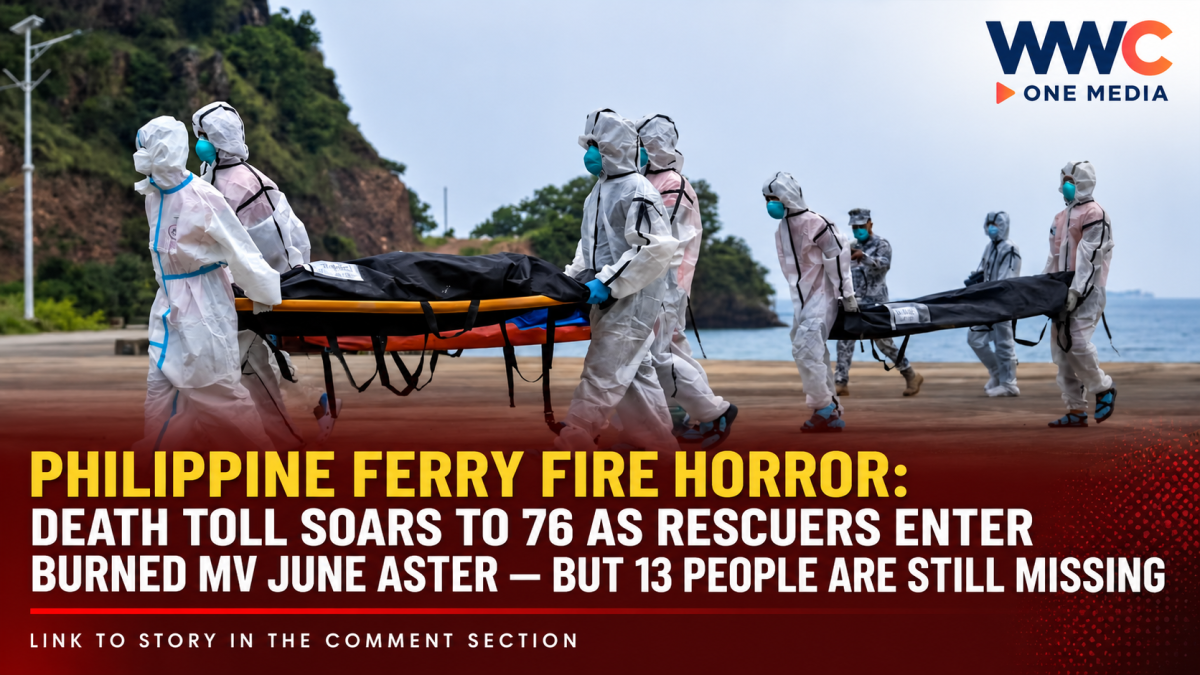
CORON, PALAWAN, Philippines — The death toll from one of the Philippines’ worst maritime disasters in recent years has climbed to 76, after rescuers recovered dozens more bodies from the burned-out MV June Aster, days after the passenger ferry was engulfed by a devastating fire off Palawan.
Authorities said 41 additional remains were recovered from inside the vessel, dramatically raising the confirmed death toll. As of the latest reports, 13 people remain missing, while 43 survivors were rescued from the disaster.
The scale of the tragedy became clearer only after Philippine Coast Guard personnel and other responders were finally able to enter sections of the ferry that had remained inaccessible because of extreme heat and thick smoke.
Bodies Found Inside Heavily Damaged Economy Section
The MV June Aster was traveling from Manila to Coron, Palawan, when fire broke out near the end of its more than 20-hour journey.
The vessel had been carrying about 132 people, according to the latest verified figures after authorities revised the original manifest. The fire erupted while the ferry was still offshore from Coron, a popular tourist destination known for its island-hopping and diving sites.
Responders initially struggled to board the ship because smoke and intense heat continued to pour from the burned vessel.
When emergency personnel eventually gained access to the interior, they discovered a far greater number of victims than initially feared. Many of the newly recovered remains were found in the economy accommodation area, one of the sections hardest hit by the fire.
Survivors Describe Explosions Before Fire Spread Within Seconds
As investigators search for the cause of the disaster, survivor accounts have raised alarming questions about what happened in the moments before the ferry was consumed by flames.
Several accounts cited by authorities indicated that two explosions were heard before the fire rapidly spread.
One survivor told Philippine media that he initially noticed only a small amount of smoke, but the situation escalated within seconds into a raging inferno. He and other passengers reportedly spent nearly two hours in the water before being rescued.
Authorities have also been examining reports that the fire may have originated near the vessel’s cargo hold. The ferry was carrying vehicles and cargo, including motorcycles, an electric vehicle, a forklift and a pickup truck, according to earlier Coast Guard information. However, officials have stressed that the exact cause has not yet been determined.
Some Passengers Jumped Into the Sea to Escape
The speed of the fire created scenes of panic aboard the MV June Aster.
According to accounts gathered by international news agencies, some passengers were forced to jump into the sea as flames and smoke spread through the vessel. Strong winds may have further intensified the blaze, while difficult sea conditions complicated rescue operations.
Philippine Coast Guard vessels, military units, local fishermen and private boats joined the massive search and rescue operation.
Earlier in the disaster, rescuers deployed vessels and aircraft and used drift-modelling tools to determine where survivors or victims could have been carried by ocean currents.
Families Now Face the Painful Wait for Identification
With the death toll now at 76, the focus has increasingly shifted from rescue to recovery and identification.
Authorities are transporting remains to Coron, where forensic teams are working to determine the identities of the victims. Families have been anxiously waiting for information about loved ones who remain unaccounted for.
The identification process is expected to be difficult because many of the remains recovered from the ferry were severely burned.
Temporary burial preparations were also underway in Coron as authorities confronted the possibility that identification could take time.
Investigation Targets Cause of Fire and Emergency Response
The Philippine government has launched investigations into the tragedy, including a review of how the fire started and whether proper emergency procedures were followed.
Authorities are expected to examine the actions of the vessel’s captain and crew, passenger evacuation procedures and the condition of the ferry before the voyage.
The fate and whereabouts of the ferry’s captain have also emerged as a major question in the investigation. Reports have indicated that the captain may have survived, but authorities were still working to establish his status and account of the disaster.
The ferry’s operator, Atienza Inter-Island Ferries, has said it is cooperating with authorities as the investigation continues.
Philippines Faces Fresh Questions Over Maritime Safety
The MV June Aster tragedy has once again placed the Philippines’ maritime safety record under intense scrutiny.
As an archipelago of more than 7,600 islands, the Philippines depends heavily on ferries and other sea transport to move passengers and cargo between communities.
But the country has also suffered numerous deadly maritime disasters over the decades, often raising concerns about vessel maintenance, overcrowding, emergency preparedness and safety enforcement.
The latest disaster has drawn comparisons to previous ferry tragedies, including the 1987 Dona Paz disaster, widely regarded as the deadliest peacetime maritime disaster in history.
However, investigators caution that it is still too early to determine exactly what caused the MV June Aster fire.
Search Continues as 13 Remain Missing
For now, the search is not over.
Authorities continue recovery operations for the 13 people still missing, while investigators work to reconstruct the final moments before the fire transformed the passenger ferry into a burned-out wreck.
The confirmed death toll of 76 makes the MV June Aster disaster one of the deadliest Philippine maritime tragedies in recent years.
But the most important questions remain unanswered:
What caused the explosions reported by survivors? How did the fire spread so quickly? And could more lives have been saved if passengers and crew had been given more time to escape?
As families wait for identification and rescuers continue searching the waters off Palawan, the investigation into the deadly MV June Aster fire is only beginning.




Leave a Reply