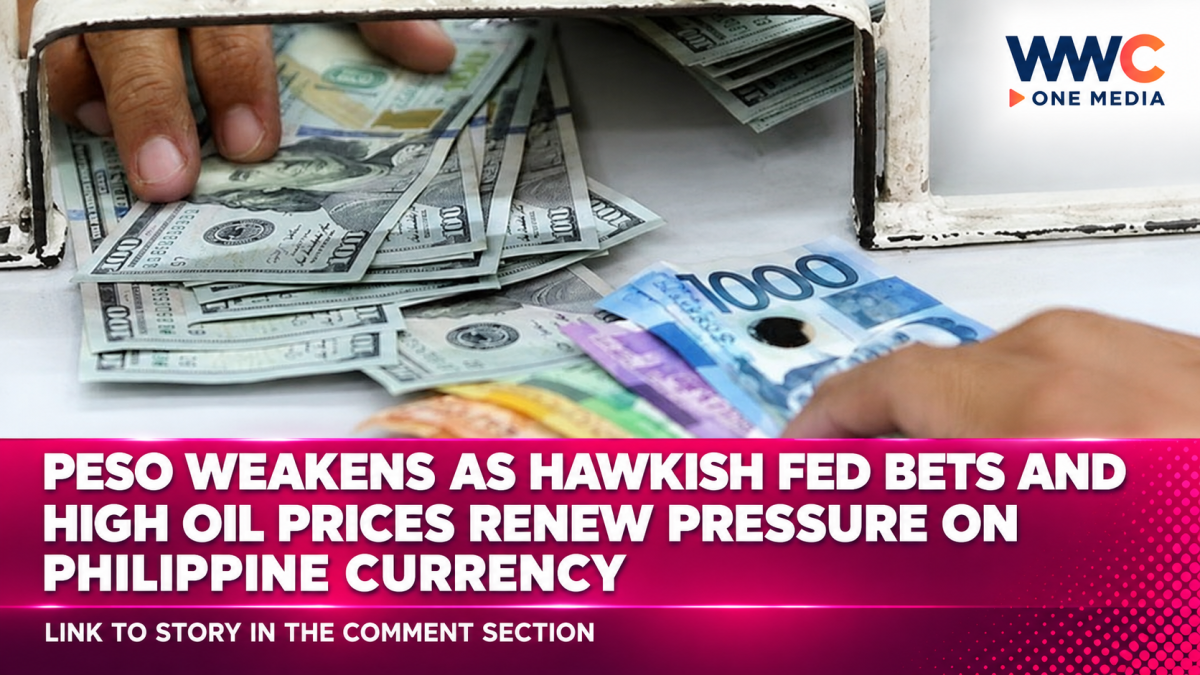
MANILA — The Philippine peso weakened against the US dollar on Thursday as stronger-than-expected US economic data reinforced expectations that the Federal Reserve could keep monetary policy tighter, while elevated oil prices continued to pressure emerging-market currencies.
The peso closed at ₱62.735 per dollar on September 24, down 15 centavos from Wednesday’s ₱62.585 finish. It opened at ₱62.70 and reached an intraday low of ₱62.795, reflecting renewed pressure on the local currency.
The decline came after a brief recovery earlier in the week. The peso had strengthened to ₱62.585 on Wednesday as global crude prices eased on hopes of diplomatic developments surrounding the Middle East conflict. That improvement was reversed a day later as oil prices and US interest-rate expectations again moved against the peso.
One of the major drivers was a stronger US economic backdrop. Recent US data pointed to continued economic expansion, strengthening expectations in financial markets that the Federal Reserve may have less room to reduce interest rates and could maintain a restrictive stance for longer.
Higher US interest rates can support the dollar by making dollar-denominated assets relatively more attractive to investors. For emerging markets such as the Philippines, sustained dollar strength can increase pressure on local currencies and raise the peso cost of imported goods and foreign-currency obligations.
Oil is another major concern for the Philippines because the country remains heavily dependent on imported petroleum. Higher global crude prices increase the country’s import bill and can put additional pressure on the peso as demand for US dollars rises to pay for energy imports.
The currency’s weakness also comes at a sensitive time for the Philippine economy. Recent revisions to growth and inflation forecasts have raised concerns about the domestic outlook. The Asian Development Bank, for instance, lowered its 2026 Philippine growth forecast to 3.3% from its earlier 3.8% projection while raising its inflation forecast to 5.9% from 3.9%.
Those changes add another layer of pressure to financial markets because slower economic growth alongside elevated inflation can complicate monetary-policy decisions and investor expectations.
The Bangko Sentral ng Pilipinas has already responded to persistent inflation pressures. On September 23, the Monetary Board raised its Target Reverse Repurchase Rate by 25 basis points to 5%, saying the measured increase would help anchor inflation expectations and limit the further broadening of price pressures.
The move means the BSP is now balancing several competing concerns: inflation remains above target, economic growth has weakened, and the peso remains vulnerable to external shocks such as US monetary policy and oil-price movements.
The latest currency decline could also feed back into domestic inflation. A weaker peso makes imported fuel, food, machinery and other goods more expensive in local-currency terms. The impact can spread further through transportation, logistics and production costs.
That risk is particularly relevant after Philippine inflation remained elevated at 6.1% in August, according to the BSP. Inflation has eased from its 7.2% peak in April, but remains above the central bank’s 2% to 4% target range.
The peso’s latest movement also underscores how vulnerable the currency remains to global developments. Earlier this month, the peso recorded multiple new lows amid surging oil prices and geopolitical uncertainty, demonstrating how quickly external shocks can affect the Philippine foreign-exchange market.
For businesses, a weaker peso can increase the cost of imported raw materials, equipment and energy. Exporters may benefit from stronger dollar revenues when converted into pesos, but companies dependent on imported inputs face greater cost pressures.
For consumers, the biggest concern is the potential pass-through to fuel, transportation and other prices if the peso remains under pressure while global oil prices stay elevated.
The bigger question now is whether the peso’s latest decline will remain a short-term reaction to stronger US data and oil prices—or become another source of inflationary pressure just as Philippine policymakers are trying to stabilize the economy.