
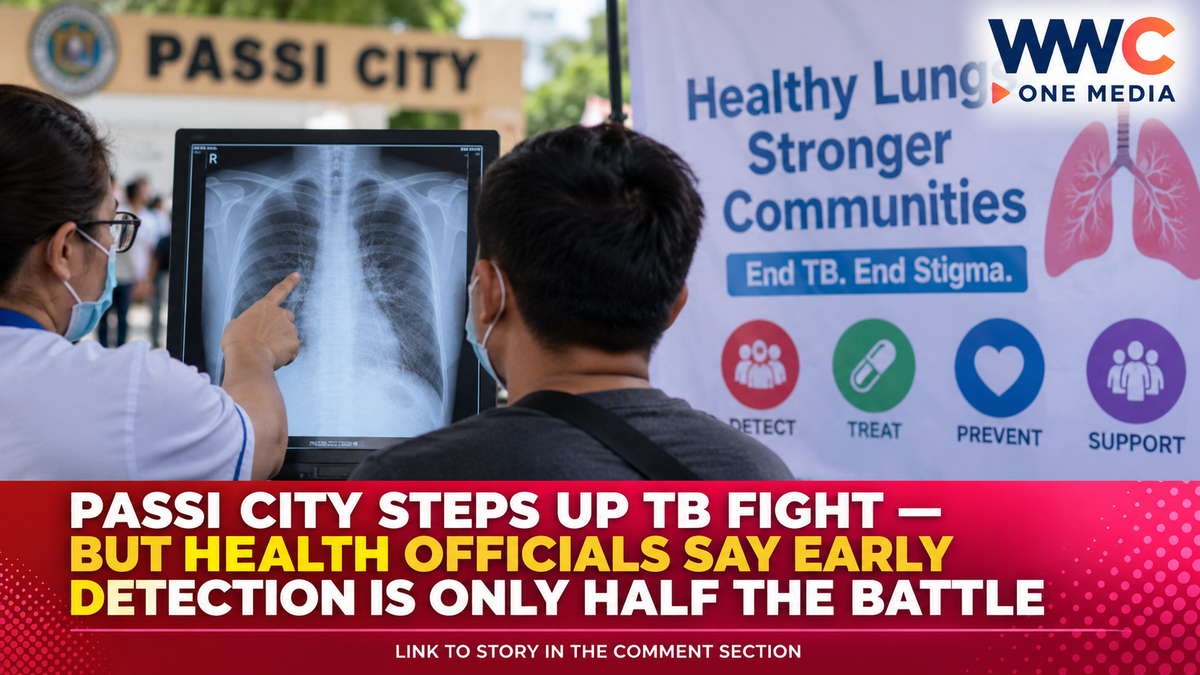
PASSI CITY, Iloilo — Passi City is intensifying its fight against tuberculosis (TB), bringing detection and prevention efforts closer to communities as health officials warn that delayed diagnosis, incomplete treatment and stigma can allow the disease to keep spreading.
The Department of Health (DOH) Region 6 and the Passi City government are strengthening a community-centered strategy built around prevention, early detection, proper treatment and treatment adherence.
The campaign was highlighted during a Tuberculosis Awareness Program and Interactive Discussion held at the Passi City Arena on Aug. 27 as part of National Lung Month activities.
Early detection is the key
Passi City Health Officer II Dr. Phoebe Palomo stressed that detecting TB as early as possible and completing the prescribed treatment are critical to controlling transmission.
Health authorities are encouraging residents to seek screening when symptoms or risk factors raise concern rather than waiting until the disease becomes more severe.
That approach is consistent with the broader national TB strategy. The DOH and World Health Organization have set a goal of screening 12 million Filipinos in 2026 under the Philippine Strategic TB Elimination Plan Phase 2, while the government proposed increasing the national TB program budget to ₱4.2 billion.
The national program is also expanding the use of ultra-portable, AI-assisted chest X-rays and WHO-recommended molecular tests to help identify TB more rapidly, particularly in communities where access to conventional diagnostic services can be difficult.
Passi is already part of the national TB network
The effort is not starting from scratch.
The Department of Health’s National Tuberculosis Control Program lists Passi City Health in Barangay Sablogon as an iDOTS facility, as well as a PMDT facility and a laboratory providing TB-related services.
PhilHealth’s 2026 list of accredited TB-DOTS package providers likewise includes the Passi City Health DOTS Center.
That network gives local health workers an important platform for screening, diagnosis, treatment and follow-up.
Iloilo’s numbers show why the push matters
The urgency is not limited to Passi.
According to the Iloilo Provincial Health Office, the province recorded 8,868 TB cases in 2024, with Passi City reporting 539 cases, the highest number among the province’s municipalities and cities listed in the report. The same report said 160 TB patients died in 2024, underscoring the consequences of delayed diagnosis and treatment challenges.
More recent data from Iloilo City also show that TB remains a significant public-health challenge.
From January through June 2026, Iloilo City recorded 1,520 notified TB cases, representing about 51% of its full-year notification target of 2,972. Most patients were between 25 and 45 years old.
The city’s health authorities have responded by expanding free chest X-ray screening and encouraging residents who may otherwise hesitate to visit health facilities to undergo testing.
The problem isn’t only medical — it’s also stigma
Health officials say treating TB requires more than medicine.
Fear, embarrassment and discrimination can prevent people from seeking testing or continuing treatment, allowing infections to remain undetected.
Western Visayas has faced this challenge on a broader scale. A 2025 report cited estimates of more than 22,000 TB cases in the region in 2023, substantially higher than the number actually notified, with health advocates warning that stigma and fear of judgment can discourage people from getting help.
The Passi campaign therefore places community education alongside screening and treatment.
Health workers are emphasizing that TB is preventable and curable, and that patients should not abandon medication simply because they begin feeling better.
Treatment must be completed
Stopping treatment prematurely can have serious consequences, including the development of drug-resistant TB.
Health authorities are therefore pushing standardized treatment regimens and follow-up support while also strengthening contact tracing so that people who have been exposed to TB can be assessed and, when appropriate, offered preventive treatment.
In neighboring Antique, health officials similarly emphasized contact investigation and treatment adherence, noting that close contacts can be tested and offered preventive treatment when appropriate.
A wider fight to end TB
Passi’s intensified campaign forms part of a much larger national effort to reduce TB transmission and move the Philippines toward its elimination targets.
The strategy is increasingly shifting from simply waiting for sick patients to appear at health facilities toward actively finding people with TB, bringing screening into communities and ensuring patients complete treatment.
For Passi, that means health workers, local officials and communities all have a role to play.
Because the biggest threat may not always be the patient who is already diagnosed.
It is the person who has TB but does not know it yet — and the people around them who may unknowingly be exposed.



Leave a Reply