
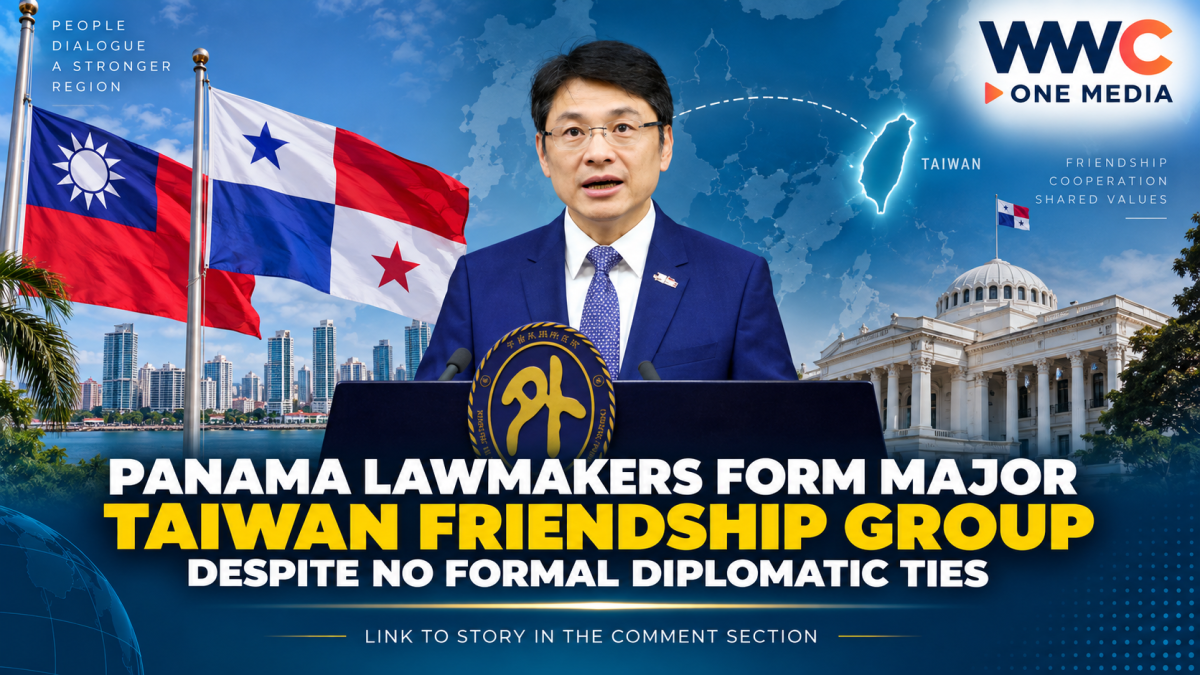
PANAMA CITY — More than 60 percent of Panama’s National Assembly has joined a newly established parliamentary friendship group with Taiwan, marking a significant development in relations between the two sides nearly a decade after Panama cut formal diplomatic ties with Taipei.
The multiparty parliamentary exchange group was formally launched at a ceremony in Panama City, bringing together 45 of the National Assembly’s 71 lawmakers, including Assembly President Shirley Castañedas and Vice Presidents Manuel Cohen and Manuel Cheng.
The move is being seen as one of the strongest recent displays of support for Taiwan within Panama’s legislature, despite Panama maintaining official diplomatic relations with Beijing under its one-China policy.
More Than 60% of Panama’s Lawmakers Join Taiwan Group
Taiwan’s Ministry of Foreign Affairs said the newly formed group includes lawmakers from multiple political parties and was created to strengthen exchanges between Panama’s National Assembly and Taiwan’s Legislative Yuan.
The 45 lawmakers represent more than 60 percent of Panama’s 71-member legislature.
Taiwanese officials said the group’s formation followed a surge in parliamentary exchanges, with more than 20 Panamanian lawmakers visiting Taiwan over the past six months. The visits have increasingly focused on areas including technology, trade and economic development.
The group is expected to provide a platform for cooperation in areas such as education, commerce, technology, entrepreneurship and knowledge exchange.
Taiwan Welcomes Move as New Opening for Cooperation
Taiwanese Foreign Minister Lin Chia-lung welcomed the creation of the group in a prerecorded message shown during the inaugural ceremony.
Lin said Taiwan and Panama share values including democracy, freedom and respect for human rights.
He expressed hope that the parliamentary platform would help deepen exchanges, expand cooperation and promote mutual benefits for both sides.
The initiative is particularly notable because Taiwan and Panama ended their formal diplomatic relationship in June 2017, when Panama switched diplomatic recognition to the People’s Republic of China.
The new group does not restore formal diplomatic ties.
Instead, it creates a channel for what officials and lawmakers describe as parliamentary diplomacy — allowing legislators to maintain and develop exchanges even when their governments do not have official diplomatic relations.
Panamanian Lawmakers Call It a ‘Step in the Right Direction’
Panamanian lawmaker José Antonio Pérez-Barboni described the creation of the Taiwan-Panama exchange group as a “step in the right direction.”
He said the initiative could mark the beginning of closer economic and trade relations and expressed hope for expanded bilateral engagement in the future.
Another Panamanian lawmaker, Joan Guevara, said the group showed that Taiwan and Panama could continue building parliamentary relations despite the absence of formal diplomatic ties.
Both lawmakers are associated with the Inter-Parliamentary Alliance on China, or IPAC, an international network of legislators focused on issues involving Beijing and democratic governments.
The Group Emerged as Parliamentary Exchanges Increased
The creation of the friendship group did not happen overnight.
Panamanian legislators have increased contact with Taiwan over the past two years, with several delegations visiting the island.
According to reports, IPAC-linked lawmakers led delegations to Taiwan in late 2025 and again in February 2026. Another delegation, led by Orlando Carrasquilla, chairman of Panama’s National Assembly Committee on Agricultural and Fisheries Affairs, visited Taiwan in July.
The pattern suggests that recent exchanges have increasingly focused on practical areas of cooperation, particularly technology and trade.
Taiwan is a global powerhouse in advanced technology and semiconductor manufacturing, making economic and technological cooperation an important potential area of interest for lawmakers seeking stronger ties with Taipei.
Panama’s Government Keeps Its Distance
The parliamentary initiative, however, does not mean Panama’s executive branch is changing its official foreign policy.
Local Panamanian media reported that President José Raúl Mulino’s government has maintained its distance from the lawmakers’ initiative and continues to recognise the People’s Republic of China.
Reports from Panama also said the creation of the friendship group prompted objections from Beijing, while Panamanian lawmakers defended the Assembly’s right to maintain independent parliamentary exchanges.
This has created a clear distinction between formal state diplomacy, which remains under the control of Panama’s executive government, and parliamentary diplomacy, where lawmakers can pursue exchanges and cooperation with foreign legislatures.
Why the Panama-Taiwan Move Matters
The development is significant because of Panama’s strategic importance in Central America.
Panama is home to the Panama Canal, one of the world’s most important maritime trade routes, and has long been a major centre for international commerce and geopolitical influence.
For Taiwan, every new international platform matters as Beijing continues to pressure countries and international organisations to limit official engagement with Taipei.
Taiwan has lost several formal diplomatic allies in recent years, but it has increasingly worked to strengthen informal relationships through legislatures, trade, technology, cultural exchanges and cooperation with democratic partners.
The new Panama parliamentary group represents one of those efforts.
A Growing Test of Taiwan’s Parliamentary Diplomacy
The launch of the group also comes at a time when Taiwan’s international status remains one of Asia’s most sensitive geopolitical issues.
Taiwan is democratically governed and maintains its own government, military and political system, while Beijing claims the island as part of China and has not ruled out using force to bring it under its control.
Against that backdrop, parliamentary friendship groups have become an increasingly important tool for Taiwan to build international support without requiring countries to formally recognise Taipei diplomatically.
The Panama group demonstrates how those relationships can develop even after formal diplomatic recognition has ended.
The Bottom Line
Forty-five of Panama’s 71 lawmakers have now joined a parliamentary friendship group with Taiwan, creating one of the most significant new channels of engagement between the two sides since Panama ended formal diplomatic relations with Taipei in 2017.
The group does not signal an immediate restoration of official diplomatic relations.
But it does show that Taiwan’s relationship with Panama is far from dormant.
With lawmakers increasingly interested in technology, trade, education and other forms of practical cooperation, the new parliamentary platform could open a fresh chapter in Taiwan-Panama relations.
Nearly a decade after official ties were cut, Panama’s lawmakers have sent a clear message: parliamentary doors to Taiwan remain open.
WWC ONE MEDIA J.M.D




Leave a Reply