
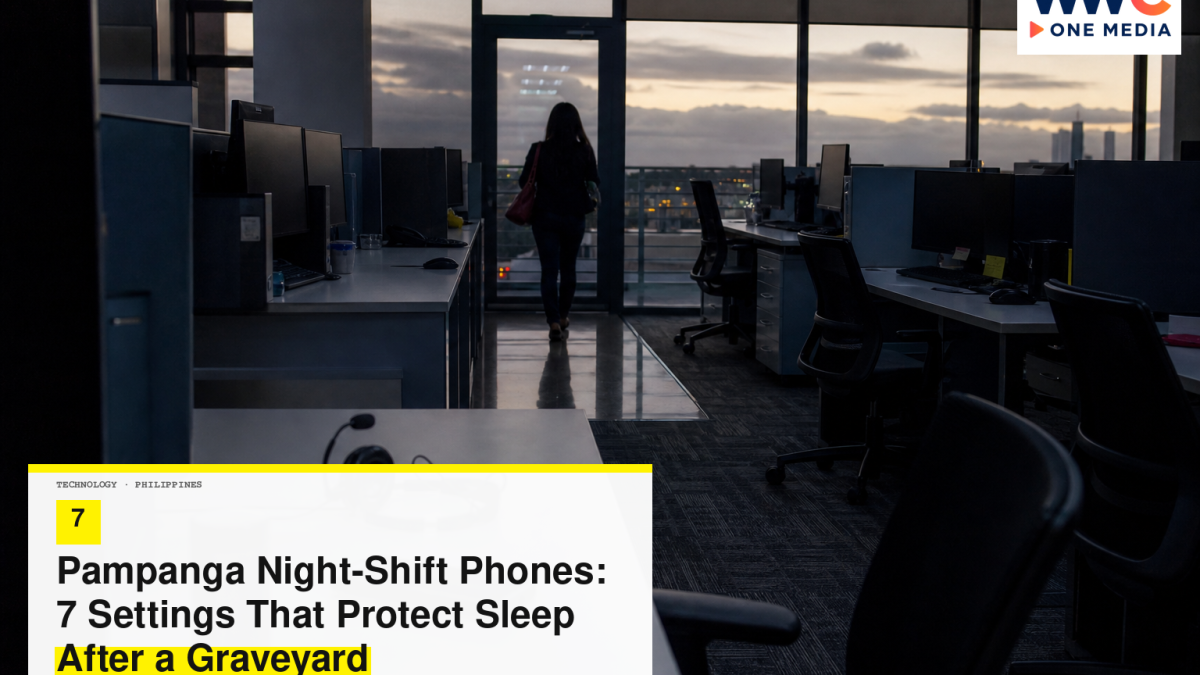
CLARK, Philippines — Pampanga night-shift phones do not live on a civilian clock. The headset comes off in a park inside Clark, or in a site toward Angeles, or after a shuttle that smells like perfume and fried food at 6:15 a.m. Sleep after a graveyard is already a negotiation with sun, with a barangay that believes morning is morning, with a family house in San Fernando that never signed the roster. The seven settings below are how the phone stops doing overtime on the ride home.
This is not wellness copy. It is a device list for people who work when Ohio is awake. DND schedules that actually match a night account, grayscale after clock-out, charging that is not a pillow, a dim that survives a dark shuttle, notifications that only let family and the bank through, a bedtime mode that is not 10 p.m. to 6 a.m. like a day-shift template, and one commute audio that is not an infinite feed: those seven are the job after the job.
Clark Freeport, Balibago, Dau, Mabalacat, the stretch toward SM City Clark, the boarding houses that learned blackout curtains the hard way: the geography is specific because the light is specific. A phone set for a Makati office will sabotage a Pampanga graveyard. The default Do Not Disturb in most phones assumes you sleep at night. You do not. If you leave the default, the phone will be quiet when you are on the floor and loud when your head hits the pillow at 8 a.m.
No invented science. Light in the face after a night account makes it harder to drop. Colour makes it easier to stay. A bed that is also a charging station makes it easier to pick the slot machine back up. You already knew. The settings are how you stop arguing with a thumb that is faster than a decision.
1. DND schedules on Pampanga night-shift phones, not a day-shift template
Do Not Disturb is the first setting that protects sleep after a Pampanga night shift, and it is the one people set wrong. They toggle it once at dawn like a candle and forget it on a day off. Or they leave a schedule that silences the phone from 10 p.m. to 7 a.m., which is exactly when a US account might still need a lead, a shuttle chat, or a parent who knows you are “awake anyway.”
Build a schedule around the roster you actually work, not the one the phone assumed. If you clock out near 6 a.m. and need to be down by 8, DND should start when the headset comes off, or when the shuttle door closes, and hold until the alarm you trust. If you sleep from 8 a.m. to 4 p.m., the schedule is 8 to 4, with a buffer on both sides. If the roster flips to midshift for training week, change the schedule that Sunday the way you change the alarm. A stale DND is how a group chat about a Saturday in Marquee Mall becomes a 10 a.m. interruption in a dark room in Angeles.
Exceptions: people, not apps. A parent. A partner. A lead who only calls when the floor is on fire. The bank if you truly need OTPs during those hours, which you usually do not while sleeping. Everyone else can leave a message. The college Viber, the selling groups, the game, the shopping live: they are not in the exception list. They are why the list exists.
Samsung calls some of this Modes and Routines. Pixel and others call it Bedtime or a schedule inside Digital Wellbeing. The name does not matter. The clock does. Name the mode Graveyard so you do not accidentally run a “Sleep” preset that ends at 6 a.m. just as you arrive at the boarding house.
Allow alarms. Always. DND that kills the alarm is how people start stacking three clocks and then using the phone anyway. The alarm is sacred. The rest is optional.
What not to do: use DND as a mood. Mood fails on a Thursday after a bad account. A schedule does not need a mood. If you have a day off, set a second schedule or a manual override you will remember. Day off is when the phone tries to drag you back into a day-shift internet. Protect a chunk of dark anyway if your body is still on Ohio.
Repeat callers: if your phone lets a second call from the same person break through, that is a decent compromise for a parent who does not text. One ring can wait. Two rings in a minute is a person. Set that if you have a family that panics at silence. Do not set it for a group chat that calls by accident.
Write the hours in Notes on Sunday with the roster. Clark sites change accounts. The phone will not guess.
2. Grayscale after clock-out: colour is how the feed wins
Grayscale is the setting that makes a Pampanga night-shift phone boring enough to put down. Colour is bait. A red badge, a warm food video, a game chest, a live shopping host in a bright shirt: those are designed for a thumb that is tired and still wired from the last call. Grey is rude to all of that. Rude is useful at 6:40 a.m. on a shuttle that is already a bedroom with seatbelts.
On Samsung, Modes and Routines can turn the screen grey when Graveyard mode starts. On many Androids, Accessibility, Color correction, Grayscale. On others, Digital Wellbeing, Bedtime mode, grayscale or extra dim. Put it on a shortcut if you cannot automate it: a two-tap tile on the pull-down. Clock out. Pull down. Grey.
You are not becoming a monk. You are making TikTok look like a photocopy so your brain can notice you are done. Maps can stay readable enough to find the boarding house. A Grab pin is still a pin in grey. A bank OTP is still numbers. What dies is the juice.
If your job requires looking at a colourful dashboard on the phone during the shift, do not grey the floor hours. Grey the home hours. The whole point is after a graveyard, not during the queue.
What not to do: skip grayscale because it looks “sad.” Sad is a sleep that starts. A colourful phone in a dark room in Balibago at 8 a.m. is how dawn becomes noon and noon becomes a late log-in you will pay for.
Some people prefer extra dim plus a warm tint instead of full grey. That is a valid second best. Full grey is stronger on payday weeks when shopping apps smell blood. Try grey for seven clock-outs before you decide it is not for you. One night is not a test. One night is a mood.
A routine that also turns off auto-brightness helps. A shuttle that goes from fluorescent site to dark highway to a bright Jollibee stop will otherwise slam the screen into your face. Manual low brightness plus grey is a pair.
3. Charging: the bed is for sleep, the outlet is for the wall
Charging is a sleep setting because the phone in the bed is a lamp, an alarm, a conversation, and a store. Pampanga night-shift phones already spent eight hours as a tool. They do not get the pillow.
Charge outside the bed. In a small boarding house near the Clark parks, “outside” may be two metres. Two metres is enough. A chair. A shelf. A corner near the door. A powerstrip that is not under the pillow. If the room is a box, the farthest outlet still counts. If you fear the alarm, buy a cheap second clock or use a dumb phone that only rings. The smartphone is a slot machine with a clock app. You know this at 7 a.m. when you only meant to check the time.
Wireless pads on the nightstand are still the nightstand. Distance is the feature. Cable across the room is the feature. If you need the phone as a modem for a partner’s alarm, you have two people and one bad system. Get a second cheap alarm.
Battery health lectures are not this article. This article is about the hand that reaches. A phone that is warm from a fast charge under the pillow is also a nightlight. Nightlights after a graveyard are how the room never gets dark enough, especially when the curtain situation in a San Fernando family house is a sheet and a prayer.
What not to do: charge in the bed “just until 80” and then fall asleep with the short video still talking. Put the cable where your body is not. If you use the phone as a flashlight to the CR, put it back on the chair. The CR trip is how many feeds restart.
If the boarding house has one outlet and a roommate, negotiate the strip in daylight, not at 7 a.m. with a dead battery and a short temper. Shared rooms kill more sleep than any app. The setting still matters: your phone, your pillow, your distance.
A powerbank on the shuttle is for the ride, not for the bed. Unplug the habit when you hit the door.
4. Warm dim, extra dim, auto-brightness off in a dark shuttle
The shuttle from a Clark site toward Angeles or Dau is a dark room that moves. Overhead lights off. Some phones on. A row of faces lit like a small cinema. That cinema is why people arrive home already stimulated, then wonder why the blackout curtain lost.
Turn auto-brightness off for the commute. Set brightness near the bottom. If the phone has Extra dim, use it. If it has a warm night light or blue-light comfort at maximum warmth, use that too after clock-out. You are not curing anything. You are stopping a white rectangle from pretending it is noon.
Reading a roster screenshot is allowed. Reading a feed is the thing the dim is trying to make unattractive. Combined with grayscale, the shuttle becomes a van again.
Disable edge lighting, blinking notifications, and always-on display if your phone has them. An always-on clock on a desk is a clock. An always-on display facing you on a pillow is a tiny dawn. Graveyard sleep wants a dark rectangle.
What not to do: watch a downloaded episode on full brightness “because the shuttle is boring.” The shuttle is a decompression. Boring is the win. If you need audio, audio. If you need to stay awake until a transfer at Dau, that is a different problem: sit with the driver-facing light, not with a phone at 100 percent.
At home, the same dim until you are actually up for the day. A 4 p.m. alarm should not start with a white flash. Night mode schedules on most phones assume evening. Set yours to cover your morning-as-night. The name “night light” is a lie for your roster. Treat it as “sleep light” and attach it to the Graveyard mode.
5. Notifications: only family, rides, and the bank get a sound
Pampanga night-shift phones collect apps the way lockers collect stickers. Each sticker wants a ping. After a graveyard, a ping is an alarm you did not set.
App by app: shopping off, games off, social off, email off if the laptop already has it, news off, “cleaner” off. Keep: the one messenger family uses, the ride app if you still have a commute, the bank for a real OTP, the alarm, maybe the work app if a lead might change tomorrow’s roster in a way you must see before you sleep. If the work app can wait until the next clock-in, mute it too. Roster changes at 10 a.m. while you sleep are a management problem. A phone that wakes you for them is how you arrive already tired.
On Samsung, you can attach “allowed apps” to a mode. Do that. On other phones, notification categories inside each app: marketing off, lives off, “recommendations” off, delivery status on only if you actually have a parcel that day.
Badge numbers are not sounds but they still pull. Hide badges on the shopping icons or move those icons off the first home screen. The first home screen after a graveyard should look like a tool: phone, messages, maps, alarm, maybe photos. Not a store.
What not to do: leave Facebook unmuted because “that’s how the family talks.” Make a family group that is the exception, and mute the rest. The rumours, the selling, the clips: they can sit until 5 p.m. Your mother can be in the exception list without the entire platform being in it.
SMS: carriers and banks still use it. Fine. Promo SMS is not fine. Filter or mute senders you do not know. You will not miss a raffle that was going to change Clark.
If you share news in the family chat at dawn because you are still wired, write it and schedule it, or wait. Your wired is their breakfast. Their replies will be your insomnia.
6. Bedtime mode, app timers, and a home screen that does not look like a mall
Digital Wellbeing, Focus, Modes: pick the one your phone has and make it ugly and automatic. Pampanga night-shift phones need a mode that starts at clock-out, greys the screen, silences the junk, and puts a lock on the stores.
App timers: 10 minutes for the short-video app after 6 a.m., not 10 minutes “per day” that you already burned on a break. If the timer is a day total, you will hit it at 3 a.m. on a toilet break and then override it when you need maps later. Prefer a mode that blocks the feed only in the sleep window.
Unpin shopping from the dock. Replace the dock with Phone, Messages, Maps, Camera. The dock is what a tired thumb hits on a shuttle. A dock that is a mall is a confession.
Focus modes that allow only one app are too strict for a commute that might need Grab. Allow maps, calls, messages. Block the rest. If you cannot be that clean, block the three you actually open without thinking. You know which three.
What not to do: set a timer, hit ignore every dawn, and call it a setting. A setting you override is a decoration. If you override daily, delete the app for a week and use the browser if you must. Reinstall later. The Play Store will survive. Your 8 a.m. sleep might.
A weekly reset: Sunday before the first night of the week, confirm the mode still matches the roster. Accounts in Clark move. Training weeks wreck people who left a 6 a.m. to 4 p.m. block running while they now sleep at noon.
If you use two phones — a personal and a unit that stays in the locker — leave the personal one in Graveyard in the bag, not on the desk with the headset. The unit in the locker can be loud. The bag should be quiet.
7. BPO shuttle texture: one audio, no cinema, phone face-down
The shuttle is the seventh setting even though it is also a place. Pampanga night-shift phones fail on the ride as much as on the pillow. Fields Avenue light on a day off is one thing. A dark van of headset-hair and lunchboxes at 6:20 a.m. is another. The van will either be a decompression or a second shift of content.
Rules that fit a Clark shuttle:
One audio. Music you already like, a downloaded podcast that ends, a sleep mix that is not a feed. Not an infinite video. Not a live shopping host. Not a story stack. Earphones. The speaker in a shuttle is how you become the villain of a 45-minute ride toward Balibago.
Phone face-down if you are not navigating. Face-down plus DND plus grey is a stack. If you need to stay awake for a stop, sit where the road light hits, not where a screen hits.
Brightness already low. Auto-brightness off. If the van hits a bright stretch near SM City Clark, you can raise it for a map, then drop it.
Do not start a conversation in a group chat that will still be pinging at 9 a.m. If you must tell a partner you are on the shuttle, send the one-liner you agreed: “On the way. Sleeping after. Love you.” Then lock. The love is the predictability. The thread is the enemy of the pillow.
If you eat on the ride — bread, a rice meal, a drink that is trying to be dinner — do not also scroll. Eating plus a feed is two stimulations. Pick eating. Graveyard stomachs are already confused. Give them a simpler room.
What not to do: film the shuttle. People are half-asleep. People are in uniform. People did not agree to be content. Put the camera permission out of your mind. This is a sleep article. It is also manners.
If you do not take a shuttle — motorbike from Mabalacat, a Grab split, a walk to a boarding house inside the park — the same stack applies. Helmet off, grey on, distance to bed measured in sockets, not in episodes.
The jeep or bus from Dau at dawn is harsher light. Sunglasses help. The phone still does not get to be a sun.
The room the phone cannot fix
A setting list will not silence a rooster in a San Fernando barangay, a tricycle on the corner in Angeles, a mother who believes 10 a.m. is a civilised hour to knock, a roommate who cooks garlic at the exact minute you hit REM. Name those problems as housing. Earplugs, a wedge, a sentence on the door, a different room if the job is long-term: those are the analog pair to DND.
Blackout: the cheapest curtain that actually shuts, not a sheet that glows. Tape if you must. Clark sun is not gentle. A phone on extra dim in a bright room still loses. Do the room and the phone.
Caffeine is not a setting, but a reminder on the phone can be. If you use a last-coffee alarm three hours before planned sleep, that is a clock, not a medical claim. You know your own stomach after a night of headset coffee. Do not let the shuttle stall become a third cup because you are scrolling.
If sleep is broken for weeks — not one bad account, weeks — a clinic in Angeles exists, a conversation with a lead about the roster exists. A greyscale screen will not fix a body that is done. This article is for the ordinary wreckage, the one you can still reach with a menu.
A clock-out card you can copy
Put this in Notes, screenshot it, make it the lock-screen message for all we care:
Headset off. DND Graveyard on. Grayscale on. Extra dim on. Wi-Fi if you need it for a call home, then off. Phone in bag on the shuttle. One audio. At the door, cable on the chair, not the bed. Alarm on the cheap clock. Room dark.
Seven settings. One card. Pampanga night-shift phones do not need a new personality. They need a roster that the menus can see.
If you and a partner share the hours — both graveyard, or one day and one night — agree which mode is on in the shared room so one person’s exception list does not become the other’s 9 a.m. group chat. Shared rooms need a shared DND story. The shuttle cannot negotiate that. Sunday can.
Bottom line
Pampanga night-shift phones protect sleep after a graveyard when the menus match the roster: DND on your real hours, grayscale after clock-out, charging on a chair, a dim that survives a Clark shuttle, notifications only for people and money, a bedtime mode that is not a day-shift template, and one audio instead of a cinema in the van. The account already took the night. The phone does not get the morning. Set it on Sunday. Use it at 6:15. Sleep like the job depends on it, because next night it does.




Leave a Reply