
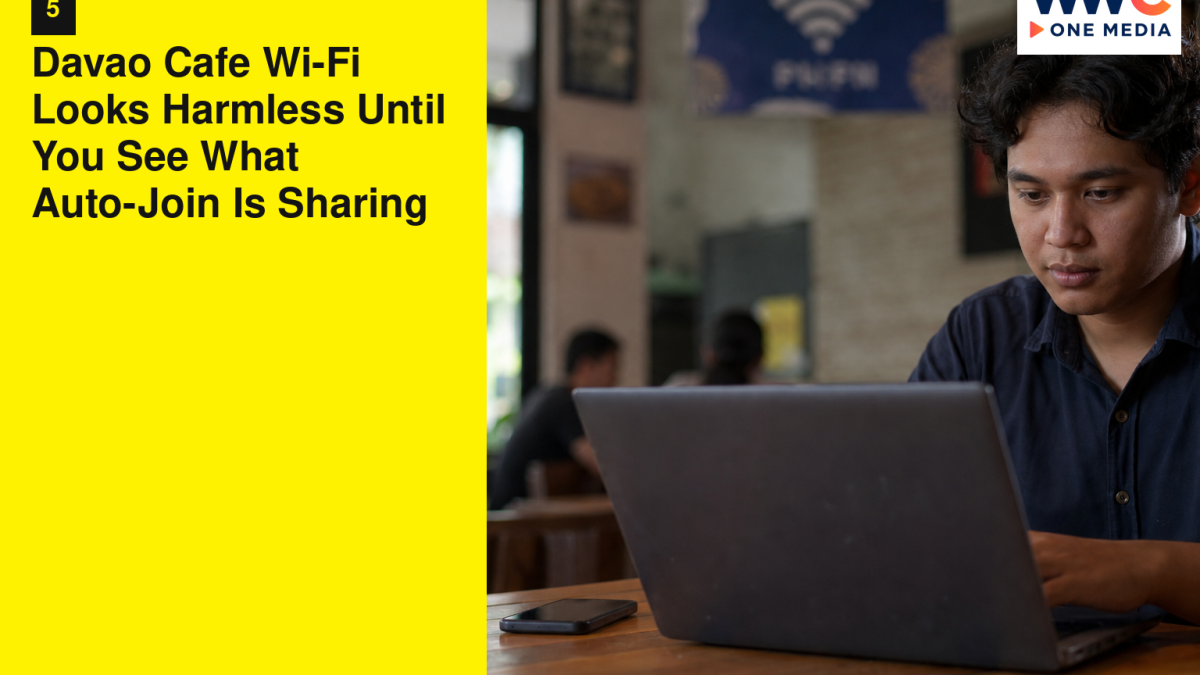
DAVAO, Philippines — Davao cafe Wi-Fi looks harmless. The password is on a chalkboard near the barista in a place along JP Laurel, or on a receipt at a table in Matina, or taped to a pillar at a coworking-ish corner near Abreeza. You join because the iced coffee is already a commitment and mobile data feels like a waste while you sit. Auto-join is the part that keeps sharing after you leave: the phone keeps the network, prefers it next time, and may even reach for a name that only looks like the cafe when you are on a jeepney down Roxas.
This is not a story about avoiding every cafe in Davao City. The city runs on tables. Students from Matina fill them. BPO people on a day off fill them. People waiting out the heat between SM Lanang and a meeting downtown fill them. The table is fine. The habit is the problem.
Auto-join, a sloppy captive-portal tap, file sharing left visible, banking apps that still ride whatever network is nearest, and a pile of saved SSIDs from every mall and inn you ever visited: those five settings and habits decide whether the cafe stays a cafe or becomes a leftover radio in your pocket. You do not need a lecture about criminal genius. You need a forget button, a data toggle, and a smaller yes list.
No exploit tour. No “how they do it.” If a page looks wrong, you leave. If money is involved, you use your own data. If you are done with the table, you forget the network. That is the whole article, stretched into the five checks a Davao regular can finish before the ice melts.
1. Auto-join: forget Davao cafe Wi-Fi when you stand up
Auto-join is the setting that makes Davao cafe Wi-Fi linger. You joined once at a place near Bajada. The phone decided that name is home. Days later you are on a UV Express toward Ecoland, or walking People’s Park, or in a different cafe with a similar name, and the phone is already negotiating with a network you are not sitting in. Sometimes it is the same shop. Sometimes it is only the same words: FREE WIFI, STAFF, GUEST, the mall’s name plus a number.
On Android, open the Wi-Fi list, tap the cafe network, tap Forget. Not Disconnect. Disconnect is a nap. Forget is a breakup. On iPhone, tap the i next to the network and choose Forget This Network. If your phone offers Auto-Join as a toggle, turn it off for every cafe, mall, airport lounge, and inn. Leave Auto-Join on for the one network you actually pay for at home, and maybe the office if it is a real office with a real IT person, not a password on a napkin.
Samsung and others bury “open network notification” and “auto-connect to Wi-Fi.” Open-network prompts train you to join whatever is loudest. Turn that prompt off. You can still join a cafe on purpose by tapping the name and typing the board password. On purpose is the standard. A phone that joins for you is a phone that shares a preference you did not make this afternoon.
Davao naming is messy in a useful way. A shop in Matina Town Square, a branch near Jack’s Ridge traffic, a hotel cafe along the airport road, a church-adjacent canteen with a router named after the owner’s child: none of these should remain in your saved list for a month. If you are a regular at one table, you can join each visit. The thirty seconds of typing is cheaper than a pocket that keeps knocking on a router in a neighbourhood you already left.
What not to do: “I’ll forget later.” Later is the jeepney. Later is a dead battery at SM Lanang. Later is never. Forget while you still have the iced coffee in your hand. Make it the same motion as stacking your laptop sticker-side down.
If you use a laptop, the same rule. Windows and macOS love remembered networks. Forget the cafe on the laptop too, or it will prefer that SSID in a meeting room that happens to be in radio range of the shop downstairs. Davao buildings are not all far apart. Radio does not respect your calendar.
A small extra: turn off “share Wi-Fi with contacts” or QR-sharing features if you do not use them. The password on the board is already public. Your phone does not need to become a second board.
2. Captive portal: the login page is not a personality test
Captive portal is the extra page that appears after you join: accept terms, type an email, press Continue so the cafe can say you were informed. Davao cafe Wi-Fi uses these because a router box came with the feature, or because a mall wants a landing page, or because a shop copied another shop. Most of the time it is boring. Boring is acceptable. Rushing is not.
The habit: when the portal appears, read the address bar like you would read a fare on a jeepney. If the phone screams that the certificate is wrong, or the page wants a password that is not the one on the chalkboard, or it wants a GCash PIN, a bank login, a selfie, or a file upload, you are done. Close it. Switch to mobile data. Sit and drink the coffee anyway. The table does not require a portal.
You do not need to diagnose the page. You do not need to “check if it is real.” A cafe login that wants more than “connect” or a simple accept is not your project. Use data. If you cannot afford data for an hour, you cannot afford a weird portal either. Buy a promo. The iced coffee already cost more than a day of a small data bundle.
Type less. A portal that asks for your company email, your birthday, and three social logins for a two-hour sit in Matina is a form you can skip. Use data, or ask the barista if there is a plain connection. Many Davao shops will just say the password again. They want you to sit. They do not want your HR address.
What not to do: tap through because the deadline is a deck due to a Manila client. The deadline is why you should not be improvising on a login page you did not expect. Hotspot from your phone if the laptop must move. One device’s data is a cleaner story than a portal that asked for a password manager fill.
If the portal wants a phone number for an SMS, decide if you like that shop enough to give a number that will receive promo texts until the heat death of the Davao afternoon. A spare number is a luxury. Your main number is how GCash finds you. You can also just use data.
Hotels along the airport road and malls like Abreeza or SM Lanang often have a more official looking page. “Official looking” is still a page. If the certificate warning appears, leave. If it wants a room number and a last name, that can be a hotel’s real flow — still type only what the front desk told you to type, not a bank field that appeared beside it.
Captive portals also linger as auto-join’s cousin. You saved the network, the portal saved a cookie, next visit the phone does a dance while you are still walking from the curb. Forget the network and the dance dies.
3. Files: nothing on your phone should be browseable at a Bajada table
File sharing is how Davao cafe Wi-Fi stops being a pipe for your browser and starts being a room where your photos, a PDF of a contract, or a folder named “scan” can be offered to whoever is looking for devices. You are not going to get a cinematic scene. You are going to get a habit: Nearby Share, Quick Share, Media share, a Windows network folder you never turned off, AirDrop set to Everyone from a trip, a printer you once tapped.
On the phone: Nearby Share / Quick Share / Android Beam leftovers set to Off, or to Contacts only if you truly need to drop a file to one person this hour. Then back to Off. Visibility for two minutes while you send a PDF to a classmate in Matina is a task. Visibility all afternoon while you buy a second coffee is a billboard.
On the laptop: file sharing off, public folder sharing off, “let other PCs on this network see me” off. Guest networks exist because of this. If the cafe has a guest SSID, use that rather than anything named STAFF or CCTV or the owner’s first name. You still forget it when you leave. Guest is not a blessing. It is slightly less stupid.
Printers and “scan to phone” tools have no business in a cafe along JP Laurel. Print at home, at the office, or at a real print shop downtown on C.M. Recto if you need paper. A cafe printer named HP-something is not your workflow.
Photos: turn off any setting that backs up or offers the camera roll to other devices on the current Wi-Fi. Cloud backup on your own account over a network you chose is a different sentence. Offering the roll to the room is the sentence you do not want.
What not to do: test a file send by making yourself visible to everyone “just this once” and then forgetting because the latte art was good. Set a timer if you must. Two minutes. Then Off. Davao tables turn over. The people change. Your visibility setting does not change unless you change it.
Also check Bluetooth names. A laptop called “JANE-PAYROLL-THINKPAD” is a small confession in a Bajada cafe. Rename it to something dull before you work in public. That is not paranoia. That is the same instinct as not leaving a payslip face-up.
If you use a tablet for drawing or notes, it follows the phone rules. Tablets are worse because people leave them unlocked while they queue for the toilet. Lock. Sharing off. Auto-join off.
4. Banking apps: money rides your data, not the chalkboard password
GCash, Maya, bank apps, a credit-card app, even the one shopping app with a saved card: they do not need Davao cafe Wi-Fi. They need a moment of mobile data. The chalkboard password is public. Public is fine for reading the news, sending a long email, streaming a tutorial at low resolution if you must. Public is not fine for a PIN.
The habit is physical. When money moves, swipe down, turn off Wi-Fi, confirm you are on the carrier, open the bank, finish, lock, turn Wi-Fi back on if you still want the cafe pipe for ordinary browsing. That sequence is slower than one-thumb GCash on whatever network is nearest. Slower is the point. A Davao afternoon can spare twenty seconds.
If your phone offers per-app data settings, pin the bank and the e-wallets to mobile data only. Then you cannot accidentally pay rent on a network named after a dessert. Not every skin has this. The manual toggle always exists.
Lock the apps. App lock, biometric, extra PIN. A cafe table is a grab-and-forget environment. You stand to take a call on the sidewalk. You leave the phone next to a laptop. The lock is for the ten seconds you were kind to a stranger’s question about the outlet under the table.
Saved Wi-Fi proxy settings should be empty. If you ever typed a proxy for a school or an office, it should not still be attached to a cafe profile. You will not see a cinematic warning. You will just have a browser that behaves oddly. If the browser behaves oddly, forget the network and use data.
What not to do: “I’ll just check the balance, not transfer.” Balance is still a login. Login is still a session. Data is still cheaper than a shrug. Also do not type card numbers into a browser on cafe Wi-Fi because the app was slow. The app can wait. The card number can live in the app on data, or not be typed at all.
OTPs arrive by SMS or in-app. Read them on the phone, not out loud to a tablemate in a shop near Abreeza. Obvious. Still happens. Davao cafes are social. Social is not a reason to narrate a six-digit code.
If you must pay the cafe itself by QR, that QR should be the shop’s. Look at the stand. If the stand looks newly taped over another stand, pay cash or ask. You do not need a seminar. You need to look at the tape.
Work email is not a bank, but it is close. A mail app full of invoices can wait for data if the cafe page already felt weird. Ordinary reading on cafe Wi-Fi is fine for most people most hours. The line is money, passwords, and anything you would not put on the chalkboard next to the Wi-Fi code.
5. The saved-network pile: your phone is a map of every Davao table you ever loved
The fifth habit is housekeeping. Auto-join is one switch. The pile is the archive. Years of Davao cafe Wi-Fi, mall Wi-Fi, inn Wi-Fi from a Samal trip, airport Wi-Fi, a church event, a co-working week, a hotel along J.P. Laurel, a friend’s house you should have forgotten after you moved out of their sofa: all of it sits in Saved networks, waiting to auto-prefer a name that is close enough.
Open the saved list. Delete anything that is not your home, your real office, and maybe a parent’s house you visit on purpose. Malls go. Cafes go. “Conference.” “Guest.” “FREE.” “iPhone.” Random names that are just a default router brand. If you do not recognise it, forget it. Recognition is the bar, not nostalgia.
Do this in the cafe the first time you read this, then once a month on a Sunday when you are already in Matina for a different reason. The list grows like receipts in a tote. Davao is a city you move around. Radio range is not the city limit. A saved network from a shop in Ecoland can still make a claim when you are near a similarly named shop in Bajada.
Turn off “connect to open networks” again while you are in this screen. Turn off Wi-Fi scanning for location if you do not need maps to use Wi-Fi pings to guess a block. Maps work on GPS and data. A cafe-hopping phone does not need to be a survey device.
Hotspot from your own phone is the adult alternative when the cafe network is crowded, named vaguely, or portal-hungry. You are already paying a carrier. A personal hotspot for the laptop is a small battery tax and a large reduction in stories. Sit near an outlet if you do this. Davao heat plus hotspot plus a full brightness laptop is how a battery dies before the second coffee. An outlet is part of the hygiene, not a luxury.
What not to do: keep twenty saved cafes because “I might go back.” You might. You can type a board password again. You have typed it before. The board is not going anywhere. Your saved list is going everywhere with you, including onto a jeepney at rush when you would rather the phone use data and sit still.
If you share a phone with a sibling, do the forget pass together or you will fight about why the house Wi-Fi vanished. Shared phones need a written home SSID. Cafes still get forgotten.
Rename your own hotspot to something dull if you use it in public. A hotspot named “PLDT-HOME-LASTNAME” is a small biography. Dull names are free.
When a Davao cafe is actually fine
You can use Davao cafe Wi-Fi. This is not a vow to sit in silence on data forever. Reading news, sending a long file you do not mind existing, joining a mundane video that is not a bank, downloading a podcast for the ride to Calinan: those are ordinary. The five habits are how ordinary stays ordinary.
Choose tables with your back to fewer walkers if you type passwords at all. Tilt the screen. That is older than Wi-Fi and still works in a shop near Roxas at dusk, when the glass is a mirror.
Prefer https in the address bar as a minimum, and leave if the browser fights you. You do not need to understand certificates. You need to refuse a fight.
Keep the OS updated on your own time at home, not as a giant download on a cafe pipe that will die when the rain hits the line. Updates are hygiene. Cafe bandwidth is a courtesy, not your patch server.
If you work with other people’s money or medical details, you already know you should not do that work on a chalkboard network. Use the office, the VPN your office issued, or data. A freelance designer sending a moodboard is not the same as a person logging into a payroll file. Know which one you are this hour.
Davao heat will still push you indoors. Indoor is allowed. Indoor with auto-join, a greedy portal, visible files, a bank on the chalkboard, and a saved pile from 2022 is how a harmless table follows you home.
A leaving ritual that fits a wet afternoon
Stand up. Laptop lid shut. Nearby Share off. Wi-Fi forget. Data on if you still need a map to Bankerohan or a Grab to Lanang. Pocket the phone. That is the ritual.
If you will sit again tomorrow in the same Matina place, you can still forget. Tomorrow the board is still there. Tomorrow you join on purpose. On purpose is the only setting that does not leak into the jeepney.
If the group chat wants the password, send it and also say forget when you leave. You will sound like a parent. Good. Davao group chats are how entire classes join the same router and leave sharing on because one person needed a deck.
If rain traps you for three extra hours, do not treat the extra hours as a reason to lower the bar. The bar does not care about rain. Money still rides data. Files still sit on off. Auto-join still gets forgotten when you finally run to the curb.
Bottom line
Davao cafe Wi-Fi looks harmless until auto-join keeps the chalkboard in your pocket. Forget the network when you stand up. Treat a greedy captive portal as a reason to use data. Turn file sharing off. Keep GCash and the banks on the carrier. Delete the saved pile so the phone stops hunting names down Roxas. The iced coffee is the point. The router is not a friend. Make the phone boring before the jeepney, and the cafe stays a cafe.


Leave a Reply