
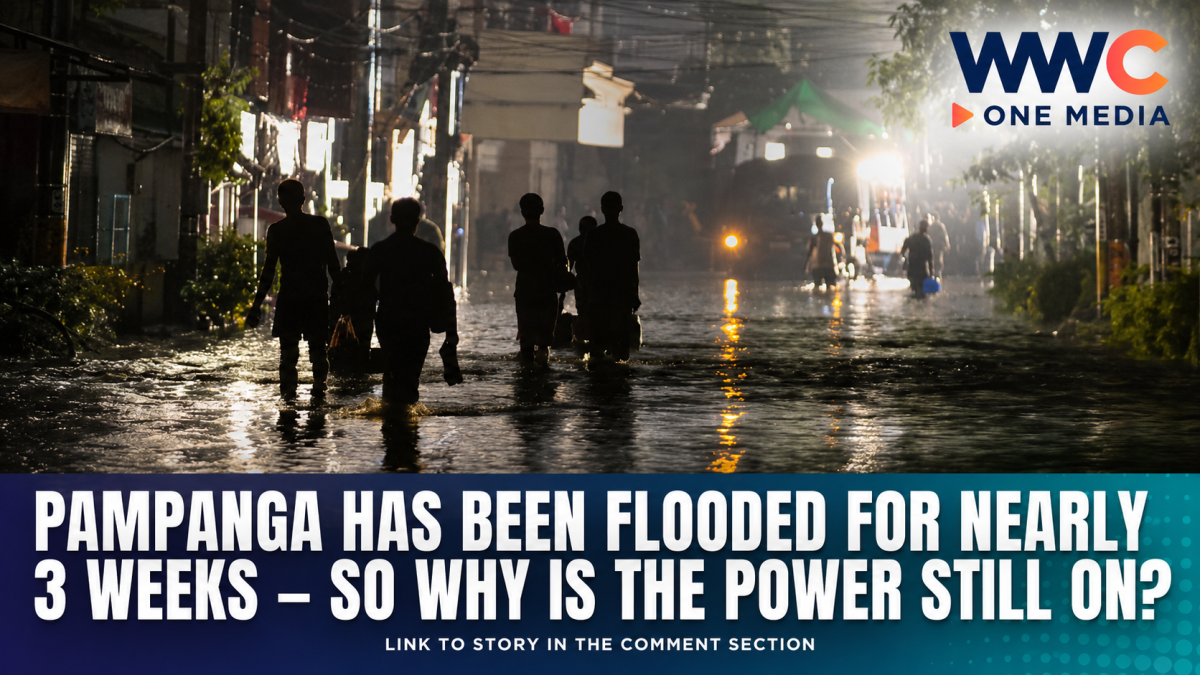
PAMPANGA, Philippines — In communities where floodwater has lingered for nearly three weeks, one essential service has remarkably continued operating: electricity.
Pampanga Governor Lilia Pineda said Sunday, August 30, that power remains available in affected parts of the province despite prolonged flooding that has left some communities under waist-deep water.
But keeping the lights on amid widespread flooding comes with a serious warning: electricity and floodwater can be a deadly combination, while renewed heavy rains and damaged dikes are creating another layer of danger for communities that have already endured weeks of disruption.
Governor: Electricity and water remain crucial for flooded families
Speaking in an interview with Super Radyo dzBB, Pineda said she planned to meet with electric cooperatives serving the province to discuss the continued operation of electricity services during the flooding.
The governor said maintaining electricity and water is particularly important for residents who remain in their homes, arguing that losing both essential services could make conditions even harder for families already surrounded by floodwater.
Pineda nevertheless stressed that household electrical installations must be properly secured.
That distinction is critical.
Health and energy authorities have repeatedly warned that flooded electrical equipment, damaged wires, submerged outlets and energized appliances can cause severe electric shock or electrocution. The Department of Energy has previously emphasized that submerged electrical infrastructure must be inspected and tested before it can safely be energized, with public and worker safety taking priority over rapid restoration.
Residents should therefore never assume that a flooded home is electrically safe simply because power remains available in the surrounding community.
Flooding has already affected more than 1 million Pampanga residents
The scale of Pampanga’s flooding has grown dramatically during August.
The province was placed under a state of calamity on August 12 after widespread flooding caused by the enhanced southwest monsoon.
At the time, provincial figures showed around 860,000 people affected across 17 local government units.
By August 24, the Provincial Disaster Risk Reduction and Management Council reported that 1,009,257 people from 314,945 families had been affected, with flooding recorded in 253 barangays across 16 LGUs.
More than 11,000 people were staying in designated evacuation centers, while thousands more had sought shelter elsewhere.
The changing figures reflect different reporting periods and conditions on the ground, but they underline the extraordinary scale and duration of the disaster.
Why does Pampanga stay flooded for so long?
Pineda said Pampanga’s problem is not limited to the rain falling directly over the province.
Its geography means large volumes of water also move downstream from mountainous and upstream areas, effectively turning parts of Pampanga into a catch basin.
She identified water coming from areas around Zambales, the Sierra Madre, Aurora and Nueva Ecija as contributing to the volume moving toward lower-lying Pampanga communities.
That helps explain why some downstream areas can remain flooded even when rainfall temporarily weakens.
Macabebe, Masantol, Minalin, Santo Tomas, Sasmuan, San Fernando and Mexico were among the areas cited by the governor as dealing with flooding.
Fresh dike breach adds another emergency
The danger escalated again early Sunday.
The Gugu River overflowed and breached part of the San Fernando–Santo Tomas–Minalin tail dike in Barangay Santa Catalina, Minalin, according to the Philippine Daily Inquirer.
Authorities said an approximately 30-meter section of the dike was breached as powerful river currents continued to push through the area.
Residents living near the structure had already been urged to evacuate as water levels climbed.
Officials in neighboring Santo Tomas also warned residents near another checkgate to move to safer locations because water from the damaged Minalin section could put additional pressure on nearby flood-control structures.
And Minalin was not the only trouble spot.
In Lubao, the Department of Public Works and Highways said another dike in Barangay Sto. Cristo was damaged after powerful currents from the overflowing Gumain River and Santo Cristo Dam.
Public Works Secretary Vince Dizon ordered dredging of the Gumain River, clearing of debris and logs, and repairs to the damaged flood-mitigation structures.
GMA News separately reported that raging floodwaters in Sto. Cristo destroyed or damaged several houses and forced more than 100 residents to evacuate.
And the rain is not finished yet
PAGASA’s August 30 forecast placed Pampanga among the areas expected to experience monsoon rains caused by the southwest monsoon, with possible flash floods and landslides due to heavy to intense rainfall.
The affected forecast area also included Ilocos Sur, Pangasinan, La Union, Benguet, Bataan, Zambales and Tarlac.
The weather bureau’s warning matters because Pampanga’s rivers, dikes and already saturated communities are dealing not with an isolated downpour, but with accumulated water from repeated weather disturbances.
The Armed Forces of the Philippines has also deployed disaster-response personnel and equipment to flood-hit Central Luzon communities, including Macabebe, Pampanga, as rescue and humanitarian operations continue.
Officials push earlier evacuation
Pineda urged families—particularly those with children and senior citizens—to leave vulnerable areas before floodwater becomes dangerously high.
She also said officials would discuss limiting forced evacuations at night because darkness, strong currents and submerged hazards can increase the danger not only for evacuees but also for rescuers.
The Department of the Interior and Local Government has similarly urged local governments to carry out preemptive and forced evacuations in communities threatened by floods and landslides rather than waiting until conditions become critical.
Health officials have also warned residents against unnecessary contact with floodwater because of leptospirosis and other health hazards.
The bigger question is what happens next
For Pampanga residents, electricity remaining available after weeks of flooding may provide a vital lifeline—keeping lights, phones, communications equipment and basic household needs running.
But electricity alone cannot make a flooded community safe.
With water still arriving from upstream areas, newly damaged dikes, saturated communities and additional monsoon rain in the forecast, the bigger challenge is preventing an already prolonged disaster from becoming even more dangerous.
For families living beside Pampanga’s rivers and flood-control structures, the next major rise in the water may matter more than whether the lights remain on.
And after nearly three weeks of flooding, officials are now confronting a difficult question:
How much more water can Pampanga’s communities—and its defenses—take?




Leave a Reply