
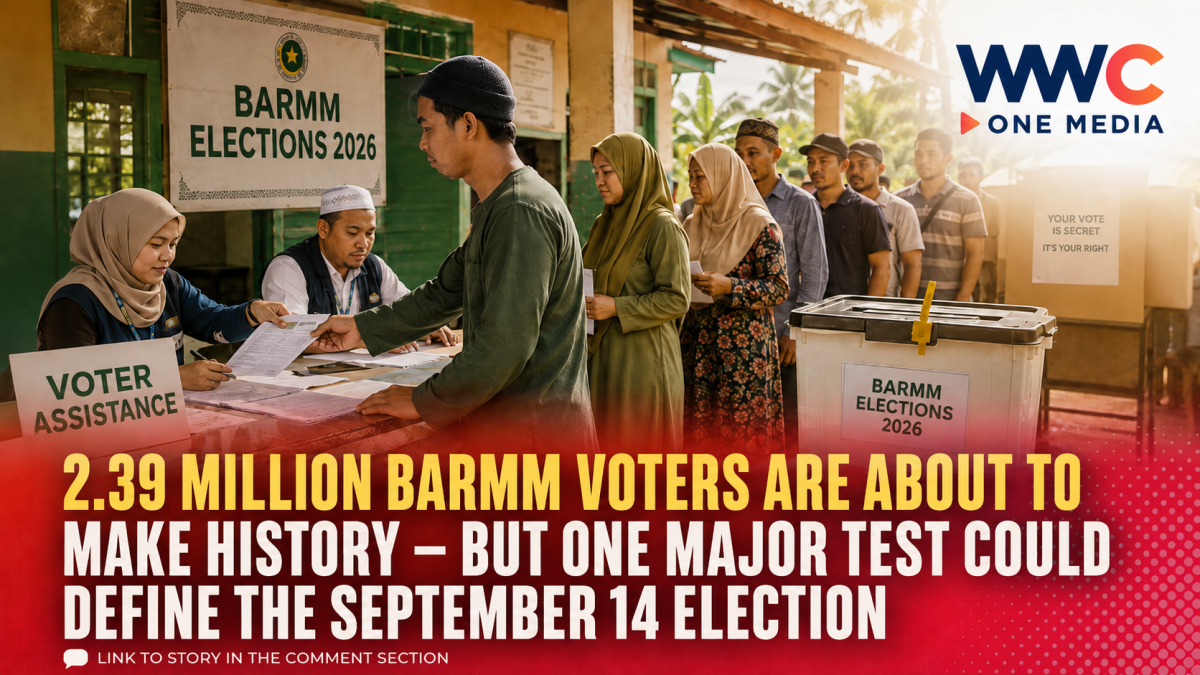
COTABATO CITY, Philippines — With the Bangsamoro Autonomous Region in Muslim Mindanao just days away from a political milestone years in the making, the government’s peace office is urging political parties, security forces and communities to make sure history is written at the ballot box — not through violence.
The Office of the Presidential Adviser on Peace, Reconciliation and Unity (OPAPRU) on Sunday, August 30, called for an orderly, credible and peaceful electoral process ahead of the first regular parliamentary elections in BARMM on September 14, 2026.
Presidential Peace Adviser Mel Senen Sarmiento praised the Commission on Elections, security agencies and political groups for their preparations, while stressing that cooperation must continue through Election Day.
Sarmiento said political parties and their leaders have so far shown “maturity and a sense of responsibility” as the region approaches what he described as a major milestone in the Bangsamoro political process.
The stakes are unusually high.
Around 2,393,202 registered voters are eligible to participate in the September 14 polls, according to Comelec figures. The elections will cover five provinces — Basilan, Lanao del Sur, Maguindanao del Norte, Maguindanao del Sur and Tawi-Tawi — as well as Cotabato City and the Special Geographic Area composed of 63 barangays in North Cotabato.
More Than an Election: A Test of the Bangsamoro Peace Process
For OPAPRU, the vote represents far more than the selection of regional officials.
Sarmiento described the parliamentary elections as a crucial step in fulfilling the political commitments established under the Comprehensive Agreement on the Bangsamoro and the Bangsamoro Organic Law, which created the autonomous regional government.
“The success of these elections will not only be a milestone for the Bangsamoro peace process,” Sarmiento said. “It will be a victory for peace, democracy, and the Filipino people.”
The September election will finally move BARMM from a transition government toward its first fully elected parliamentary administration.
Under the current structure, the Bangsamoro Parliament has 80 seats: 40 party representatives, 32 parliamentary district representatives and eight sectoral representatives.
Voters will choose a regional political party, a parliamentary district representative and candidates representing several sectors, including women, youth, traditional leaders, settler communities and the Ulama.
Two representatives of the Non-Moro Indigenous Peoples have already been selected separately: Jo Genna Jover of the Teduray people and Leticio Datuwata of the Lambangian indigenous community. They are expected to be proclaimed alongside the other 78 winning members who will complete the 80-seat Parliament.
Security Remains the Biggest Immediate Test
The appeal for peaceful elections comes amid heightened security concerns following the August 15 ambush on the convoy of interim BARMM Chief Minister Abdulraof “Sammy Gambar” Macacua in Datu Odin Sinsuat, Maguindanao del Norte.
Macacua and his companions escaped unharmed.
The incident prompted authorities to strengthen security ahead of the polls, although Comelec Chairman George Erwin Garcia said this week that the region remained generally peaceful and that only one election-related incident of violence had been recorded.
Earlier in August, the Philippine National Police said Comelec had identified 108 areas of concern across BARMM requiring varying levels of security attention. Lanao del Sur had the largest number of areas classified under the highest-risk category at that time.
Despite those concerns, Garcia has repeatedly insisted that the September 14 elections will proceed.
Following a final command conference involving Comelec, the Department of the Interior and Local Government and security agencies, Garcia said authorities were “on top of the situation” and had no plans at the time to place any BARMM locality under direct Comelec control.
Interior Secretary Jonvic Remulla has likewise warned police personnel that they will be held accountable for failures to prevent election violence.
Why the September 14 Election Took Years to Reach the Ballot
The first BARMM parliamentary election has gone through several postponements and legal complications.
One major turning point came after the Supreme Court ruled that Sulu was not part of BARMM, forcing authorities to revisit parliamentary districts originally assigned to the province.
In October 2025, the Supreme Court then declared two Bangsamoro districting laws invalid or unconstitutional and halted the election scheduled at the time, ruling that a legally valid districting framework was necessary before parliamentary voting could proceed.
The Court found, among other problems, that one redistricting measure was enacted after the election period had already begun and that some proposed districts failed requirements involving contiguous or adjacent areas.
Congress later reset the first regular BARMM elections to September 14, 2026, under Republic Act No. 12317.
The officials elected in September will begin their terms at noon on October 30, 2026, with succeeding BARMM elections eventually synchronized with the national and local election cycle beginning in 2031.
Comelec Wants Voters to Show Up
Security is not Comelec’s only concern.
Election officials also want strong voter participation to give the first elected Bangsamoro Parliament a clear democratic mandate.
Garcia earlier said Comelec hoped for turnout of around 70% to 75%. More recently, he said he would like turnout to reach at least 65% to 70% and avoid falling below 50%.
For BARMM, September 14 therefore represents more than another regional election.
It is the culmination of a lengthy transition shaped by peace negotiations, autonomy, court decisions, political restructuring and repeated delays.
And with more than 2.39 million voters preparing to choose the region’s first regular Parliament, the biggest question now is whether BARMM can turn years of political transition into what peace officials have long promised: a credible election in which ballots — rather than bullets — decide who governs the Bangsamoro.



Leave a Reply