
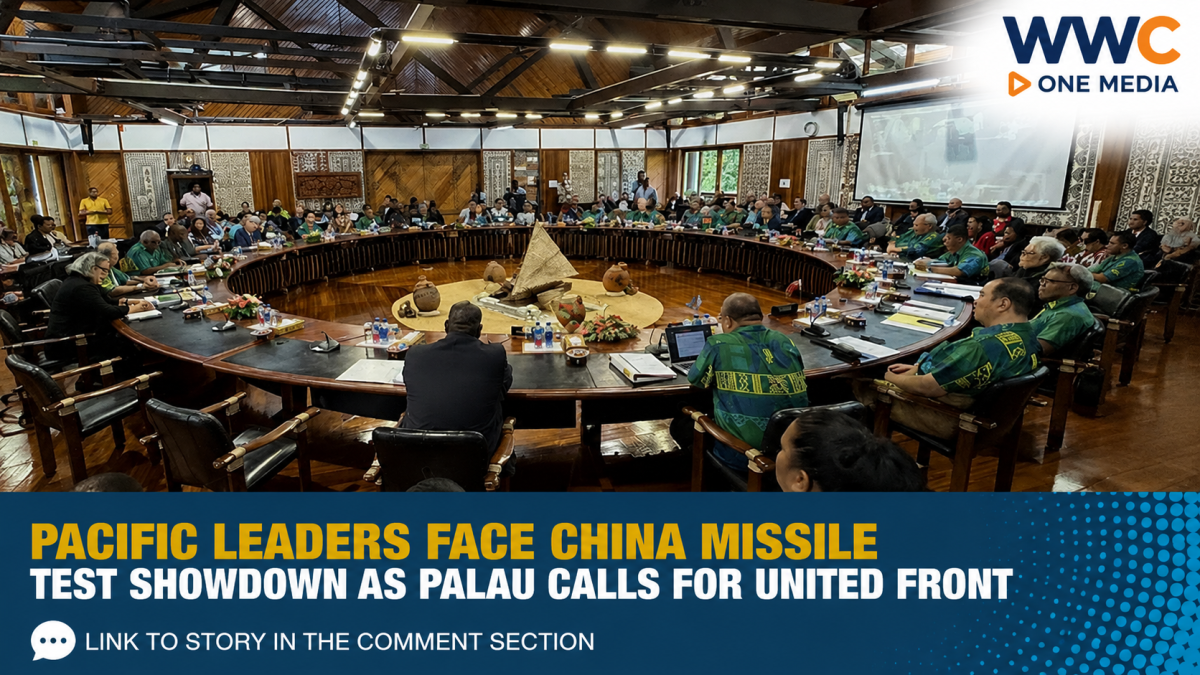
Pacific Unity Put to the Test as China’s Missile Launch Dominates Summit
SYDNEY — A major geopolitical divide is confronting Pacific leaders as the region debates how strongly it should respond to China’s ballistic missile test in the Pacific.
Palau President Surangel Whipps Jr., who is chairing the current Pacific Islands Forum gathering, is pushing for the 18-member bloc to reach consensus on a statement addressing the July missile test before the summit concludes in Palau.
Whipps said a unified Pacific voice is important to ensure that major powers respect the sovereignty, transparency and security concerns of smaller island nations.
“We don’t want our backyard, our homes, to be threatened,” Whipps said.
The push comes after Pacific foreign ministers failed last month to reach agreement on a statement specifically condemning the Chinese launch, exposing the difficult balancing act facing governments that maintain very different relationships with Beijing, Washington, Canberra and Taipei.
China Says the Missile Test Was Routine
China has defended the July launch, describing it as part of its regular military training.
Beijing said the test was conducted safely, complied with international law and was not directed at any particular country or target. Chinese officials also said relevant countries had been notified in advance.
The missile was launched from a Chinese submarine and travelled into the Pacific carrying a dummy warhead. Regional governments, however, raised concerns about the location of the test and the amount of advance notification provided.
The missile appeared to have landed in the Pacific near the exclusive economic zones of Tuvalu and Kiribati, roughly 1,000km northeast of the Solomon Islands.
Australia and several Pacific governments have argued that the launch demonstrated a significant long-range military capability and should have involved greater transparency.
Why Pacific Countries Are Divided
The dispute is about more than one missile test.
Pacific governments have spent years trying to maintain what they describe as an “Ocean of Peace”, while simultaneously navigating increasing strategic competition between China and the United States.
For some governments, the Chinese missile launch represents an unacceptable expansion of military activity in their region.
Others are reluctant to single out Beijing, particularly when Pacific waters have also been used for missile testing and military exercises by other major powers.
Kiribati’s President Taneti Maamau has previously argued that the region should apply the same standards to all major powers rather than specifically targeting China. Australia has rejected that comparison, saying the circumstances surrounding the Chinese test were different.
That disagreement illustrates why reaching consensus has proved so difficult.
China-Taiwan Tensions Add Another Layer
The missile dispute is unfolding against an even broader geopolitical confrontation at the Pacific Islands Forum.
This year’s summit has also been overshadowed by China’s opposition to Taiwan’s participation in events surrounding the meeting.
Palau is one of only three Pacific island countries that maintains official diplomatic relations with Taiwan, alongside Tuvalu and the Marshall Islands. China claims Taiwan as part of its territory and strongly objects to Taipei’s participation in international and regional forums that it considers inappropriate.
Taiwan’s presence has therefore become another flashpoint at a summit already struggling to demonstrate regional unity.
China’s Pacific envoy has warned of consequences over Taiwan’s involvement, while Beijing has criticised Palau’s approach to the issue.
Several Pacific Leaders Are Missing
The challenge to unity is particularly visible because several national leaders have not attended the summit in person.
The prime ministers of Fiji, Vanuatu, Samoa and the Solomon Islands, as well as Kiribati’s president, were absent and represented by ministers or senior officials. Reuters reported that the absences were occurring against a backdrop of growing China-Taiwan tensions.
Solomon Islands Prime Minister Matthew Wale left Palau after a political challenge emerged at home.
Kiribati said its president was unable to travel because of parliamentary commitments and limited flights.
New Zealand Foreign Minister Winston Peters has raised concerns about possible foreign influence behind some of the absences, although no evidence has been publicly established showing that Beijing caused the withdrawals.
That distinction is important: the absences are confirmed, but allegations of outside interference remain allegations rather than established fact.
The Pacific Doesn’t Want to Become a Battlefield
The debate also reflects a deeper concern among island nations that their waters could become a stage for strategic competition between larger powers.
Pacific countries have long experience with military activity and nuclear testing. The region witnessed hundreds of nuclear tests during the 20th century, making questions about weapons testing particularly sensitive.
At the same time, the United States, Australia, New Zealand and China are all expanding or strengthening their strategic relationships across the Pacific.
The result is a difficult balancing act: island governments want security partnerships, investment and economic opportunities, but many also want to avoid becoming locked into a confrontation between major powers.
What Happens Next?
The immediate test for the Pacific Islands Forum is whether leaders can agree on language that addresses China’s missile launch without further splitting the bloc.
Foreign ministers had previously settled on language calling for “transparency and reassurance” regarding missile testing, but stopped short of directly condemning China.
Whipps is now seeking a stronger and more unified position.
Whether the leaders can achieve that could become one of the most important outcomes of this year’s summit — not only because of the missile test itself, but because it will reveal how much strategic unity the Pacific Islands Forum can maintain as competition between China and Western powers intensifies.
WWC ONE MEDIA J.M.D




Leave a Reply