
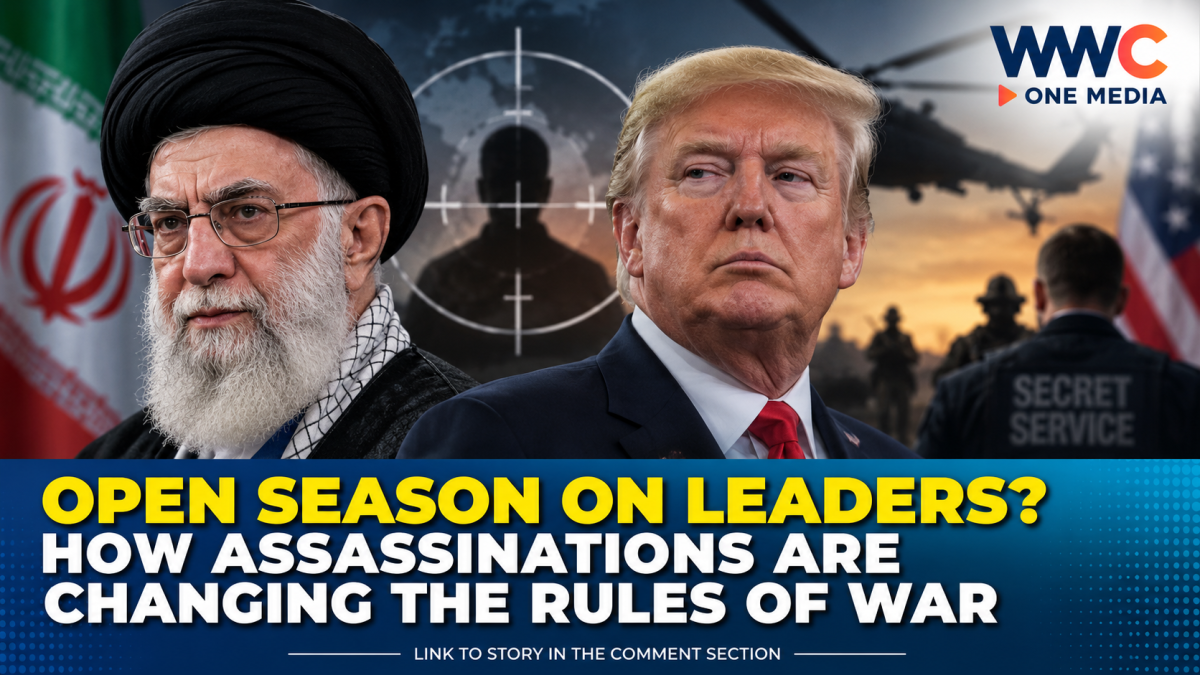
A dangerous question is emerging from the latest conflicts: Are the world’s unwritten rules protecting national leaders from assassination beginning to disappear?
That question is at the heart of a new Asia Times analysis by security expert Sajid Farid Shapoo, which argues that the long-standing political norm against deliberately killing foreign leaders is under growing strain. The argument comes as the killing of senior Iranian leaders and reports of a possible threat against US President Donald Trump have pushed leadership targeting back into the center of international debate.
The issue is bigger than one president, one country or one war.
It goes to the basic question of how states fight each other—and what happens when the people making decisions about war become direct targets themselves.
From Khamenei to Trump: the issue moved into the spotlight
The debate intensified after Iran’s Supreme Leader Ayatollah Ali Khamenei was killed during a major US-Israeli attack on Iran on February 28, 2026.
The Associated Press reported at the time that the killing created enormous uncertainty over Iran’s political future and increased concerns about regional instability.
Reuters later reported that Israeli Prime Minister Benjamin Netanyahu had argued to Trump for a joint operation that could kill Khamenei and other senior Iranian leaders. The report described the proposed operation as a “decapitation strike”—a military operation designed to eliminate a country’s top leadership.
That development matters because leadership targeting was no longer simply being discussed as an extraordinary theoretical option.
It had become part of the strategy of an active interstate war.
And then came another extraordinary episode.
Trump secretly switched planes after NATO summit
In July, Trump secretly changed aircraft while leaving the NATO summit in Ankara, Turkey, after US officials received information about a possible Iranian threat.
BBC reported that Trump confirmed the aircraft switch, saying the Secret Service and military wanted him to use a different plane.
The operation was unusually elaborate.
Trump reportedly boarded what appeared to be Air Force One before secretly transferring to a smaller military aircraft using a catering truck. Journalists and some officials remained aboard the original aircraft, which continued operating as a decoy.
Reuters subsequently reported that Israeli intelligence had repeatedly warned Washington about alleged Iranian assassination plans against Trump, including a warning before the NATO summit involving a possible missile attack against his aircraft.
But there was a major caveat.
US intelligence agencies could not independently verify the specific allegations. Reuters reported that the CIA had low confidence in some of the Israeli intelligence, while Turkish authorities also had no evidence corroborating the particular threat.
That distinction is crucial.
There was a real security response.
But that does not establish that Iran actually had an operational assassination plot against Trump.
Why this is bigger than one alleged plot
According to the Asia Times analysis, the most important question is not whether the reported Trump threat was genuine.
It is what happens when states increasingly consider the elimination of political and military leaders a legitimate instrument of warfare.
Historically, states developed strong political and legal incentives against assassination because deliberately targeting national leaders could produce uncontrolled escalation, retaliation and instability.
Asia Times argues that this restraint has weakened over time, pointing to developments ranging from Cold War covert operations to the 2020 killing of Iranian General Qassem Soleimani and the 2026 attacks on Iran’s leadership.
The concern is straightforward:
If one country decides that killing another country’s leadership is an acceptable way to end a conflict, its opponent may eventually decide the same thing.
That creates a potentially dangerous cycle.
But is leadership assassination actually illegal?
This is where the story requires careful treatment.
The answer is not simply yes or no.
International humanitarian law prohibits certain methods of killing, including killing through perfidy. The International Committee of the Red Cross notes that Article 37 of Additional Protocol I prohibits killing, injuring or capturing an adversary through perfidy. Historical interpretations have also treated treacherous assassination as prohibited.
But that does not mean every deliberate attack against a leader is automatically unlawful.
During an armed conflict, the legal status of the individual, whether they are directly participating in hostilities, the circumstances of the attack and the applicable rules of international humanitarian law all matter.
Reuters’ March 2026 legal analysis illustrated the complexity. International-law professor Marko Milanovic said that Khamenei and some senior officials could plausibly be considered direct participants in hostilities because of their role in operational military decisions, potentially making them lawful targets under international humanitarian law.
That is very different from saying that “assassination is now legal.”
It isn’t that simple.
The Soleimani precedent
One of the most important turning points came in January 2020, when a US drone strike killed Qassem Soleimani, commander of Iran’s Quds Force, in Baghdad.
The United States defended the operation as an act of self-defense.
The legality was fiercely disputed.
Reuters has noted that US officials argued Soleimani was a legitimate military target, while a UN human-rights investigator concluded that the killing violated international law.
What made the episode particularly significant was that the United States publicly acknowledged and defended the killing rather than treating it as an ambiguous covert operation.
That helped reshape the political debate over whether senior officials of another sovereign state could be deliberately targeted outside a conventional battlefield.
The danger of “decapitation” warfare
The argument for leadership strikes is often straightforward:
Remove the person at the top, and perhaps the war ends faster.
But history offers no guarantee.
Following the deaths of Khamenei and other senior Iranian officials, analysts interviewed by Al Jazeera questioned whether eliminating leadership would actually collapse Iran’s political system. Instead, they warned that the killings could empower younger and more hard-line security figures.
The Washington Post similarly reported that the killings had produced major upheaval within Iran’s political and military establishment while leaving a hard-line government in place.
That creates an uncomfortable possibility:
A strike designed to remove one leader may not remove the conflict. It may simply remove the people who could negotiate an exit.
Asia Times makes essentially this warning, arguing that eliminating senior figures can reduce the number of political “off-ramps” available during a crisis.
And technology could make the problem worse
Modern surveillance, drones, precision weapons and increasingly autonomous military systems are making it easier to identify and strike individual people.
That could make leadership-targeting operations more attractive to governments.
It could also make them more dangerous.
If governments believe that enemy leaders can be located and eliminated with comparatively limited military risk, the temptation to strike first could increase.
And once that behavior becomes normalized, the logic can spread.
The target could be a president.
Then a defense minister.
Then a military commander.
Then a diplomat involved in negotiations.
Eventually, the distinction between warfare, deterrence and political assassination becomes increasingly difficult to maintain.
Diplomacy may become the biggest casualty
Perhaps the most serious consequence isn’t the death of any individual leader.
It is what happens to diplomacy afterward.
Negotiations depend on officials believing they can meet, communicate and make concessions without becoming immediate targets.
If senior officials begin to believe that participating in negotiations could make them easier to locate and eliminate, diplomatic engagement becomes harder.
That is particularly troubling in conflicts where back-channel negotiations are often the only realistic path toward a ceasefire.
The Washington Post reported in July that US officials had even warned Iran about concerns that Israel might target senior Iranian negotiators, including Foreign Minister Abbas Araghchi and parliamentary speaker Mohammad Bagher Ghalibaf. The concern, according to the report, was that killing those officials could eliminate pragmatic channels for negotiation.
That illustrates the central paradox.
A military operation can win a tactical victory while making a political settlement harder to achieve.
A new era—or an old rule under pressure?
The Asia Times analysis makes a deliberately provocative argument: the taboo against leadership assassination is weakening.
But the evidence is more nuanced.
The international legal system has not simply abandoned restrictions on assassination, and the legality of individual strikes remains intensely contested.
What is changing is the willingness of powerful states to publicly consider—and sometimes execute—operations aimed at senior leaders of opposing states.
That shift matters.
Because norms do not disappear overnight.
They erode through exceptions.
Then precedents.
Then repetition.
And eventually, behavior that once seemed unthinkable can start looking normal.
THE BIG QUESTION
The world has entered an uncomfortable phase in which precision weapons can put political leaders within striking distance almost anywhere.
The question is no longer simply:
“Can a government kill its enemy’s leader?”
It is:
“What happens when every government begins to believe it has the right to do the same?”
That is the warning behind the Asia Times analysis—and perhaps the most consequential question facing modern warfare.
WWC ONE MEDIA M.J.E




Leave a Reply