
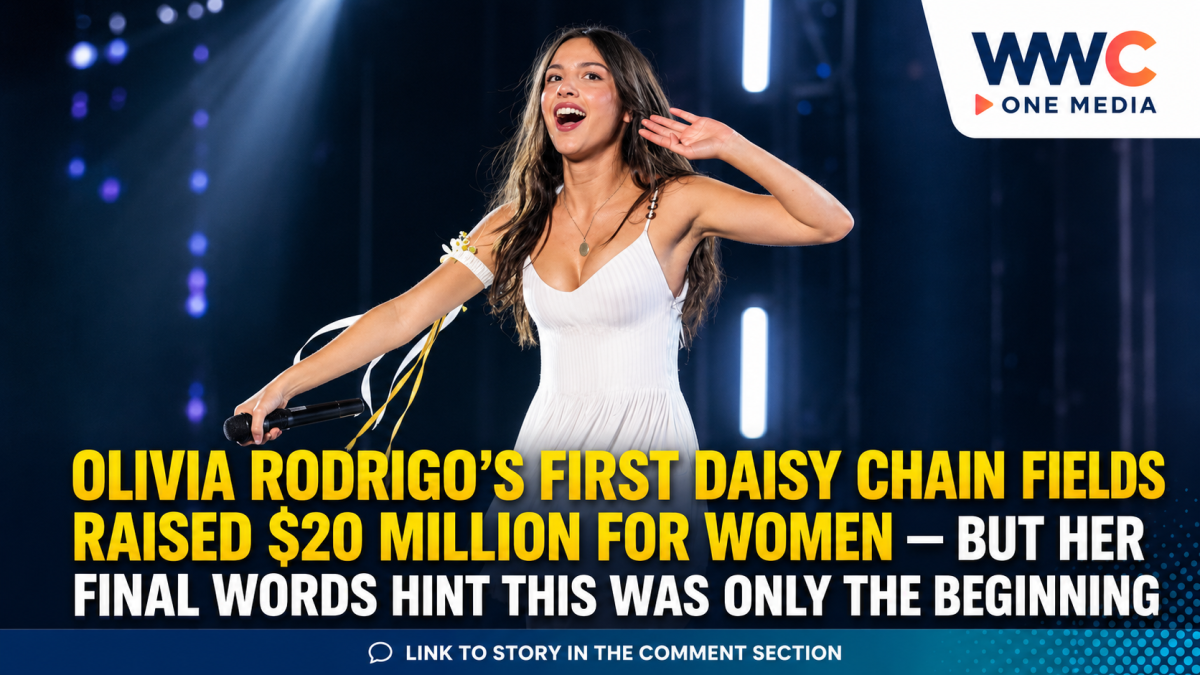
IRVINE, California — Olivia Rodrigo’s first-ever Daisy Chain Fields festival was designed to prove that a music event could be more than a collection of superstar performances.
By the end of the night, it had generated US$20 million for organizations supporting women and girls, drawn an estimated 45,000 people to Great Park in Irvine, California, and positioned the 23-year-old singer as not just the festival’s headliner but the architect of what could become a major new annual event.
Rodrigo revealed that Daisy Chain Fields had already raised US$10 million for 10 nonprofit partners. Then came an unexpected announcement: philanthropist Melinda French Gates, appearing ahead of Rodrigo’s headline performance, pledged another US$10 million through her organization Pivotal Ventures, doubling the total to US$20 million.
The result transformed what could have been simply another celebrity-curated festival into one of 2026’s most striking intersections of pop music, philanthropy and activism.
A festival deliberately built around women
Held on August 29 at Great Park, Daisy Chain Fields was conceived as a women-led music festival while raising money for organizations focused on the welfare and rights of women and girls. Rodrigo said when announcing the event that 100 percent of net proceeds would benefit its nonprofit partners.
Its lineup crossed several generations and genres.
Chappell Roan, Doechii, Mitski, Bikini Kill, Garbage, The Breeders, Santigold, Rachel Chinouriri, Die Spitz, Eli, Not For Radio and Quiet Light were among the performers, with Rodrigo closing the festival.
KATSEYE had originally been scheduled to perform but withdrew shortly before the festival because member Megan suffered an ankle injury.
Instead of forcing fans to choose between simultaneous headliners, organizers scheduled performances across the festival’s two stages without overlapping sets — an unusual approach for a major multi-act event.
Stevie Nicks, Sarah McLachlan — and an unexpected Alanis Morissette appearance
Rodrigo’s roughly 80-minute closing performance turned the festival’s intergenerational theme into something tangible.
She shared the stage with Sarah McLachlan, the artist most closely associated with the pioneering 1990s women-led festival Lilith Fair, which Rodrigo has repeatedly cited as an inspiration for Daisy Chain Fields.
Rodrigo and McLachlan performed together before another major guest arrived: Alanis Morissette, who joined Rodrigo for Ironic. Morissette stepped in after scheduled guest Karen O was unable to participate because of an emergency.
The finale paired Rodrigo with Stevie Nicks for Fleetwood Mac’s Landslide, bringing together one of Gen Z’s biggest pop stars and one of rock’s most influential female performers.
It was a fitting ending for a festival explicitly designed to connect different generations of women in music.
Why Lilith Fair matters to Rodrigo’s idea
Daisy Chain Fields has inevitably drawn comparisons with Lilith Fair, founded by Sarah McLachlan and launched in 1997.
Lilith Fair challenged an entrenched music-industry belief that audiences would not support multiple female artists appearing consecutively on the same bill. Its original 1997-1999 run raised roughly US$10 million for charity, according to AP’s reporting carried by CNA.
Nearly three decades later, Rodrigo used a similar idea but attached it to issues facing a different generation.
She described the name “Daisy Chain” as symbolic of separate pieces linking together to become something stronger — an idea reflected in the festival’s attempt to connect musicians, fans and advocacy groups rather than treating charitable giving as a side project.
The 10 organizations receiving support
The nonprofit beneficiaries announced for Daisy Chain Fields were:
- Baby2Baby
- Black Mamas Matter Alliance
- Center for Reproductive Rights
- FreeFrom
- Jhpiego
- Johns Hopkins Center for Indigenous Health
- National Domestic Workers Alliance
- National Institute for Reproductive Health
- National Women’s Law Center
- Planned Parenthood
Their work ranges from maternal health and reproductive healthcare to workplace protections, domestic violence prevention, legal advocacy and support for families.
Daisy Chain Fields also included a “philanthropy village”, allowing festivalgoers to interact directly with nonprofit representatives rather than simply being told that part of their ticket money would go to charity.
Fans could learn about healthcare services, caregiving, workplace rights and other issues represented by the participating groups.
That distinction may prove important to the festival’s identity.
Rather than placing activism behind the music, Daisy Chain Fields placed both in the same physical space.
Melinda French Gates doubles the impact
The biggest financial moment came immediately before Rodrigo’s headline set.
After the festival generated US$10 million, Melinda French Gates announced that Pivotal Ventures would match that amount with another US$10 million.
That brought the total impact to US$20 million.
Rodrigo credited ticket buyers, sponsors, donors and artists who waived their fees with helping the festival reach its original US$10 million figure.
The size of the contribution is particularly notable because Daisy Chain Fields was only in its first year.
The festival wasn’t flawless
Reviews were strongly positive overall, but the event was not without problems.
The Guardian reported that Irvine faced extreme heat during the festival and that some attendees dealt with limited shade, water-access concerns and lengthy food lines.
Variety likewise described temperatures reaching around 95 degrees Fahrenheit and difficult conditions for the estimated 45,000-person crowd.
Those logistical challenges could become important if Daisy Chain Fields grows — especially because Rodrigo appears to have ambitions beyond a one-off event.
Rodrigo appears to confirm Daisy Chain Fields will return
Perhaps the most consequential announcement arrived almost casually.
At the end of her performance, Rodrigo told the audience she would see them next year, widely interpreted as confirmation that Daisy Chain Fields is expected to return in 2027. Variety reported that Rodrigo indicated the festival was not intended as a one-off, while the Los Angeles Times noted the crowd interpreted her comments as pointing toward a second edition.
That possibility changes the significance of what happened in Irvine.
One successful charity concert can generate headlines.
An annual festival with a 45,000-person audience, heavyweight performers and tens of millions of dollars flowing toward nonprofit organizations could become an institution.
From pop superstar to cultural organizer
Rodrigo built her career largely on brutally direct songs about heartbreak, anger and growing up. Daisy Chain Fields signals an expansion of that influence.
The festival positioned her alongside established figures such as Stevie Nicks and Sarah McLachlan while simultaneously giving younger audiences direct access to advocacy organizations.
And the numbers are difficult to overlook: 45,000 attendees, 10 nonprofit beneficiaries and US$20 million in combined support during the festival’s inaugural edition.
The question now is whether Daisy Chain Fields can repeat — or surpass — that impact.
Because after proving that a first-year festival can bring Chappell Roan, Doechii, Bikini Kill, Stevie Nicks and Sarah McLachlan into the same orbit while generating US$20 million for women and girls, Rodrigo may have created something considerably bigger than a celebrity benefit concert.
She may have created the beginning of a new festival institution.

Leave a Reply