
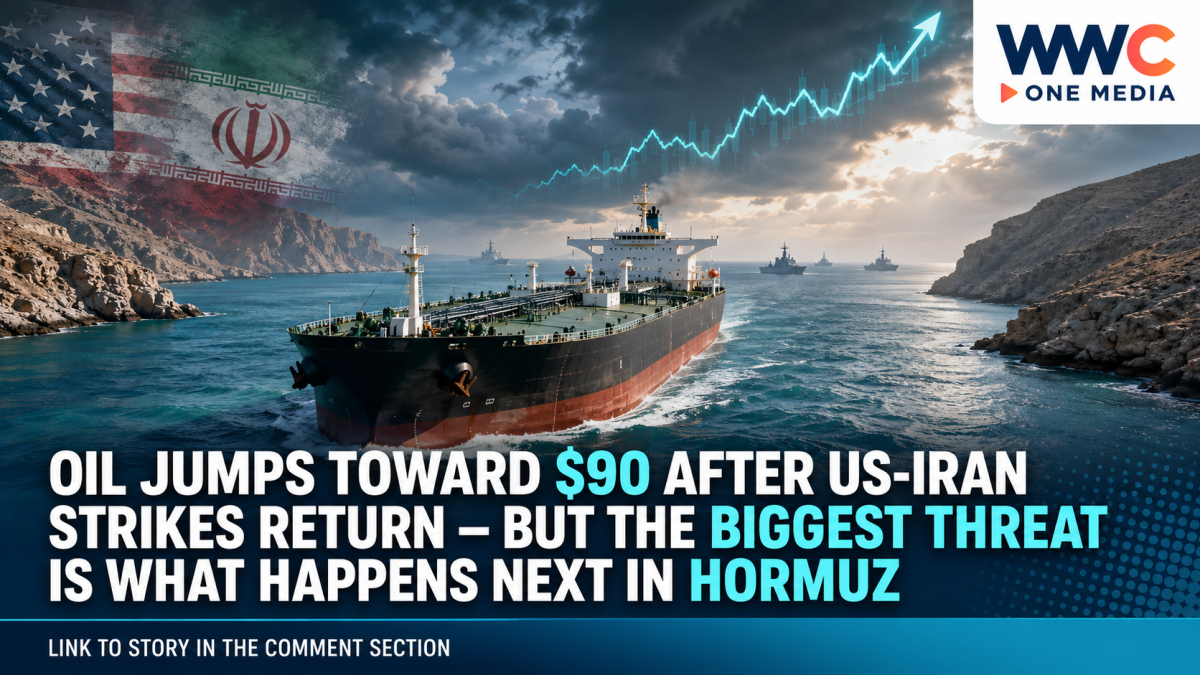
Oil prices surged toward the psychologically important $90-a-barrel level on Monday as renewed military exchanges between the United States and Iran abruptly shattered a period of relative calm around the Strait of Hormuz.
But for energy markets, the biggest question is no longer simply whether Washington and Tehran will exchange more strikes.
It is whether the latest confrontation will once again choke one of the most important oil shipping routes on Earth.
Brent crude futures climbed roughly 2% to $89.87 a barrel by 07:33 GMT on August 31, while US West Texas Intermediate crude rose about 1.7% to $84.85. At other points during Monday trading, Brent moved above $90 as traders rapidly priced a fresh geopolitical risk premium into the market.
The rally followed the first known US strikes inside Iran since late July.
US Strikes Larak Island, Iran Fires Back
US forces struck two launchers on Iran’s Larak Island on Sunday, a strategically located island close to major shipping lanes in the Strait of Hormuz.
According to US officials, forces linked to Iran’s Islamic Revolutionary Guard Corps had been preparing to launch rockets carrying sea mines into the strait. Washington described the operation as a limited action aimed at stopping an imminent threat to international shipping.
Iran retaliated.
Iranian media, citing the Revolutionary Guards, said ballistic missiles were launched at two US military bases in Jordan that Tehran said had been involved in supporting the Larak operation.
Jordan’s military said eight missiles entering its airspace were intercepted.
The confrontation represented a sharp reversal after roughly a month without major direct US military strikes on Iranian territory.
And the regional tension did not stop there.
The United Arab Emirates said its air force intercepted an Iranian drone over UAE territorial waters on Monday. Abu Dhabi separately rejected Iranian media reports claiming that Al Minhad Air Base in Dubai had been struck.
The developments underline just how quickly a US-Iran confrontation centred on Hormuz can spill into neighbouring Gulf states.
Oil Traders Are Really Watching the Strait of Hormuz
For global oil markets, Larak Island itself is only part of the story.
The Strait of Hormuz is the critical issue.
Before the current conflict, roughly one-fifth of the world’s oil passed through the narrow waterway separating Iran from Oman.
The scale of the disruption already caused by the conflict is enormous.
The US Energy Information Administration estimated that oil and petroleum-liquid flows through Hormuz averaged about 21.6 million barrels per day during the fourth quarter of 2025.
By the second quarter of 2026, that figure had plunged to about 4.9 million barrels per day.
That helps explain why even a relatively contained military exchange can immediately move global crude prices.
Shipping companies must consider the risk of missiles, drones and mines. Insurers can raise premiums. Tanker owners can delay voyages. And refiners thousands of kilometres from the Gulf can suddenly face uncertainty over when their next cargo will arrive.
Signs of renewed caution are already emerging.
Reuters reported that the number of visible commodity vessels passing through Hormuz fell to about five per day over the weekend.
The United Kingdom Maritime Trade Operations also reported that a tanker travelling into the strait was struck by a projectile on Saturday.
Until shipping companies become confident that commercial vessels can pass through the waterway safely and consistently, traders are likely to keep a geopolitical premium embedded in oil prices.
The Kharg Island Claim Sent an Even Bigger Warning
Another development briefly raised the stakes even further.
US President Donald Trump posted on Truth Social that Iran’s Kharg Island was being “blown to smithereens” alongside dramatic footage appearing to show explosions.
That claim should be treated carefully.
There was no independently verified evidence at the time that Kharg Island had been attacked. Iranian officials denied that an assault had taken place and said oil operations on the island were continuing.
Reuters also concluded that the video accompanying Trump’s post was most likely synthetically generated.
Why does Kharg matter so much?
Before the war, the island handled roughly 90% of Iran’s oil exports.
An actual sustained attack on its export infrastructure could therefore have consequences far beyond another military exchange. It could cripple Iran’s ability to ship crude and potentially trigger a much larger escalation involving regional oil infrastructure.
That is why traders are likely to react quickly to any credible evidence of damage there.
Washington Is Also Turning Up the Economic Pressure
Military action is only one part of Washington’s strategy.
US Treasury Secretary Scott Bessent said the administration is likely to introduce new secondary sanctions against Iran on a weekly basis, with banks expected to be among the initial targets.
Secondary sanctions can affect companies and financial institutions outside Iran if they continue doing certain types of business with Tehran.
That raises another source of uncertainty for the oil market.
Even if physical production facilities remain intact, tighter enforcement against buyers, banks, shipping companies and intermediaries could make Iranian crude harder to sell and transport.
The combination of military risk and financial pressure could therefore keep oil prices elevated even without a dramatic escalation on the battlefield.
Analysts See $85-$95 Oil — Unless Hormuz Changes Everything
DBS head of energy research Suvro Sarkar said the more likely scenario remained a contained confrontation rather than prolonged escalation.
However, every new flare-up makes negotiations over reopening the Strait of Hormuz more difficult.
DBS expects crude to remain broadly within an $85 to $95 per barrel range unless the situation surrounding Hormuz becomes clearer.
That qualification may be more important than the price forecast itself.
During the six-month conflict, crude prices have already demonstrated how quickly they can move when traders fear major supply disruptions. The National reported that Brent climbed as high as roughly $126 a barrel during April before subsequently retreating as diplomatic prospects improved.
The market is therefore balancing two very different possibilities.
If Sunday’s strikes remain limited, commercial traffic continues improving and diplomacy resumes, the latest price spike could fade.
But if mining activity increases, tankers suffer additional attacks, Kharg Island or other major energy infrastructure is genuinely targeted, or negotiations collapse completely, the risk premium could return with extraordinary speed.
For now, oil is hovering around $90.
The number that matters next may depend less on how many missiles are launched — and more on how many tankers can still safely make it through the Strait of Hormuz.




Leave a Reply