
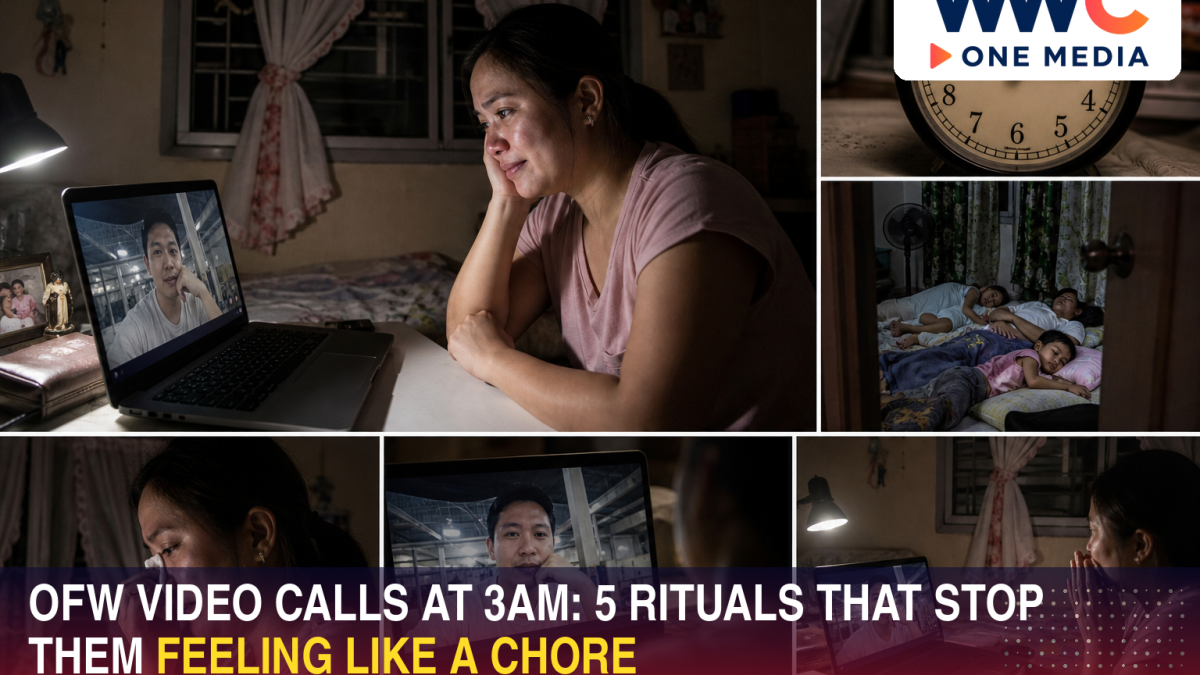
PAMPANGA, Philippines — The phone lights the sala at 3 a.m. A kitchen that still smells like last night’s ulam. A partner, a parent, a child who has school in San Fernando in a few hours. On the other end: a bunk in the Gulf, a cramped room in Hong Kong after a late close, a face that has already worked a full day while Pampanga was asleep.
OFW video calls at 3am start as devotion. They curdle into a chore when the household treats every ring like an emergency and every silence like a fight. Five rituals will not make the time zone kind. They will make the call a place you can both stand.
Write them on the fridge. Romantic people forget at 2:47 a.m.
1. A sacred window for OFW video calls, even if it is short
Pick a window you can actually keep most days — 15 minutes, 25, not a fantasy hour — and protect it the way you protect a bus to Clark. The sacred window does not move for a teleserye, a barkada videoke that started in Angeles at midnight, or a “quick” scroll that ate the only overlap.
Middle East nights and Hong Kong closing shifts do not line up with a Pampanga breakfast. Name the overlap that does exist. If Thursday is a graveyard on their side, Thursday is a voice-note day. If Sunday after Mass is the long call, put Sunday on the calendar like a relative’s birthday.
A window that is always flexible is a mood. Moods lose to overtime and a neighbour’s karaoke. The sacred one is short on purpose. When the ring comes an hour late, you are allowed to send: I am up at 6, voice note me, we do the window tomorrow. A groggy 40-minute call you resent is not care.
2. Voice notes that wait — the call is not the only door
Live video is a luxury of two awake brains. Voice notes are how a Pampanga morning and a Gulf evening share a day without stealing sleep. Send the ordinary: the market, the kid’s homework, the rain on the tin, the thing you saw on the way to SM City Pampanga. Send it when you are actually alive, not when you are performing being alive at 3 a.m.
They can listen on a bunk. You can listen while rice cooks. Waiting is not neglect if you agreed that some days the live call is the window and the rest is audio. A 20-second clip of the drawing, the dog, the plate — not a stream. If every ping has to be a face in the dark, you will dread the light. The person on night duty in Hong Kong is not a 24-hour switchboard. Neither is the person in Pampanga. Notes wait. That is their job.
3. Family not on speaker unless you meant to put them there
A 3 a.m. call on speaker in a house with thin walls is a public event. Parents hear. Kids wake. A sibling on the other mat hears a money hint, a complaint about a supervisor, a softness that was meant for one person. Then the family meeting happens at breakfast, without you, and the OFW finds out they were on a panel.
Earphones. A room with a door if you have one. If the window is for the couple, it is for the couple. A planned Sunday hello beats a 3 a.m. cameo a child will not remember. Record the drawing; play it in the window. Relatives who wander into frame to ask for a favour are how a private call becomes a barangay session. One adult says: not tonight, Sunday, peso topic off this clock.
4. An end-time you both can see
Open-ended 3 a.m. calls are how someone shows up to a morning shift in Pampanga as a ghost, and how someone in a bunk shows up to work having performed a marriage instead of sleeping. Set an end. A clock on the screen. A sentence at the start: we have 20 minutes, then I sleep.
Ending is how the next window stays possible. The person who always “five more minutes” until the sky is grey is not more loving. They are more depleted. Close with the same two sentences and the next window — not a new issue, not a verdict. A hospital or a job scare is an exception. Exceptions four nights a week are a schedule. Change the window. Do not keep calling it love.
5. No money talk at 3am — the peso gets daylight
GCash requests, a sibling’s tuition, a roof, a “small” loan for a cousin, the remittance that landed short of what a tita expected: these are daylight topics. At 3 a.m. they are ambushes. The OFW is tired and homesick. The household is half-asleep and ashamed of needing. Shame plus fatigue is how a sleepy yes becomes a month of resentment.
Park money on a weekly or monthly sitting when both of you are not wrecked. A Sunday list: what goes home, what stays in the Gulf or in Hong Kong, what is an emergency cap, what needs a receipt. Emergency is a hospital, a storm, a lost job. Emergency is not a sale, a fiesta flex, or a relative who treats the OFW like a public ATM.
If a parent uses the 3 a.m. call to smuggle a request, the couple answers later, together, in pesos. Put the rule on the fridge. The call can hold missing each other. It cannot hold a budget meeting and a love scene. The budget meeting will still be there at noon.
What the rest of the house does with the night
After you hang up, do not open a feed. Drink water. A dim lamp, not the sala’s overhead. Settle a woken child without a recap. The OFW side: do not stack a second video with a parent “because they are already awake.” That is how 3 a.m. becomes 4:30. Parent call on the day off, or a voice note.
The day-off call is a different animal
Hong Kong and the Gulf both have days that are not 3 a.m. Use them for the long talk and the money sitting. Put the day-off call on a calendar the way you put a bus to NAIA. If the day off never comes, shrink the 3 a.m. agenda. Love, then sleep. Everything else waits for light.
Bottom line
OFW video calls at 3am stop feeling like a chore when a Pampanga household treats them as a ritual: a sacred window, voice notes that can wait, no speakerphone family, a visible end-time, and money talk that waits for daylight. The time zone will not apologise. The fridge note can still save the week.




Leave a Reply